


More news on this day
Passengers across northern and western Europe faced another difficult travel day as a cluster of cancellations and delays at major carriers, including SAS, Brussels Airlines, Austrian Airlines, Air France, Lufthansa, KLM and German Airways, disrupted schedules and left travelers stranded at airports in Denmark, Belgium, Germany, France and the Netherlands.
Get the latest news straight to your inbox!
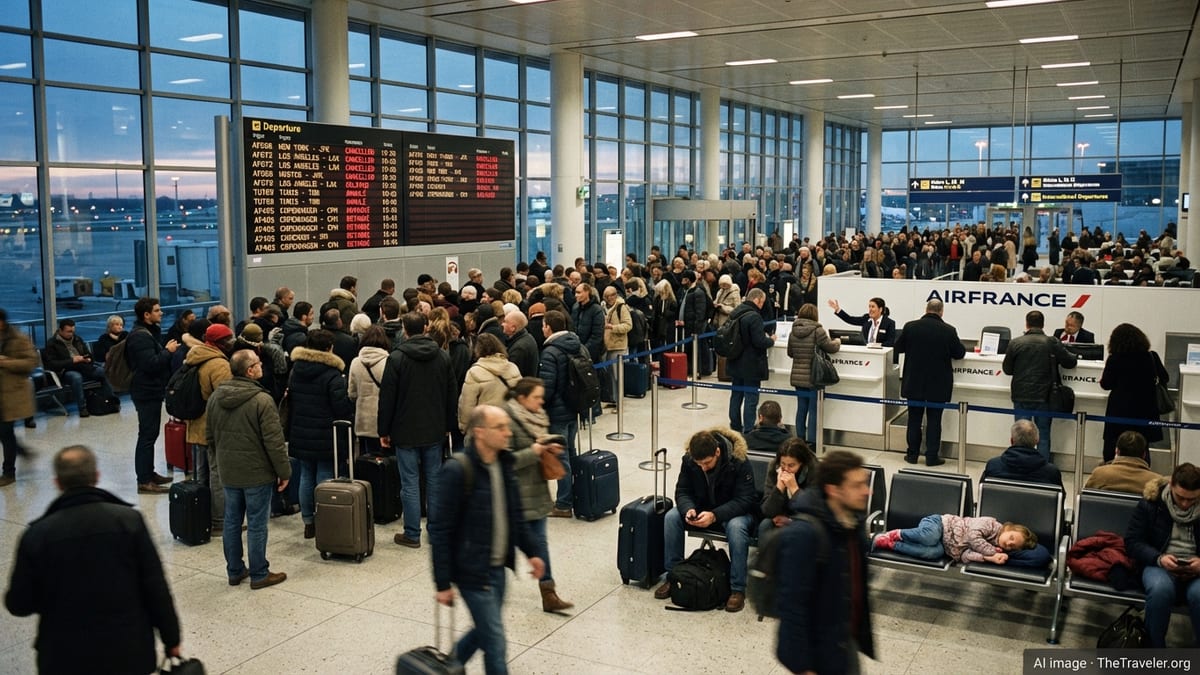
Cluster of Disruptions Hits Multiple Flag Carriers
Publicly available flight tracking data and airport information screens on Monday indicated at least 84 cancellations and 24 significant delays affecting services operated by SAS, Brussels Airlines, Austrian Airlines, Air France, Lufthansa, KLM and regional operator German Airways. The disruptions were concentrated at major hubs such as Copenhagen, Brussels, Frankfurt, Munich, Paris Charles de Gaulle and Amsterdam Schiphol, but knock-on effects were reported at smaller regional airports across Scandinavia, Germany and the Benelux countries.
The pattern of disruption followed a familiar sequence for frequent European travelers, with early morning rotations cancelled or delayed, leading to aircraft and crews being out of position for the rest of the day. By midday, rolling updates at affected airports showed waves of red indicators on departure boards as carriers tried to consolidate lightly booked services, reroute aircraft and free up spare capacity for long haul connections.
While the total number of affected flights remained limited in comparison with the thousands of movements logged daily across the continent, the concentration of cancellations on key trunk routes magnified the impact. Busy business corridors such as Copenhagen to Brussels, Frankfurt to Paris and Amsterdam to major German cities saw repeated schedule changes, creating bottlenecks at transfer points and long rebooking queues.
Operational data from recent weeks in Europe have highlighted how relatively modest shocks to airline schedules can cascade through tightly timed networks. With aircraft utilization running high at many carriers during the spring shoulder season, schedule planners have less slack to absorb weather disruptions, air traffic control restrictions or crew availability issues, increasing the risk that local problems translate into wider travel chaos.
Weather, ATC Bottlenecks and Capacity Constraints Converge
Reports from aviation monitoring services indicate that a mix of adverse weather conditions and ongoing air traffic control staffing constraints contributed to the latest wave of cancellations. Thunderstorms and low cloud over parts of central Europe triggered temporary flow restrictions, particularly around German and Austrian airspace, where earlier episodes of congestion have already put controllers and airlines under pressure this year.
Eurocontrol data and recent analytical studies on European delays show that technical issues, crew shortages and industrial action within airlines continue to play a significant role in cancellations, but capacity limits in the air traffic management system are increasingly visible. When weather cells move across densely trafficked corridors, regulators often impose departure caps or extended separation between flights, forcing airlines to slim their schedules on short notice.
These constraints have become more pronounced as traffic volumes edge back toward or beyond pre-pandemic levels on some intra-European routes. Several recent industry briefings have underlined that staffing in some control centers remains below 2019 benchmarks, particularly in parts of central and western Europe. This mismatch between demand and available capacity leaves carriers such as Lufthansa, Austrian Airlines and KLM with little choice but to proactively cancel rotations to maintain overall network stability.
The result for passengers is a pattern of intermittent but intense disruption. Even on days when the majority of flights operate normally, pockets of bad weather or congestion can force targeted airlines to thin out short haul services, creating the kind of multi-carrier disruption seen across northern Europe today.
Passengers Stranded at Key Hubs Across the Region
The operational challenges translated into long lines and crowded terminals at several airports, according to images posted on social media and accounts compiled by European travel media. At Copenhagen and Brussels, travelers reported extended waits at transfer desks as airline staff worked through rebooking backlogs for passengers whose connecting flights with SAS and Brussels Airlines were cancelled.
In Germany, recent experience with large scale disruption at airports in Munich and Berlin has shown how quickly local delays can spill over to passengers connecting from long haul services. While the current disruption was more contained, cancellations at Lufthansa and German Airways affected key feeder routes that normally bring passengers from smaller cities into major hubs. This left some travelers facing overnight stays or complex alternatives involving rail connections and rerouting through secondary airports.
Similar scenes were reported at Paris Charles de Gaulle and Amsterdam Schiphol, where Air France and KLM passengers encountered cascading delays on short and medium haul flights. For travelers heading to or from regional destinations in Scandinavia, the Low Countries or western Germany, even a single cancelled sector could mean missing tightly timed onward journeys, particularly on evening flights with limited backup options.
European passenger rights regulations offer a degree of protection in such situations, but the immediate reality for many stranded travelers remained hours spent in queues, searching for alternative flights and competing for limited hotel rooms near major hubs. Recent consumer advocacy coverage has noted that while digital rebooking tools have improved, spikes in disruption often overwhelm self-service channels, pushing passengers back toward traditional airport counters.
Operational Pressures Mount Ahead of Peak Summer Travel
The latest travel chaos comes at a sensitive moment for European airlines as they prepare for the peak summer season. In recent weeks, carriers including Lufthansa and Brussels Airlines have adjusted their networks, cutting selected frequencies or entire routes in response to high fuel prices, geopolitical tensions and operational constraints. These structural changes are designed to improve reliability, but they also reduce redundancy when unplanned problems emerge.
Austrian Airlines and its group partners have signaled modest capacity increases on some European routes for the northern summer, yet analysts note that any additional flights are being layered onto networks that are already finely balanced. Industrial relations in parts of the sector remain fragile as crews and ground staff push for improved pay and conditions after several years of intense pressure, raising the risk of further strike action during the holiday period.
Industry observers point to the recent wave of route suspensions to the Middle East by Lufthansa Group carriers, as well as previously announced schedule reductions in Germany, as examples of how quickly airlines must pivot in response to external shocks. Each structural change can have second order effects on aircraft positioning, crew rostering and hub connectivity, factors that may have contributed to today’s cluster of cancellations and delays across several brands.
With jet fuel costs elevated and competition intense on many intra-European routes, airlines face strong incentives to run their operations close to maximum efficiency. The trade off, as highlighted by the latest day of disruption, is that there is less buffer in the system when weather, congestion or technical issues arise.
What Travelers Can Expect in the Coming Weeks
Travel industry analysts caution that similar episodes of targeted disruption are likely to recur through late spring and early summer, particularly on busy Fridays and Mondays when business and leisure demand overlap. Forecasts from European aviation bodies have identified central European airspace, including the corridors over Germany, Belgium and the Netherlands, as areas where even modest storms or staffing gaps can rapidly trigger system wide delays.
For passengers, this means that building extra time into itineraries and favoring earlier departures in the day may provide a modest hedge against sudden cancellations. Consumer organizations continue to advise travelers to stay informed of their rights to rebooking, care and compensation in the event of disruption, especially on flights departing from or within the European Union.
While airlines such as SAS, Air France and KLM have invested in digital tools to speed up notifications and self service changes, recent days have shown that demand can quickly outstrip capacity during irregular operations. Travelers connecting across multiple carriers or alliances, particularly at complex hubs like Frankfurt, Paris and Amsterdam, remain especially vulnerable to missed connections when schedules unravel.
As peak season approaches, the latest cluster of 84 cancellations and 24 delays serves as a reminder that Europe’s recovering aviation network remains sensitive to shocks. Unless structural bottlenecks in air traffic control and staffing are eased, passengers planning trips through northern and western European hubs should be prepared for occasional bouts of travel turbulence well into the summer.