


More news on this day
Australia is edging into one of its boldest aviation experiments in decades as the first aircraft for Qantas’ ultra-long-haul Project Sunrise completes its maiden flight, setting the stage for non-stop services that could shrink the world to a single hop from Sydney.
Get the latest news straight to your inbox!
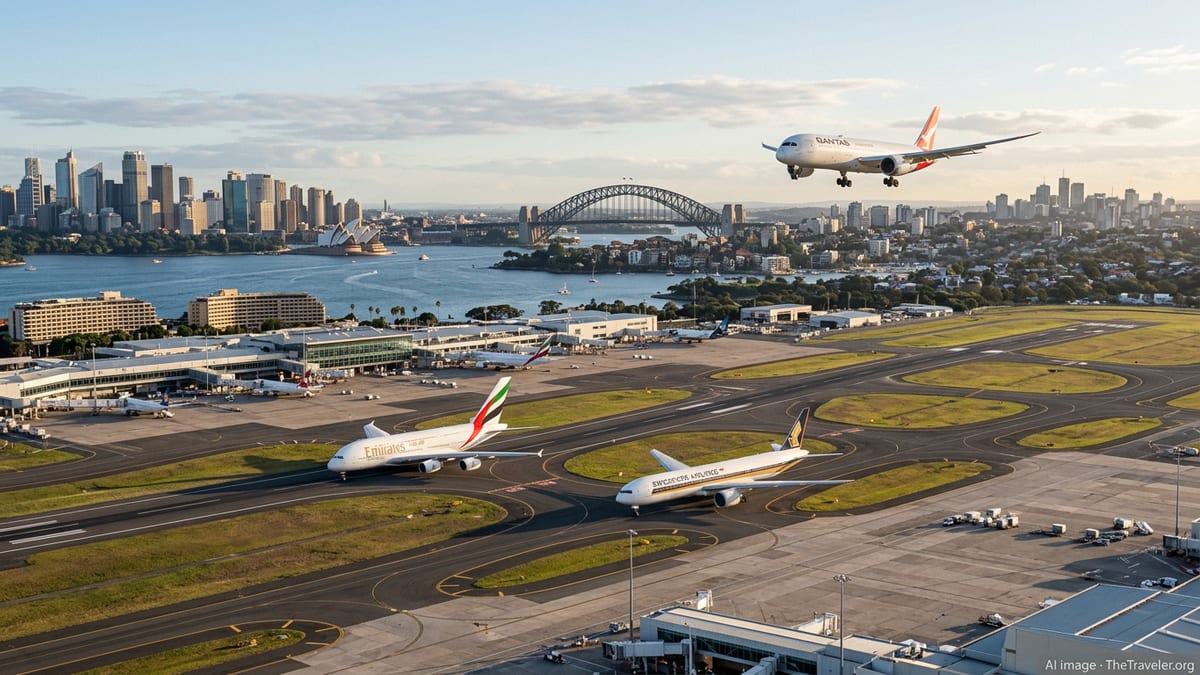
A Decade-Long Gamble Reaches a Critical Milestone
What began nearly ten years ago as an audacious brief to aircraft manufacturers is now lifting off the runway. Publicly available information shows that the first Airbus A350-1000ULR designated for Qantas’ Project Sunrise completed its maiden test flight from Toulouse in early June 2026, starting a focused certification campaign for the extra range and fuel systems needed to link Australia’s east coast directly to Europe and North America.
The aircraft, one of 12 on order, has been heavily modified compared with standard A350 models. Documentation from the airline and Airbus highlights additional fuel capacity, weight savings and cabin changes aimed at safely sustaining flights of up to about 22 hours. These technical steps move Project Sunrise from concept to operational reality and mark a turning point for an initiative that has weathered a pandemic, supply chain issues and shifting launch targets.
Reports in specialist aviation media indicate that the A350 will now undergo several months of trials to validate performance on ultra-long routes and to secure regulatory approvals for the bespoke long-range configuration. Only after that phase will the aircraft be delivered to Australia for crew training and proving flights, a sequence that underscores the complexity and risk of attempting the world’s longest commercial services.
For Australia, the gamble is not only about one airline’s fleet. The country’s geographic isolation has long shaped travel, trade and tourism patterns. If nonstop services from Sydney to London and New York become routine, they could alter the way passengers, cargo and even investment decisions flow to and from the region.
Nonstop Sydney to London and New York Edges Closer
According to recent coverage in international travel and business outlets, Qantas continues to position Project Sunrise as the final step in overcoming what it has often described as the “tyranny of distance.” The airline’s plan is to launch non-stop services from Sydney to London Heathrow and New York John F. Kennedy, creating routes of roughly 10,000 nautical miles that would rank among the longest in commercial aviation.
Current one-stop journeys between Australia’s east coast and Europe typically involve a change of planes in hubs such as Singapore, Dubai or Doha and can exceed 24 hours from gate to gate. Publicly available schedules suggest that a direct Sydney to London flight would cut travel time by up to four hours, while nonstop services to New York could reduce total journey time even further and eliminate the uncertainty of tight connections.
In the near term, the timeline remains fluid. Updated reporting from multiple outlets in May and June points to a later-than-first-planned service entry, with initial commercial flights now widely expected in 2027 rather than the mid-2020s targets once discussed. Industry analysis notes that certification pacing, aircraft delivery slots and pilot training pipelines are all influencing the exact start date.
Even so, the narrative has shifted from “if” to “when.” The test flight program now under way is specifically designed to prove that the aircraft can operate such long missions within fuel, safety and performance margins, removing one of the final technical hurdles between Australian passengers and single-hop flights to the world’s major financial and cultural capitals.
Cabin Design Aims to Rethink the Longest Day in the Air
If Project Sunrise succeeds, passengers will spend close to an entire day aboard a single aircraft. To make that feasible, Qantas and Airbus have designed a cabin that prioritizes space and wellbeing over seat count. Material released by the airline indicates that the A350-1000ULR will carry significantly fewer passengers than comparable long-haul aircraft, with a high proportion of premium seats and an emphasis on dedicated movement areas.
Central to the design is a “wellbeing zone” for all cabins, incorporating space to stretch, stand and access hydration and light snacks. The feature builds on research flights conducted before the pandemic, where volunteer passengers were monitored on 19 to 20 hour test sectors between New York, London and Sydney. Academic and medical partners examined sleep patterns, light exposure, movement and nutrition to develop strategies aimed at reducing jet lag and the physical strain of ultra-long travel.
The aircraft will also feature reworked premium economy and economy cabins with more generous pitch and enhanced recline compared with existing long-haul standards, according to technical fact sheets shared publicly. At the front of the aircraft, new first-class suites and business suites are being positioned not only as a luxury product but as a way to attract high-yield corporate and premium leisure travelers who might otherwise route via Asia or the Middle East.
How these design choices perform in real-world service will be closely watched by airlines and regulators alike. Issues such as passenger movement, access to medical assistance on very long flights, and the incidence of deep vein thrombosis are likely to be ongoing points of scrutiny once the routes open for booking.
Strategic Shock for Global Hubs and Competitors
Beyond the cabin, Project Sunrise is a strategic play that could shift traffic away from traditional stopover hubs. Analysts quoted in recent aviation and financial coverage note that non-stop east coast Australia to Europe and North America will give Qantas a powerful differentiator against Gulf, Asian and European rivals that currently rely on hub-and-spoke networks.
Today, much of the traffic between Australia and Europe flows through cities such as Singapore, Dubai, Doha and Hong Kong, where airlines connect passengers onward to dozens of destinations. If a meaningful share of premium customers opts for nonstop Sydney to London or New York, those hubs could see a gradual erosion in their high-yield connecting markets, even if overall volumes remain strong.
At the same time, Australia’s domestic and regional network may feel the impact as schedules and fleet plans are reshaped around ultra-long-haul priorities. Some industry observers suggest that Melbourne and Brisbane are likely candidates for future nonstop services if the initial Sydney routes prove commercially viable, creating a new hierarchy of gateways within Australia itself.
Competitors are already signaling responses, from enhanced premium products to additional point-to-point links of their own. While only a handful of airlines have aircraft and balance sheets suited to flights approaching 22 hours, growing demand for direct connectivity is prompting broader reevaluation of how far, and how nonstop, long-haul aviation should go.
Cost, Climate and the Question of Demand
Whether Australia’s biggest aviation gamble becomes a template for the industry or a niche product will depend heavily on economics and public perception. Ultra-long-haul flights require significant fuel, specialized aircraft and higher crew costs, factors that typically translate into premium fares. Commentary from travel analysts suggests that economy tickets may be priced above existing one-stop options, with business and first-class seats positioned at the very top of the market.
Environmental considerations add another layer of complexity. Qantas has previously stated that net emissions from Project Sunrise operations will be addressed through a combination of fleet efficiency gains, sustainable aviation fuel and broader decarbonization programs. However, critics arguing for more modest flying habits are likely to question whether 20-plus-hour point-to-point services fit with global climate goals, regardless of incremental efficiency improvements.
Demand signals so far appear mixed but promising. The airline’s existing non-stop services from Perth to London, Rome and Paris have drawn strong loads and positive customer feedback, according to recent regional reporting. Those routes are shorter than the planned Sydney links but offer an early indication that travelers are willing to trade a stopover for the convenience of staying on one aircraft.
Over the next two years, as certification advances and tickets eventually go on sale, travelers will face a new calculation: pay more to bypass a hub and compress the journey into one very long day in the air, or continue to break the trip with a stop and potentially lower fares. The answer to that question will decide whether Project Sunrise remains a bold Australian outlier or becomes a model that reshapes how the world flies very long distances.