


More news on this day
Bahrain International Airport recorded a new wave of disruption with 39 delayed departures and six outright cancellations on Monday, as renewed Gulf tensions and regional airspace concerns disrupted services to major destinations in Qatar, the United Arab Emirates, Saudi Arabia, India, Pakistan, Turkey, Oman, Jordan and China.
Get the latest news straight to your inbox!
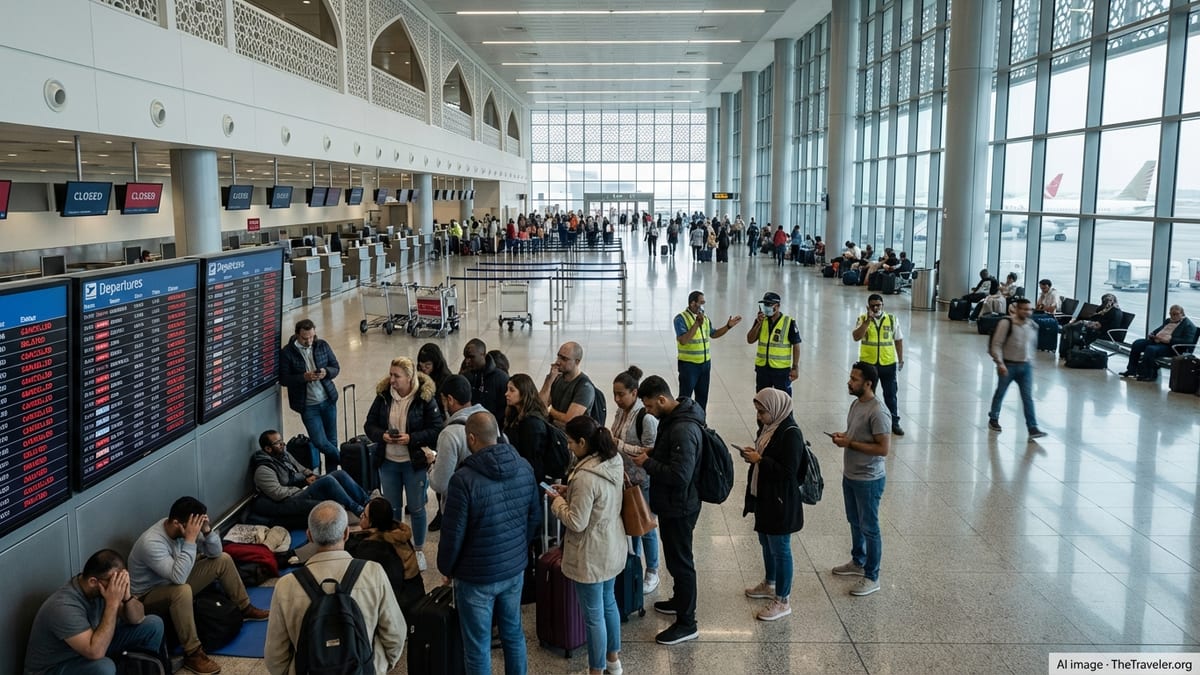
Spike in Delays and Cancellations at Bahrain Hub
Operational data and airline updates for Monday indicate a sharp increase in schedule disruption at Bahrain International Airport, which serves as a key regional hub for Gulf and Asia traffic. Flight tracking snapshots for the day show 39 departures running significantly behind schedule and six services cancelled outright, affecting thousands of passengers in peak summer travel season.
The latest disruption comes after months of intermittent instability across Gulf airspace linked to the 2026 Iran conflict and subsequent flare ups. Earlier phases of the crisis saw Bahrain’s airspace periodically curtailed and some operations at the airport temporarily halted, with carriers diverting aircraft to neighboring states or trimming schedules across high risk corridors.
While Bahrain International Airport has largely remained operational in recent weeks according to regional logistics and port advisories, the new cluster of delays and cancellations underlines how quickly conditions can tighten once again when tensions rise. Airlines serving the hub appear to be juggling aircraft rotations, revised routings and crew duty constraints as the security picture shifts.
Passengers on affected services reported extended ground holds, late inbound aircraft and last minute gate changes, particularly on flights traversing the most sensitive segments of Gulf airspace. Travel advisories issued for the wider region over recent months have consistently warned that even open airports can experience sudden timetable shocks when security alerts intensify.
Regional Security Flare Up Ripples Through Gulf Airspace
The disruption in Bahrain is unfolding against a renewed spike in regional tensions centered on Iran and the Strait of Hormuz. Recent security analyses for the Gulf describe a pattern of missile and drone activity targeting infrastructure and military assets in Bahrain, Kuwait, Qatar, Oman and Jordan, alongside threats to shipping lanes and commercial overflights near key chokepoints.
Public statements from the European Union and Gulf Cooperation Council in mid July reiterated concern about attacks on commercial vessels and regional territory and stressed the importance of freedom of navigation and overflight through Hormuz. That focus on maritime routes has an immediate aviation dimension, because many long haul services linking Europe and Asia route close to the same corridor and rely on coordinated airspace management across Gulf states.
In Bahrain itself, air raid sirens sounded on Sunday after what regional coverage described as incoming attacks linked to the broader Iran confrontation. Residents were instructed via public alerts to seek shelter as alarms were activated nationwide. Parallel reporting from neighboring Jordan noted temporary flight suspensions around the same period as missiles were tracked across parts of the region.
Although there have been no widely reported direct strikes on Bahrain International Airport in the latest escalation, analysis of previous phases of the conflict highlights how even limited damage or precautionary shutdowns can ripple outward. Earlier in the year, intelligence and risk consultancies documented periods when Bahrain’s airspace was restricted, operations at the airport were described as mostly halted and Gulf Air relocated part of its fleet to airports in Saudi Arabia.
Key Routes to Qatar, UAE, Saudi Arabia and Beyond Affected
The immediate impact of Monday’s disruption has been most visible on Bahrain’s dense regional network linking Gulf neighbors and South Asian hubs. Schedules show delays and cancellations clustering on services to Doha in Qatar, Dubai and Abu Dhabi in the United Arab Emirates, Riyadh and other Saudi gateways, as well as onward connections to India and Pakistan.
These routes form the backbone of cross Gulf commuting and transit traffic, carrying migrant workers, business travelers and holidaymakers who often rely on Bahrain as a connecting point. Aviation data for 2026 indicates that Gulf Air and partner airlines operate a web of short haul sectors from Bahrain into Saudi Arabia, Qatar, the UAE and Oman, with onward links to major Indian and Pakistani cities such as Mumbai, Delhi, Karachi and Lahore.
Travel advisories prepared for multinational clients over recent weeks have highlighted “selective delays” and capacity compression on exactly these corridors, even when airports remain nominally open. Increased track miles to skirt sensitive airspace, congestion on alternative routings and higher fuel costs have all contributed to thinner buffers in airline schedules, raising the likelihood that an overnight security scare translates quickly into visible disruption the following day.
Disruptions have not been confined to the Gulf. Routes connecting Bahrain with Turkey, Jordan and China have also been affected at various points in the crisis, as carriers adjust flight plans around evolving overflight guidance. Industry briefings on the economic impact of the 2026 Iran conflict have noted widespread airspace closures and rerouting that cut into the capacity of Middle Eastern hubs and pushed global airlines to reconfigure networks at short notice.
Stranded Passengers Confront Rebookings and Uncertain Timelines
For travelers on Monday’s delayed and cancelled flights, the latest wave of disruption has revived memories of earlier shutdowns that left passengers stranded across Gulf airports earlier this year. Social media posts and forum reports over recent months have documented Bahrain based travelers sleeping in terminals, searching for scarce hotel rooms and struggling to secure rebookings when airspace restrictions triggered rolling cancellations.
Online discussions among affected travelers indicate that some passengers are being rerouted via Saudi Arabian airports or alternative hubs in the United Arab Emirates when Bahrain services are pulled from the schedule. Others describe being offered dates several days out, reflecting the limited spare capacity on already busy summer routes and the cautious approach airlines are taking to reinstating full timetables amid a fluid security environment.
Consumer advocates and aviation analysts reviewing the broader pattern of disruption have pointed out that regional airlines are balancing safety requirements, regulatory directives and commercial pressures. With war risk premiums, fuel costs and operational complexity elevated, carriers have tended to build in extra slack, which can translate into late departures, creeping delays and conservative cancellation decisions when risks climb.
Travel forums show many passengers asking whether to cancel or reroute trips entirely rather than risk being caught mid journey. Common advice from experienced travelers across these channels has been to maintain flexible tickets where possible, monitor airline and airport channels closely in the 24 to 48 hours before departure and prepare backup plans involving alternative routes or surface travel where feasible.
What Travelers Should Expect in the Coming Days
With tensions around the Strait of Hormuz and Gulf airspace still elevated, aviation risk specialists expect intermittent disruptions to continue across the region in the short term. While there are no clear indications of a full shutdown at Bahrain International Airport at present, the pattern of 39 delays and six cancellations in a single operational day underscores the fragility of schedules under current conditions.
Industry briefings suggest that airlines serving Bahrain and neighboring hubs are likely to maintain contingency routing plans, keep aircraft positioned at secondary airports and adjust frequencies dynamically in response to security assessments. Passengers on routes touching Qatar, the United Arab Emirates, Saudi Arabia, Oman, Jordan, Turkey, India, Pakistan and China should be prepared for short notice timetable changes even if their flights remain officially confirmed.
Travel management companies advising corporate clients on Middle East itineraries have emphasized the value of building longer connection windows, avoiding back to back critical meetings immediately after arrival and ensuring that travelers have access to real time flight status tools. For leisure travelers, the recommendation in many public advisories has been to factor possible overnight delays into budgets and to verify accommodation cancellation policies in case plans need to shift rapidly.
In the absence of a durable de escalation across the wider Gulf theater, Bahrain’s role as a strategic hub means periodic travel disruption is likely to remain a feature rather than an exception. Monday’s wave of delays and cancellations highlights how developments far from the terminal building, from missile launches to maritime incidents, can cascade swiftly into departure boards and boarding gates for passengers moving between the Middle East and Asia.