

More news on this day
Bahrain’s decision to reopen its airspace after a weeks-long security shutdown is beginning to reset travel patterns across the Gulf, India and Europe, as airlines restore suspended routes and reconnect severed transit flows through the kingdom’s strategic aviation corridor.
Get the latest news straight to your inbox!
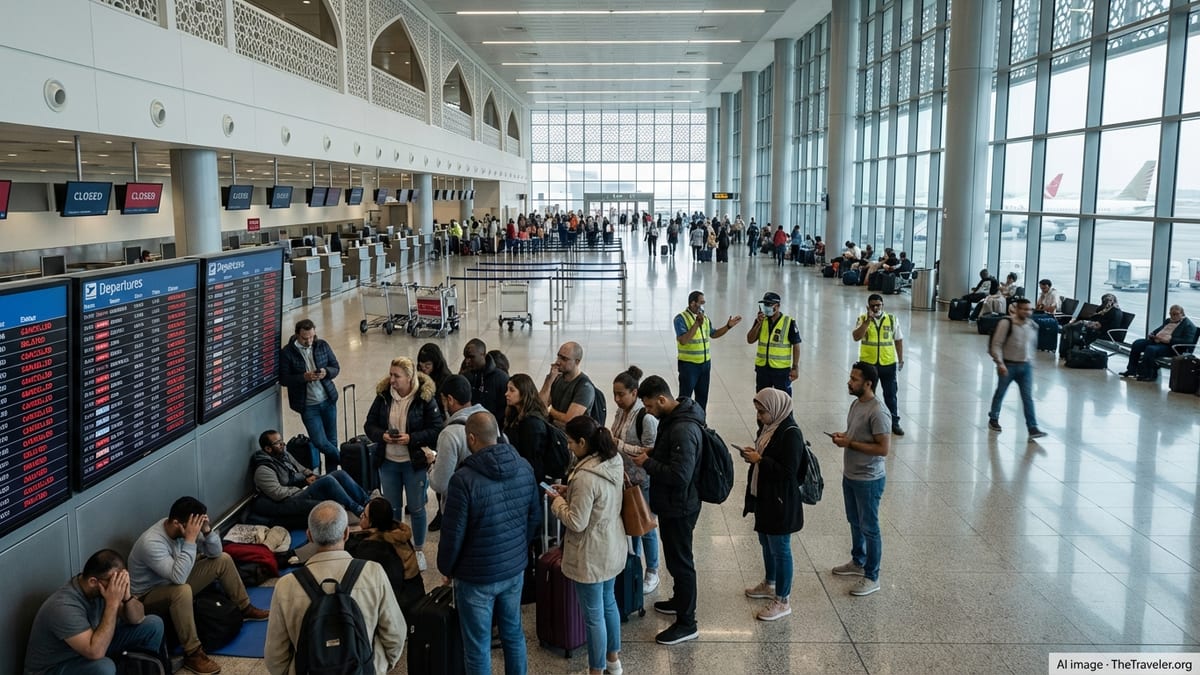
Gradual Reopening Turns Bahrain Back Into a Gulf Hub
Published information from Bahrain International Airport indicates that a phased resumption of flights began on April 8, following the formal reopening of the kingdom’s airspace by Civil Aviation Affairs. Initial operations are described as gradual, with a limited schedule focused on stabilising core routes and processing a backlog of passengers who had been stranded or forced to reroute via alternative hubs.
The restart marks a turning point after the closure of Bahrain’s skies in late February in response to regional missile and drone attacks, which had effectively frozen commercial traffic in and out of the country. For several weeks, Bahrain International Airport functioned largely as a technical and humanitarian node, while regular passenger and cargo services remained suspended or heavily curtailed.
Aviation advisories note that Bahrain is rejoining a wider, still-fragile recovery in Gulf airspace, where Saudi Arabia and some neighbouring states had remained open as diversion corridors during the crisis. The reopening is expected to ease congestion over alternative routings and shorten flight times on some services that had been forced into lengthy detours around closed or restricted airspace.
Industry observers caution, however, that scheduling remains subject to short-notice adjustments while airlines test routes, monitor security assessments and align their networks with updated risk evaluations for the broader Middle East.
Gulf Carriers Rebuild Networks via Bahrain
The restart of Bahrain airspace is particularly significant for Gulf-based airlines that rely on the kingdom’s flight information region as a bridge between the Arabian Peninsula, South Asia and Europe. Carrier updates reviewed by travel trade publications describe a shift from emergency diversions and pop-up operations in neighbouring airports back toward Bahrain-centred scheduling.
Gulf Air, Bahrain’s national carrier, had previously repositioned aircraft and operated temporary services from Saudi Arabia’s Dammam during the closure, according to trade and agency bulletins. With the airspace now open, publicly available documentation on ticketing policies shows that the airline is transitioning from pure disruption management toward restoring its core hub-and-spoke model, while still honouring flexible rebooking and refund options for passengers whose journeys were affected between late February and mid-April.
Regional analysis from logistics and risk consultancies suggests that other Gulf carriers, including major operators based in Dubai and Abu Dhabi, are also recalibrating their routings. Many had been flying longer paths that avoided Iranian and Iraqi skies while also steering clear of Bahrain’s closed sector, adding hours to some European and transcontinental flights. Bahrain’s return reduces one of several bottlenecks in an already crowded Gulf air corridor.
Airport capacity, crew availability and aircraft positioning remain practical constraints. Schedules released in the coming days are expected to prioritise high-demand trunk routes before secondary destinations are reintroduced, with carriers signalling that full normalisation will likely unfold in stages rather than overnight.
India Connections Resume Through a Critical Corridor
For travellers between India and the Gulf, Bahrain’s reopening restores an important, if less visible, piece of regional infrastructure. The kingdom’s airspace sits on heavily used tracks that link Indian metros with Bahrain itself, other Gulf states and onward European destinations. When those routes closed, Indian passengers were among the groups most affected, facing cancellations, elongated itineraries and last-minute rebookings through Muscat, Riyadh or Dubai.
Indian and Gulf-focused travel agencies report that bookings are now being shifted back toward traditional routings as schedules update global distribution systems. In particular, itineraries that use Bahrain as a transit point between Indian cities and Gulf or Levant destinations are beginning to reappear, reversing weeks of reliance on more distant connection points.
Analysts point out that India–Gulf traffic is both high volume and structurally important, driven by labour flows, business ties and family travel. The closure of Bahrain’s skies had amplified pressure on remaining open hubs, raising fares and shrinking seat availability at peak times. As Bahrain re-enters the network, competition on some city pairs is expected to increase, potentially easing prices for travellers who had been pushed into costlier or less convenient options.
However, advisory notes from several airlines still encourage passengers to monitor flight status closely and allow additional buffer time for connections, reflecting the possibility of rolling schedule changes while the corridor stabilises.
Europe Reconnects With Shorter, More Direct Routings
European carriers and Gulf airlines serving European markets are also set to benefit from Bahrain’s aviation uplift. During the closure, several European operators either suspended Bahrain-bound services entirely or restructured legs to bypass the affected airspace, while Gulf carriers stretched their Europe routes around multiple restricted zones.
Reports from aviation analytics firms suggest that reopening Bahrain’s skies enables more direct great-circle routings between Europe and the northern Gulf, trimming block times and fuel burn on select services. For passengers, that translates into shorter journeys and greater schedule reliability on routes that had been prone to diversions and extended ground holds.
The change is especially relevant for one-stop Europe–Asia itineraries that rely on Gulf hubs. Bahrain’s airspace forms part of the sequencing that allows carriers to stagger departures and arrivals smoothly across time zones. With this piece of the puzzle restored, airlines can fine-tune bank structures at their hubs, improving connection windows for travellers heading between European cities and destinations in the Indian subcontinent or Southeast Asia.
European tourism boards and trade bodies tracking outbound demand to the Gulf indicate that traveller interest has remained resilient, but booking behaviour has shifted toward airlines and routings perceived as more predictable. A more stable airspace map, with Bahrain included again, may gradually narrow the gap between underlying demand and actual travel.
Travelers Face a Transitional Period Despite Rebound
Despite the optimistic headline of flights resuming, the coming weeks are expected to feel like a transitional phase rather than an immediate return to pre-crisis normality. Operational bulletins published in recent days highlight continuing cancellations and reroutes on specific days and routes, underscoring the complexity of rebuilding a network that spans volatile skies.
Travel advisers note that passengers should treat April as a period of elevated uncertainty, even as connectivity improves. Seats on the most direct services may be limited while airlines work through pent-up demand from travellers who postponed trips during the closure. Some carriers are using larger aircraft or adding short-notice extra sections where feasible, but airport slots, crew duty limits and maintenance requirements set practical bounds.
Risk consultancies tracking the Gulf region continue to flag a heightened security backdrop, and insurers are monitoring how rapidly airlines restore full utilisation of previously restricted flight paths. For the leisure market, that may mean a short lag between the technical reopening of airspace and a broad-based return of package holidays and group tours routed through Bahrain.
Even so, the symbolic and practical value of Bahrain’s airspace reopening is significant. For the first time since late February, the Gulf, India and Europe are again linked by a more typical web of routes across Bahrain’s skies, signalling cautious optimism for travellers and the aviation industry as the region navigates an uncertain geopolitical landscape.