


More news on this day
Air travel across Asia faced another uneven day of disruption this week, with real-time flight tracking data pointing to a mix of delays and cancellations affecting Bangkok, Beijing, and a wider group of major airports, complicating connections and increasing the odds that travelers will need to rebook at short notice.
Get the latest news straight to your inbox!
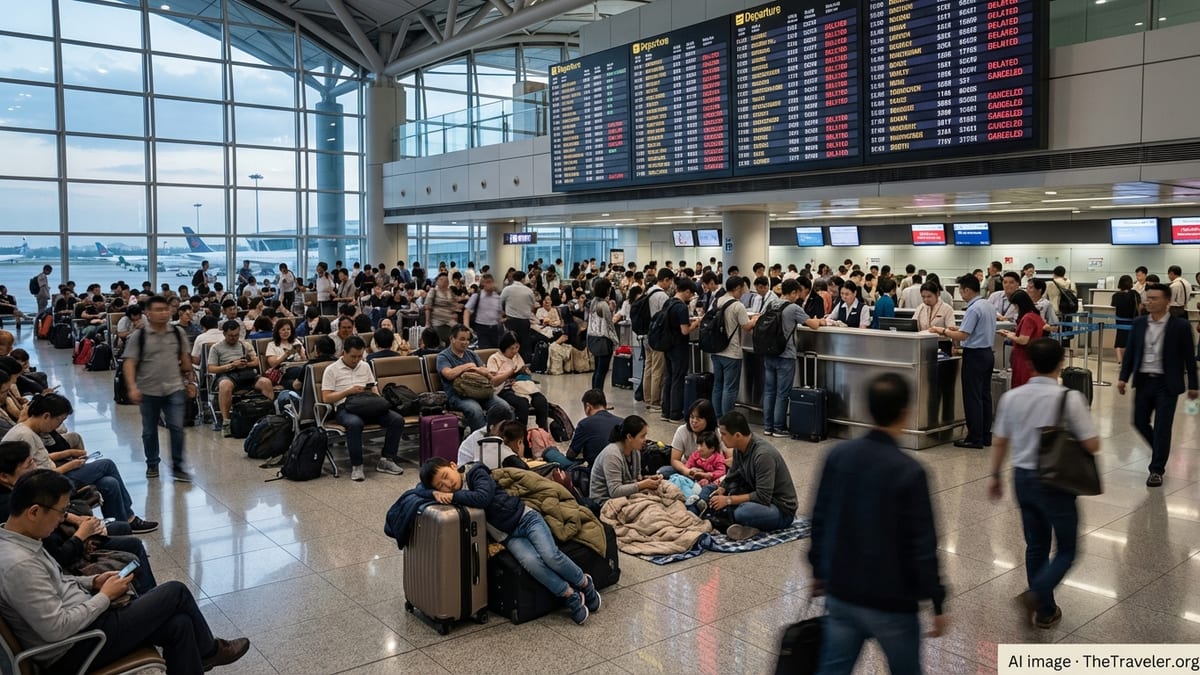
What the data is showing across Asia
Publicly available dashboards from flight-tracking providers indicated that the day’s disruption was not concentrated in a single country, but scattered across multiple high-volume hubs. Flightradar24’s Asia airport disruption view showed notable cancellation counts at some airports and elevated delay percentages at others, underscoring how quickly localized issues can ripple across schedules.
On Flightradar24’s Asia rankings for “Today (Total),” Jakarta Soekarno-Hatta International Airport (CGK) appeared near the top with 253 cancellations and 23 delayed flights at the time of viewing. Other large airports on the same table included Shenzhen (SZX), Delhi (DEL), Taipei (TPE), Shanghai Pudong (PVG), Kuala Lumpur (KUL), Guangzhou (CAN), and Hong Kong (HKG), illustrating the breadth of disruptions affecting travelers transiting through major gateways.
For travelers, the practical impact is that even when a departure airport is running close to normal, a delay at an intermediate hub can still break onward connections, especially on itineraries built around tight transfer windows.
Bangkok: storms and schedule knock-on effects
In Bangkok, travelers typically split between Suvarnabhumi Airport (BKK) for many long-haul and full-service operations and Don Mueang (DMK) for a heavy concentration of short-haul and low-cost flights. Flight and airport status pages can show materially different conditions between the two airports on the same day, depending on airline banks and weather timing.
FlightAware’s airport activity page for Suvarnabhumi displayed a weather bulletin that included temporary thunderstorm and reduced-visibility conditions in the forecast window, the kind of pattern that often drives departure spacing, ground stops, and late inbound aircraft that arrive out of sequence.
At Don Mueang, publicly visible departure boards showed a mix of on-time flights alongside significant delays for some services, a reminder that disruptions can be uneven even within the same terminal. When delays hit a few early rotations, they can cascade through the day for aircraft that are scheduled to operate multiple segments.
Beijing: delays and cancellations tracked in real time
In Beijing, live airport-wide delay and cancellation totals can shift quickly as air traffic flow restrictions and weather evolve. FlightAware’s daily statistics page for Beijing Capital International Airport (PEK) showed 158 total delays and 6 cancellations for “today” at the time the page was viewed, signaling meaningful disruption potential for travelers using the capital’s busiest airport.
Beijing is also served by Beijing Daxing International Airport (PKX), and travelers sometimes connect between the two airports on separate tickets or split itineraries. Daxing’s publicly available departure listings showed at least some cancellations mixed into an otherwise mostly on-time board at the time of viewing, illustrating how conditions can diverge between airports within the same metropolitan area.
For passengers, the most important takeaway is to treat Beijing connections as higher risk on disruption days, particularly when an inbound flight is already late and a connection depends on a short minimum transfer time or a terminal change.
Why “multi-airport” disruption can feel worse for travelers
Even modest disruption at many hubs can feel more severe than a single large outage, because the network has fewer clean alternatives. If flights are delayed across several connecting points at once, travelers may see shrinking rebooking options as later flights fill up, especially on popular city pairs.
Recent analytical coverage from aviation data firms has highlighted how airspace constraints and reroutings beyond Asia can still affect Asia-Pacific schedules by changing aircraft utilization and pushing arrival banks later, which then compresses connection windows and increases missed-connection risk.
Separately, FlightAware notes in its customer guidance that it does not receive operational details on the specific causes of delays and cancellations, meaning travelers often need to rely on airline tools and airport advisories for the most actionable, flight-specific context.
What travelers can do right now to reduce missed connections
Travelers moving through Bangkok and Beijing during disruption periods can lower risk by verifying flight status shortly before leaving for the airport, then again after arriving, since gate assignments and estimated departure times may change multiple times in a short window.
Where possible, building extra time into connections can help. If an itinerary includes a self-transfer, switching airports, or re-checking baggage, disruption days are when tight schedules are most likely to fail. Travelers should also keep booking references handy for all segments, including partner and codeshare flights, because rebooking options may vary depending on the ticket issuer.
For those already mid-trip, monitoring both the departure airport’s status and the arrival hub’s conditions can provide an earlier warning of inbound aircraft delays. In many cases, the first visible sign of trouble is that the incoming flight operating your aircraft is running late, which can be easier to spot in tracking apps than on a static airport display.