


Barcelona’s Josep Tarradellas Barcelona El Prat Airport can feel confusing at first glance. Two separate terminal areas (T1 and T2), different transport options, and a long list of airlines mean it is easy to get turned around before your trip has even begun. Understanding how the terminals are laid out, which airlines use them, and how to move between them will save you stress and often a surprising amount of time and money.
Get the latest updates straight to your inbox!
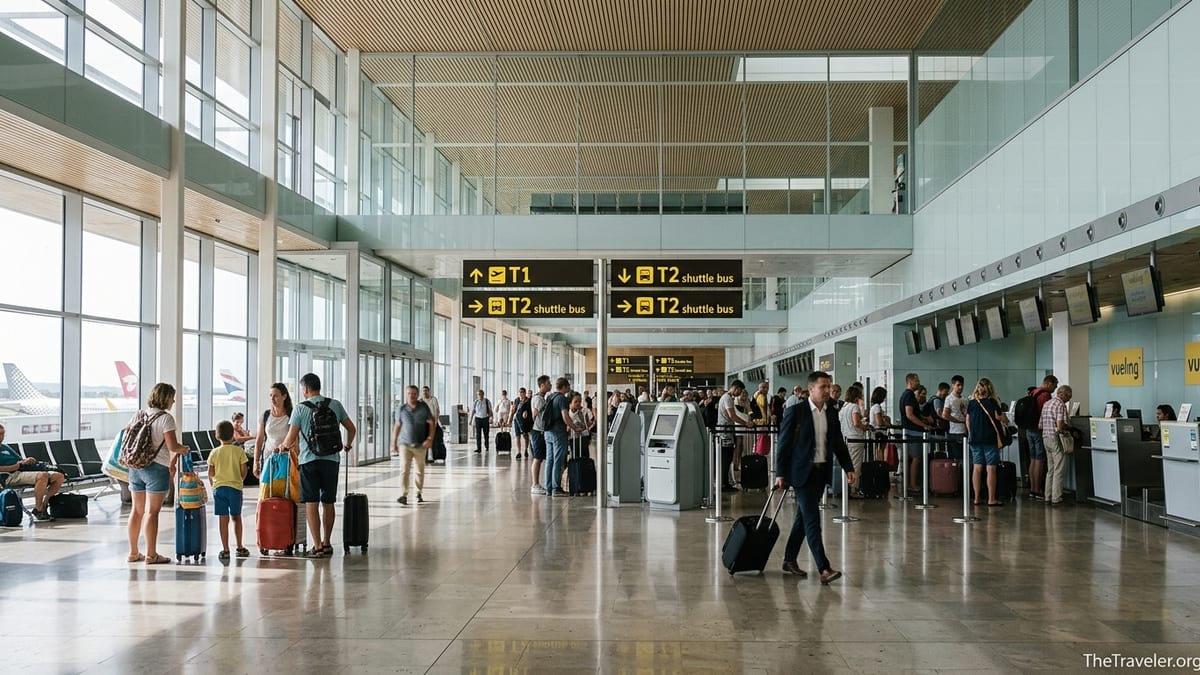
BCN in 2026: The Big Picture of T1 and T2
Barcelona El Prat has two passenger terminals: T1 and T2. They are not side by side but separated by the runways, so you cannot walk between them. Instead, a free green shuttle bus links both 24 hours a day and takes around 10 to 15 minutes in normal traffic. During the day it usually runs every 5 to 7 minutes, and at night typically every 10 minutes, which is fast enough for most connections but still something you must factor into your timing.
Terminal 1 is the newer, larger building, opened in 2009, and handles the bulk of Barcelona’s traffic. Most full-service airlines and the dominant local carrier Vueling operate from T1. Terminal 2 is the older complex on the other side of the airfield, divided into T2A, T2B and T2C. Today it is used mainly by low-cost carriers such as Ryanair and easyJet, as well as a mix of charter and seasonal flights. Knowing this split already gives many travelers a strong clue about where they will fly from.
Ongoing expansion works are gradually transforming T1, with plans through the early 2030s to add floor space and increase capacity. In practice, for travelers in 2026 this mostly means that T1 is busy at peak times but still feels modern, bright and reasonably efficient, with long but organized security lines during morning and evening waves. T2, although more basic, benefits from its simpler layout and tends to feel a little less intense except on summer Saturdays when low-cost leisure flights peak.
For most visitors, the main decision is not which terminal to “choose” but which terminal fits their airline and travel style. A couple flying Vueling nonstop from New York JFK to Barcelona and connecting to Ibiza will be entirely within T1. A budget traveler from London Stansted on Ryanair will use only T2. Where things get tricky is when you book separate tickets on different airlines and end up crossing between T1 and T2 in the middle of a tight connection.
Which Airlines Use T1 vs T2?
The single most important factor in choosing your terminal at Barcelona is your airline. In 2026, Vueling, Iberia, most Oneworld and Star Alliance members, and long-haul carriers such as Emirates, Qatar Airways and Singapore Airlines operate from T1. That means if you are flying on one ticket from, for example, Chicago to Barcelona on United and connecting to Vueling onward to Seville, you will remain in T1 from start to finish.
T2, by contrast, is the home of many low-cost and point-to-point carriers. Ryanair uses T2 for its network of European routes. EasyJet generally operates from T2A and T2C, sharing the terminal complex with other value-focused airlines such as Jet2, Transavia and Wizz Air. Seasonal charters to beach destinations around the Mediterranean also tend to depart from T2. If your booking confirmation lists Ryanair BCN, you can safely assume Terminal 2.
A practical example: An American traveler flying Boston to Barcelona on American Airlines, then transferring to Ryanair for a cheap hop to Rome booked separately, will land at T1 and depart from T2. This is where reading your confirmation email carefully matters. Look for references such as “Terminal 1,” “T1,” “Terminal 2,” or “T2B” next to your Barcelona flight details. If nothing is mentioned, checking directly with your airline, or the airport’s terminal assignment page shortly before departure, is strongly recommended because occasional airline moves do happen.
If you are still in the planning phase and flexibility matters more than a few dollars, choosing airlines that share T1 can make your trip smoother. For instance, pairing a transatlantic flight on Lufthansa or Swiss with a Vueling connection in T1 usually produces a more straightforward experience than mixing a full-service carrier at T1 with a low-cost airline across the runway in T2 on a completely separate ticket.
What It Feels Like: Inside T1 vs Inside T2
Terminal 1 is designed as a large, flowing building with high ceilings, extensive glass façades and long sightlines. Arrivals and departures are on different levels, with a central check in hall that stretches the length of the structure. Airside, T1 is divided into modules labelled A, B, C, D and E, serving Schengen and non Schengen flights. Signage is clear and trilingual in Catalan, Spanish and English, and moving between the modules usually means a brisk 5 to 15 minute walk along wide corridors that feel similar to modern European hubs like Madrid Barajas T4.
The services in T1 match its role as the main terminal. Travelers will find large duty free stores, familiar brands such as Zara, Mango and Desigual, numerous cafés and fast food outlets, and several sit down restaurants. Vueling, Iberia and alliance partners operate multiple lounges, and there are dedicated fast track security lanes for premium tickets and some credit card holders. For a long layover, it is easy to find a quiet corner with power outlets, or to sit near the big windows overlooking the runways while using the airport’s free Wi Fi.
Terminal 2 has a more fragmented, utilitarian feel. T2B is the largest and houses most of the check in activity, while T2A and T2C serve as additional boarding areas used by certain airlines. The architecture is older, and ceilings are lower. Facilities are more limited, with fewer brand-name shops and smaller food choices, particularly in T2A and T2C. However, security can sometimes feel faster because of the smaller passenger volume per checkpoint, especially on weekday afternoons outside the high summer season.
For a real world contrast, think of a traveler arriving on Qatar Airways business class into T1 compared with a student flying Ryanair into T2. The first will likely have lounge access, a wide choice of cafés by their gate, and clear transfer paths to another full-service flight. The second might find a single crowded bar and a duty free kiosk near the gate, but will probably get through the building more quickly and be outside at the bus stop or train station in short order.
Transfers Between T1 and T2: How Long You Really Need
Because the terminals are separated by airfield and linked only by road, changing terminals is essentially a mini ground transfer. The airport’s free green shuttle bus runs continuously between T1 and T2. During the daytime, you will often see buses arriving every few minutes, and at night the gap can stretch to roughly 10 minutes. The ride itself, once you are on board, lasts about 10 to 15 minutes depending on traffic and which part of T2 you are heading for.
In practice, travelers should budget at least 30 to 40 minutes for a terminal change if they are already landside with bags in hand. That time includes walking out of arrivals, locating the shuttle bus stop, waiting for a bus, the ride itself, and walking into the other terminal. If you also need to collect baggage, clear passport control or check in again, you should add generous extra time. For self connecting on separate tickets, many frequent flyers recommend leaving at least 3 hours if your itinerary requires a T1 to T2 switch.
For example, imagine arriving in T1 at 09:00 on a long haul flight from Miami and holding a separate Ryanair ticket from T2 to Palma de Mallorca at 11:00. On paper, a 2 hour connection might appear doable. In reality, you could easily spend 20 to 30 minutes deplaning and clearing passport control, another 15 to 20 minutes waiting for bags, then 30 to 40 minutes to get to T2 and check in again. Any delay on the inbound flight would make this self transfer uncomfortably tight.
On the other hand, if you are only changing terminals to catch ground transport, such as landing in T2 on a low cost carrier but parking your car in a long-stay facility closer to T1, the shuttle timing is usually less critical. You can simply factor in an extra 15 to 30 minutes to your journey and plan accordingly, especially when returning to pick up a car before a late evening flight home.
Ground Transport: Which Terminal Is Best for the City and Beyond?
Both T1 and T2 are well connected to Barcelona city center, though the details differ slightly. Each terminal has an Aerobus stop, a fast blue express bus that runs to and from Plaça Catalunya in the heart of the city. In 2026, a one way Aerobus ticket is typically in the range of 6 to 7 euros, and a round trip ticket around 10 to 11 euros. Buses run roughly every 5 to 10 minutes during the day, and many visitors appreciate that they do not need to worry about zones or local transport cards. Landing in T1, you can be at Plaça Catalunya in around 35 minutes in light traffic.
The metro line L9 Sud serves both terminals. At T1, the Aeroport T1 station is directly under the terminal building, while at T2, Aeroport T2 station is a short walk from the arrivals area. L9 connects the airport with several residential districts and line interchanges such as Torrassa and Zona Universitària, which then link to central lines L1, L3 or L5. The metro is usually the most economical choice for solo travelers who do not mind a few changes, especially if they plan to buy passes like the Hola Barcelona card that cover multiple days of unlimited rides.
T2 has an additional advantage in the form of the mainline RENFE R2 Nord train that runs from the airport to Barcelona Sants, Passeig de Gràcia and El Clot Aragó. For someone staying near Sants or Passeig de Gràcia, taking the train from T2 can be both cheap and time efficient, with travel times of roughly 20 to 30 minutes to the city and tickets priced similarly to standard local rail fares. If you land in T1 and prefer the train, you can take the free shuttle bus to T2 and then walk to the station, though for many people the Aerobus or metro from T1 itself will be simpler.
In both terminals, official black and yellow Barcelona taxis wait outside arrivals. A typical metered taxi ride from the airport to the center, such as to Plaça de Catalunya or the Gothic Quarter, often falls in the 30 to 40 euro range depending on traffic, time of day and luggage. App based services such as Cabify, Free Now and, in some cases, Uber operate with designated pickup points near both T1 and T2. For a family of four with luggage arriving late at night, splitting a taxi or prebooked ride often makes more sense than four individual Aerobus tickets plus a metro transfer.
Choosing the Right Terminal for Your Trip Style
In many situations, you will not truly “choose” the terminal because your airline will decide it for you. Yet there are still ways to tilt your itinerary toward a more convenient terminal. If comfort, lounge access and a wide choice of shops matter to you, prioritizing flights that operate from T1 is worthwhile. For instance, pairing a Delta or United flight from the United States with a Vueling connection to Valencia, Bilbao or the Balearic Islands keeps you entirely in T1 and gives you access to several alliances and independent lounges.
If you are traveling on a strict budget and are happy to accept a more basic terminal experience, flying low cost carriers into T2 can save money. A British visitor from Manchester might find that tickets on Ryanair or Jet2 into T2 are significantly cheaper than legacy carriers into T1. That traveler can then quickly hop on the R2 Nord train or Aerobus from T2 and still be in central Barcelona within an hour of landing, provided they travel outside peak weekend crowds.
For complex multi stop trips, the smartest choice is often to minimize terminal changes. A digital nomad, for example, planning to move from Latin America to Europe might choose to fly LATAM into Barcelona and then connect to Vueling within T1 rather than mix T1 and T2 on separate tickets. Even if the low cost option via T2 saves a bit of money, the stress of a terminal transfer with heavy luggage and a laptop bag after an overnight flight can easily outweigh the financial benefit.
When comparing fares, it is worth explicitly noting not just flight times and prices but also terminal assignments and connection types. Spending an extra 30 or 40 euros to keep your whole trip within T1, on a single protected ticket, can be the difference between a calm airport experience and a frantic race across the airfield on the shuttle bus while watching the clock.
The Takeaway
Barcelona El Prat is a straightforward airport once you understand the basic split between its two terminals. T1 is the large, modern hub for Vueling, Iberia, alliance partners and most long haul flights. T2, divided into T2A, T2B and T2C, hosts Ryanair, easyJet and other low cost and charter carriers. A free shuttle bus connects them around the clock, but changing terminals still adds a solid half hour or more to your journey.
For most travelers, the terminal choice aligns naturally with airline and budget. If you value a smooth connection, broader services and a more polished feel, aim to keep your flights within T1. If you are chasing the lowest fares for short European hops, T2 will likely be your base. Whatever your preference, double check your booking to confirm the correct terminal, allow extra time for self made connections that cross between T1 and T2, and match your ground transport choice to where you are staying in the city.
Plan with those details in mind and Barcelona El Prat becomes an efficient, predictable gateway rather than a confusing maze of letters and numbers. Whether you are here for Gaudí, the beaches or a quick business meeting, choosing and navigating the right terminal will be one of the easiest parts of your trip.
FAQ
Q1. How do I know if my flight uses Terminal 1 or Terminal 2 at Barcelona?
Check your booking confirmation or boarding pass, which usually lists “T1” or “T2” next to Barcelona. If it does not, look up your airline’s terminal assignment on the airport website shortly before travel and verify again on departure day in case of last minute changes.
Q2. Which airlines normally fly from Terminal 1 at Barcelona El Prat?
Terminal 1 is home to Vueling, Iberia and most full service and long haul airlines. Many Oneworld and Star Alliance carriers, along with big names like Emirates, Qatar Airways and Singapore Airlines, typically operate from T1.
Q3. Which airlines usually use Terminal 2?
Terminal 2 is mainly used by low cost and charter airlines. Ryanair, easyJet and several leisure focused carriers use the T2 complex, with operations spread across T2A, T2B and T2C depending on the route and season.
Q4. How long does it take to transfer between T1 and T2?
The free shuttle bus ride between T1 and T2 takes around 10 to 15 minutes once on board. Including walking to the stop and waiting for the next bus, most travelers should allow at least 30 to 40 minutes for a landside terminal change, and longer if they also need to collect bags or check in again.
Q5. Is a 2 hour self transfer between T1 and T2 enough time?
Two hours can work in ideal conditions with hand luggage only and on time flights, but it leaves little margin. For separate tickets that require immigration, baggage claim and a T1 to T2 transfer, many frequent travelers prefer at least 3 hours to reduce the risk of missing the onward flight.
Q6. Which terminal is better for getting quickly into Barcelona city center?
Both terminals have Aerobus and metro connections, and T2 also has the R2 Nord train. If you land at T1, Aerobus or metro are usually simplest. If you land at T2 and stay near Sants or Passeig de Gràcia, the train from T2 can be very convenient.
Q7. Can I walk from Terminal 1 to Terminal 2 at Barcelona airport?
No. The terminals are on opposite sides of the runways and are not walkable. The only practical way to move between them is the free airport shuttle bus or a licensed taxi or car transfer on the perimeter roads.
Q8. Which terminal should I choose if I want lounges and more shops?
Terminal 1 offers more lounges, a larger duty free area and a wider range of shops and restaurants than Terminal 2. If those services are a priority and you have flexibility when booking, choosing airlines that operate from T1 will give you a better experience.
Q9. Are taxi and ride hailing services available at both terminals?
Yes. Official black and yellow Barcelona taxis wait outside arrivals at both T1 and T2. Licensed ride hailing services, such as Cabify or other app based operators, also use designated pickup zones at each terminal, with clear signs in the arrivals area.
Q10. Is it worth taking the shuttle from T1 to T2 just to use the train?
It depends on your destination and preferences. If you are staying near Sants or Passeig de Gràcia and do not mind one extra step, the R2 Nord train from T2 can be fast and inexpensive. However, many travelers arriving at T1 find the direct Aerobus or metro more straightforward and avoid the extra terminal transfer altogether.