


More news on this day
Twenty eight people remain in hospital, nine of them in a critical condition, after two passenger trains collided near Bedford in central England, disrupting a key route into London and intensifying scrutiny of rail safety on one of the United Kingdom’s busiest corridors.
Get the latest news straight to your inbox!
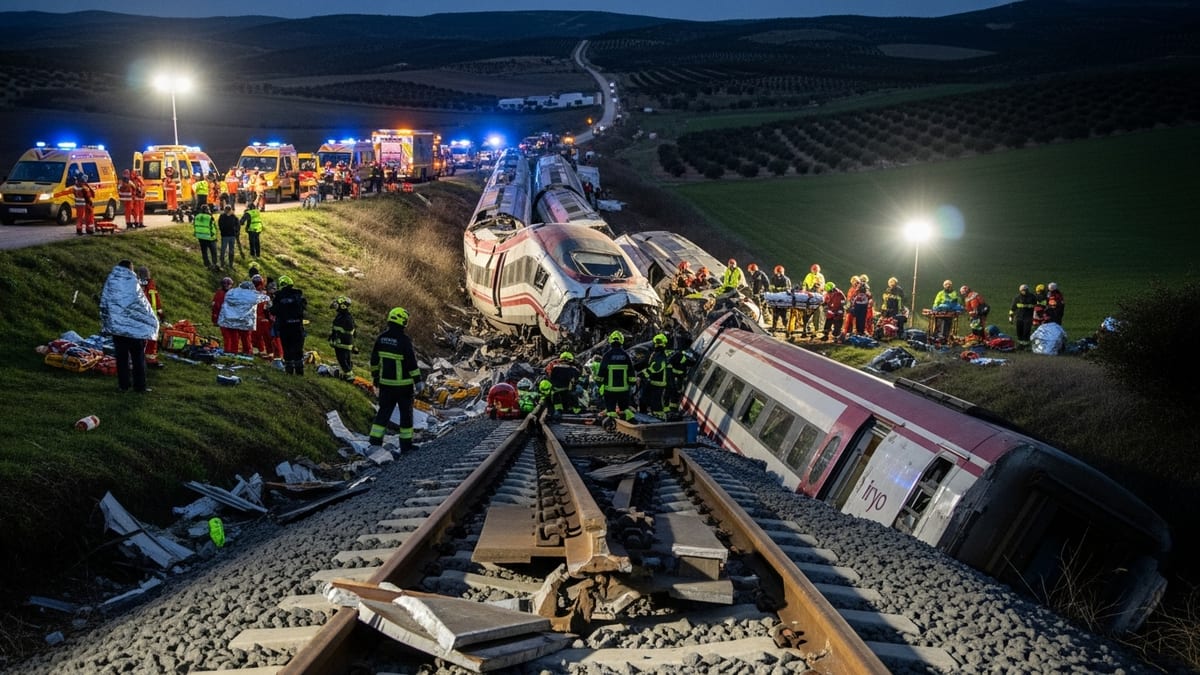
Evening rush hour journey turns to chaos
Published coverage indicates the collision occurred early on Friday evening south of Bedford, at the height of the commuter rush, on the electrified main line that links the East Midlands with London St Pancras. Two East Midlands Railway services heading to the capital were involved, one from Corby and one from Nottingham, on a stretch of track regularly used by fast intercity and regional commuter trains.
Reports describe a violent impact that left one train driver dead at the scene and caused significant damage to at least one of the train cabs. Windows were shattered and some carriages suffered structural damage, although there were no reports of coaches overturning or leaving the track completely.
According to information shared by regional ambulance services and summarized in British media, around 100 people were treated for injuries ranging from minor cuts and bruises to life threatening trauma. Many passengers were able to walk away from the wreckage, but others were trapped in damaged carriages and required assistance to escape.
Emergency responders set up triage points alongside the railway embankment, with floodlights brought in as darkness fell to support rescue efforts and initial medical care beside the tracks.
Casualties and hospital response
By Saturday morning, publicly available figures compiled in national coverage indicated that 28 people remained in hospital following the crash, nine of them in a critical condition. A further group of passengers were categorized as very seriously injured, with dozens more treated for less severe trauma and discharged.
Regional reports highlight that hospitals across the East of England received casualties, reflecting the scale of the incident and the need to distribute seriously injured patients. Trauma units were placed on heightened readiness on Friday evening as information emerged about the number of people on board the two trains.
Medical teams are understood to be treating a mix of head injuries, fractures and internal trauma consistent with a sudden deceleration event in a confined space. Doctors quoted in press coverage of similar rail incidents note that unrestrained passengers are often thrown forward into seats, tables and luggage racks when a train is involved in a collision.
While the death toll currently stands at one, travel and health correspondents report that the number of fatalities could change depending on the condition of those in intensive care, particularly the nine passengers whose injuries are described as critical.
Major disruption for rail passengers
The collision has caused significant disruption to one of the United Kingdom’s principal north south rail arteries. According to rail operator updates and transport reporting, services between Bedford and London St Pancras have been severely reduced, with some trains cancelled outright and others diverted or terminating short of their usual destination.
Passengers attempting to travel on Saturday faced extended journey times, bus replacement services and crowding on alternative routes via other main lines into London. Travel advisories issued through national media urged rail users to check timetables, allow extra time and consider postponing non essential trips while engineers and investigators worked at the crash site.
Rail infrastructure teams have been inspecting tracks, overhead power lines and signalling equipment in the affected area. Before full services can resume, damaged rolling stock must be removed, any infrastructure faults repaired and safety checks completed, a process that can take days after a serious collision.
For many daily commuters from towns in the East Midlands and Bedfordshire, the incident has underscored the dependence of regional economies on reliable rail links to London and the ripple effects when a single stretch of line is taken out of service.
Early focus on speed, signalling and train protection
Specialist rail correspondents note that attention is already turning to the technical factors that may have contributed to the crash. Questions are being raised in public reporting about the trains’ speeds at the time of impact, the performance of signalling systems and the effectiveness of automatic train protection technology on the route.
The line south of Bedford is equipped for intensive mixed traffic, combining fast intercity services with slower stopping trains. Transport analysts commenting in British media point out that such dense timetabling leaves less margin for error when an unexpected obstruction or signal problem arises, increasing reliance on both driver vigilance and robust fail safe systems.
Investigators are expected to review on train data recorders, signalling logs and radio communication to reconstruct the sequence of events. Previous inquiries into United Kingdom rail collisions have often led to changes in driver training, equipment maintenance and infrastructure design when systemic weaknesses were identified.
Safety campaigners interviewed in recent years in connection with other rail incidents have emphasized the importance of learning from each event, arguing that incremental improvements in technology and procedures are key to reducing the severity of future crashes even when human error cannot be completely eliminated.
Impact on public confidence and future journeys
While serious rail collisions in Britain remain relatively rare compared with road accidents, images of crumpled carriages and accounts from injured passengers are likely to unsettle many regular train users. Commentators in national newspapers suggest that the Bedford crash may revive debates about investment priorities across the rail network, including the balance between increasing capacity and enhancing safety systems.
Travel industry observers note that, in the short term, the incident may discourage some passengers from using the affected route, particularly while disruption continues and the causes of the collision remain under investigation. However, long term trends in Europe show that rail typically retains a strong safety reputation compared with other modes of surface transport once inquiries are completed and remedial steps are publicized.
For now, those planning to travel through Bedford are being urged in publicly issued guidance to monitor service updates closely, build additional time into their journeys and be prepared for last minute changes to train formations or stopping patterns. As repair work continues and more details emerge about how two London bound services came to collide on a busy commuter artery, the focus remains on supporting the injured and restoring confidence in a route used by tens of thousands of passengers each day.