


Most travelers step into Florence’s Piazza della Signoria, point their camera at the replica of Michelangelo’s David, glance at the Fountain of Neptune and move on toward the Uffizi. Yet the square that once served as the nerve center of the Florentine Republic is layered with symbols, scars and inside jokes that locals have read for centuries. Slow down for half an hour, and this open-air museum turns into something else entirely: a coded stone chronicle of power, punishment and civic pride, hiding in plain sight.
Get the latest updates straight to your inbox!
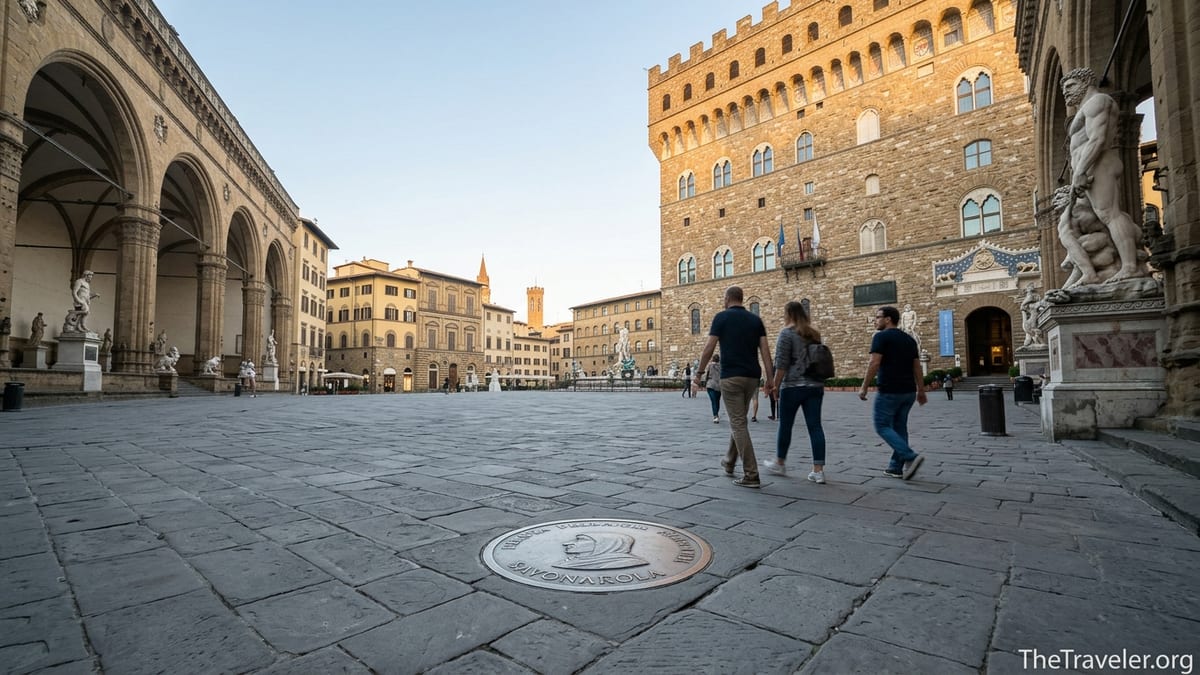
The Piazza as an Open-Air History Book
Stand in the middle of Piazza della Signoria and try to ignore the crowds for a moment. You are effectively standing in what was once Florence’s political cockpit, the place where decisions that shaped the Renaissance were argued, celebrated and sometimes violently overturned. The elegant paving, the photogenic statues and café tables can make it feel like a well-composed stage set, but nearly every surface carries traces of rougher centuries when executions, public trials and mass assemblies unfolded here.
Unlike many European squares that were redesigned in the 19th or 20th century, Piazza della Signoria largely preserves its Renaissance footprint. The W-shape still echoes the line of medieval streets buried beneath your feet, and the buildings have accrued only modest exterior changes. That continuity means details added 400 or 500 years ago still sit in their original context. A coat of arms on a corner, a Latin inscription at knee level or a strange mark on a column are not random decorations; they are fragments of civic messaging aimed at citizens who passed here daily for business and politics.
For modern visitors, the challenge is pace. Most guided walks pause only long enough for a quick explanation of “David,” “Neptune” and the Loggia dei Lanzi before pressing on. If you can give yourself even 30 to 45 minutes without a deadline, you start to see that the really revealing details are not the most photographed ones, but the small, worn elements everyone else steps past on their way to the next checklist stop.
The Plaque of Savonarola Beneath Your Feet
One of the most easily missed details in the entire piazza is actually on the ground. Walk toward the Fountain of Neptune and look for a round stone set among the paving stones, slightly lighter in color and inscribed in Italian. This unobtrusive disk marks the spot where the Dominican friar Girolamo Savonarola and two fellow monks were hanged and burned on May 23, 1498, after a dramatic downfall from power.
Savonarola’s short-lived rule turned Florence into a sort of austere theocracy, famous for the “Bonfire of the Vanities” that saw luxury goods, paintings and books consigned to the flames. When political winds shifted, he met the same fate on this very spot. The plaque itself was installed centuries later, and its wording refers to his death as an “iniqua sentenza,” an unjust sentence, reflecting the more sympathetic view that developed over time. Visitors often stand directly on top of it while angling for a photo of Neptune, never realizing they are treading on a site that terrified and fascinated Renaissance Florentines.
Because the stone is flush with the pavement and there is no barrier or signboard, you have to know to look for it. A practical way to find it is to stand with the Fountain of Neptune directly in front of you and Palazzo Vecchio behind you, then scan the stones underfoot a few meters back from the basin. Once you spot the plaque, step aside and watch how many people cross it without seeing it. It is a simple exercise that captures how the piazza’s hardest history is now literally underfoot, unnoticed by the rush of modern tourism.
Medici Messages Carved in Stone
Piazza della Signoria was not only the stage of the Florentine Republic; it later became the symbolic courtyard of Medici power. One of the most rewarding hidden-detail games you can play here is spotting the Medici coat of arms, with its distinctive rounded “palle” or balls on a shield, repeated across façades and statues. These are more than heraldic flourishes. They functioned as a visual signature of control, quietly reminding passersby who now held the keys to the city.
Look first at Palazzo Vecchio, the fortress-like building with the high tower. Above the main entrance you can see a large stone shield with six rounded forms. The exact meaning of the “palle” is still debated, but by the late 15th century they were firmly associated with the Medici banking dynasty. Elsewhere on the palace, smaller shields appear carved into corners and window frames. In the 16th century, when Cosimo I de’ Medici turned the building into a ducal residence, adding these emblems was a way of stamping the former republican palace as his own.
If you move to the Loggia dei Lanzi, the open-air arcaded gallery on the south side of the piazza, more subtle Medici references appear. Look up at the ceiling vaults and along the balustrade on top, added when the Medici used the roof as a terrace to watch ceremonies. Here, griffins and stylized lilies of Florence sit near the familiar palle. Taken together, these small carvings give the impression of a space gently occupied by a ruling family rather than completely rebuilt, a visual compromise between republican memory and ducal propaganda that most travelers never notice.
Once you train your eye for the Medici arms here, you will begin spotting them across Florence, from humble street corners to the grand Pitti Palace. The piazza is a good classroom for this, because the symbols appear in a relatively small area and in a range of sizes, from dominating shields above doorways to tiny, time-worn reliefs near eye level.
Hercules and Cacus: Florence’s Love-Hate Statue
Most visitors notice the enormous marble group to the right of Palazzo Vecchio’s entrance, opposite the replica of David, but few realize they are looking at one of Florence’s most controversial works. Baccio Bandinelli’s “Hercules and Cacus,” unveiled in 1534, was meant to stand as a muscular symbol of Medici triumph over their enemies. The hero Hercules looms in a tense stance, gripping a club over the defeated monster Cacus, who writhes beneath him.
Contemporary Florentines, however, were not impressed. Comparisons with Michelangelo’s David, which had stood nearby for three decades before being moved to the Accademia, were inevitable and brutal. Satirical verses were posted around the statue mocking Hercules’ anatomy and calling the figures clumsy. Yet the piece remained and over time fused into the iconography of the square, its political message blunted but still legible if you know the backstory.
Look closely at the interaction between Hercules and Cacus. Cacus represents chaos and lawlessness, a stand-in for those who opposed Medici rule. Hercules, by contrast, is the embodiment of controlled force. In the context of 1530s Florence, that meant Cosimo’s consolidation of power after years of republican experiments. When you stand between David’s replica and Bandinelli’s group, you can read the two statues as a silent debate: the nimble, idealized citizen-hero on one side, the heavy, state-backed muscle on the other. That tension is not spelled out on any plaque, but it is one of the piazza’s most revealing hidden conversations.
For a more intimate look, step closer and walk around the base. From the side, the twisting line from Hercules’ outstretched arm down through Cacus’s contorted body creates an S-curve that feels much more active than the front view. This was where Bandinelli hoped you would stand, but most visitors snap a quick frontal shot from the middle of the square and move on, missing the sculpture’s more theatrical angles.
The Loggia dei Lanzi: Stories in the Shadows
The Loggia dei Lanzi is usually described as an open-air sculpture gallery, but for centuries it functioned as a stage for public ceremonies and announcements. That past still haunts the space if you look for small traces. For example, near the back wall you can see iron rings and holes that once helped anchor temporary wooden barriers and decorations for state events. They now disappear into the background, overshadowed by the dramatic marble figures in the foreground.
Those sculptures themselves conceal layers of meaning that a casual stroll misses. Benvenuto Cellini’s bronze “Perseus with the Head of Medusa,” positioned prominently near the front, is a master class in detail. Visitors usually photograph the glistening hero holding Medusa’s severed head, but if you circle behind the statue you will notice a small, finely rendered self-portrait of Cellini on the back of Perseus’s helmet. The artist literally carved his presence into a work commissioned by Duke Cosimo I, a quiet assertion of authorship in an age when patrons dominated.
Nearby, Giambologna’s swirling “Rape of the Sabine Women” rises as a vertical column of intertwined bodies carved from a single block of marble. There is no base relief explaining the story; when it was unveiled, the sculptor reportedly preferred to emphasize its formal qualities over a specific narrative. That leaves modern viewers free to read it as a meditation on raw force and vulnerability, especially in the context of a square that has seen its share of coercion. Looking up from close range, you can see chisel marks and subtle shifts in texture where the artist adjusted muscles and drapery, signs of a hand at work that vanish in distant photos.
Because the Loggia is open to the elements and free to enter 24 hours a day, you can return at different times for different moods. Early morning, when delivery trucks are still rumbling through nearby streets, the figures sit in cool shadow and feel almost like guardians of an empty stage. Late at night, under the warm pools of artificial light, the bronze and marble surfaces catch reflections from the piazza, revealing scratches and weathering that testify to centuries outdoors.
Insignias, Inscriptions and the Language of the Stones
Beyond the major monuments, Piazza della Signoria rewards anyone willing to read smaller inscriptions. On the façade of Palazzo Vecchio, just above the entrance arch, a Latin motto proclaims “Rex regum et Dominus dominantium,” a reference to Christ as king of kings. Installed after a particularly tense period in Florentine politics, it served as a reminder that secular leaders, including the Medici dukes, were ultimately subject to a higher authority. In a square otherwise dominated by the imagery of human power, the line adds a note of humility, or at least the performance of it.
Elsewhere on the palace, near corner stones and under windows, you may spot carved circles and cross-like patterns that once served practical purposes as well as symbolic ones. Some marks denoted guild responsibilities for maintaining sections of the building, while others are mason’s symbols identifying which workshop executed certain portions of the stonework. These signatures were mainly meant for internal accounting and pride, yet centuries later they give visitors a glimpse into the collaborative nature of Renaissance construction, which is often overshadowed by the names of star architects and patrons.
On the edges of the piazza, a more modest detail to seek out is the Florentine lily, or “giglio,” carved into shields and brackets. Unlike the Medici palle, the lily represents the city itself rather than a ruling house. When you see the lily aligned with the republican palace or paired with depictions of David, it reinforces the idea of the community as a character in its own story. Travelers who only focus on the big statues miss this quieter chorus of symbols that filled the visual field of everyday Florentines walking to market or to the law courts.
Even the paving stones have tales to tell. Slight variations in color and alignment reveal where maintenance campaigns have patched older surfaces. In a few spots near building fronts, you can see faint outlines of former thresholds and drains that marked vanished shops and workshops. These are not dramatic discoveries, but they gently remind you that the piazza is a lived-in space, altered over time for drainage, crowd control and traffic, not a frozen museum set.
Reading the Piazza Like a Local
Florentines who work near Piazza della Signoria often use it as a shortcut or meeting point, navigating by markers that rarely appear in guidebooks. Ask a barista from a nearby café where to meet and you may hear instructions like “under Perseus” or “by the horse’s tail,” referring to Giambologna’s equestrian statue of Cosimo I. These everyday reference points highlight details you might otherwise ignore, such as the reliefs on Cosimo’s base that show scenes of his naval victories, or the way the horse’s raised foreleg casts a changing shadow on the stone throughout the afternoon.
One of the most useful local habits you can borrow is changing your vantage point frequently. Rather than standing in the center for a panorama, approach each side of the square and then turn back to face it. From the Uffizi side, Palazzo Vecchio looks most fortress-like, its crenellations sharp against the sky. From the opposite, café-lined side, the same building seems more like a civic palace, framed by balconied houses. The statues also reshuffle. David’s replica dominates certain angles, while from others Hercules and Cacus or the Neptune fountain become the visual anchor.
Time of day matters as much as point of view. Early morning, often before 9 a.m., is when you are most likely to have parts of the piazza sparsely populated, with only a few commuters and delivery workers cutting across. In this light, details like the tool marks on the stone blocks of Palazzo Vecchio or the ripple textures on Neptune’s marble beard are easier to appreciate. Late afternoon, by contrast, fills the space with golden light that deepens the warm tones of the stone and highlights shallow carvings. If you are staying in Florence for more than one day, consider swinging by the square briefly at three or four different times to see how the mood shifts.
Slowing down also allows for more spontaneous encounters. Street musicians occasionally set up at the edge of the piazza, and their music can draw your attention to corners of the square you might have neglected. A violinist under the Loggia, for example, naturally makes you look up at the vaulted ceiling and the interplay of shadow and sound, while a guitarist near Neptune underlines the fountain’s gentle background roar that you tune out in a hurry.
The Takeaway
Piazza della Signoria is often described as Florence’s outdoor sculpture gallery, but that label undersells how much lived history is embedded in its stones. Beyond the postcard view of Palazzo Vecchio, David’s replica and the Fountain of Neptune, the square is dense with small, intentional details: a round plaque recording a friar’s fiery end, repeated Medici shields signaling dynastic control, self-portraits hidden on bronze helmets and mason’s marks tucked into rough-hewn blocks.
To appreciate these layers, you do not need specialized art-historical training so much as a willingness to pause and look closer than the average passerby. Search for the Savonarola plaque before you photograph Neptune. Circle Hercules and Cacus rather than judging it from one angle. Step into the Loggia dei Lanzi and study the backs of the statues as carefully as the fronts. Scan the façades for lilies and palle, and imagine how a 16th-century merchant might have read them on the way to a council session.
Florence rewards this kind of attention everywhere, but nowhere more so than in Piazza della Signoria, where centuries of political struggles and artistic ambitions converged in one compact urban stage. The next time you find yourself here, try treating the piazza not as a single sight to be checked off, but as a dense text to be read line by line. The famous masterpieces will still be there, but it is the quiet, easily missed details that will linger longest in your memory.
FAQ
Q1. Where exactly is the Savonarola plaque in Piazza della Signoria?
The round commemorative plaque is set into the paving stones in front of the Fountain of Neptune, roughly between the fountain and Palazzo Vecchio, and can be hard to spot unless you deliberately look down.
Q2. Is there an entrance fee to see the statues in Piazza della Signoria and the Loggia dei Lanzi?
No. Both the piazza and the Loggia dei Lanzi function as open public spaces, so you can view the statues and architectural details at any time without paying an admission fee.
Q3. Why is there a replica of Michelangelo’s David in the square instead of the original?
The original David stood outside Palazzo Vecchio for centuries but was moved indoors to the Galleria dell’Accademia in the 19th century for conservation; the replica preserves the historic placement while protecting the masterpiece from further weathering.
Q4. What is the political meaning behind the Hercules and Cacus statue?
Baccio Bandinelli’s Hercules represents strong, centralized Medici power, while the defeated Cacus symbolizes chaos and opposition, turning the mythological scene into a visual message of dynastic control.
Q5. Can I visit Piazza della Signoria at night, and is it safe?
Yes, the piazza is open around the clock and is typically busy and well lit into the evening, with cafés and nearby streets active, so most visitors find it comfortable to visit after dark.
Q6. How long should I plan to stay to appreciate the hidden details?
If you slow your pace, about 30 to 45 minutes is enough to locate the Savonarola plaque, study the major sculptures from multiple angles and notice key carvings and coats of arms.
Q7. Are guided tours necessary to understand the symbolism in the square?
A good guide can enrich the experience, but with a basic sense of the history and a willingness to look closely, independent travelers can uncover many of the piazza’s stories on their own.
Q8. What time of day is best for photographing the statues and carvings?
Early morning offers softer light and fewer crowds, ideal for close-up details, while late afternoon brings warm tones that flatter the façades and larger sculptural groups.
Q9. Is there seating in the piazza if I want to sit and observe?
Public benches are limited, but the low stone steps of the Loggia dei Lanzi and café terraces around the edges provide convenient spots to sit, rest and watch the square’s life unfold.
Q10. Can I touch the statues or climb on the bases for photos?
No. Touching, climbing or sitting on the statue bases is prohibited and monitored by security; respecting these rules helps protect the artworks and maintain the site for future visitors.