

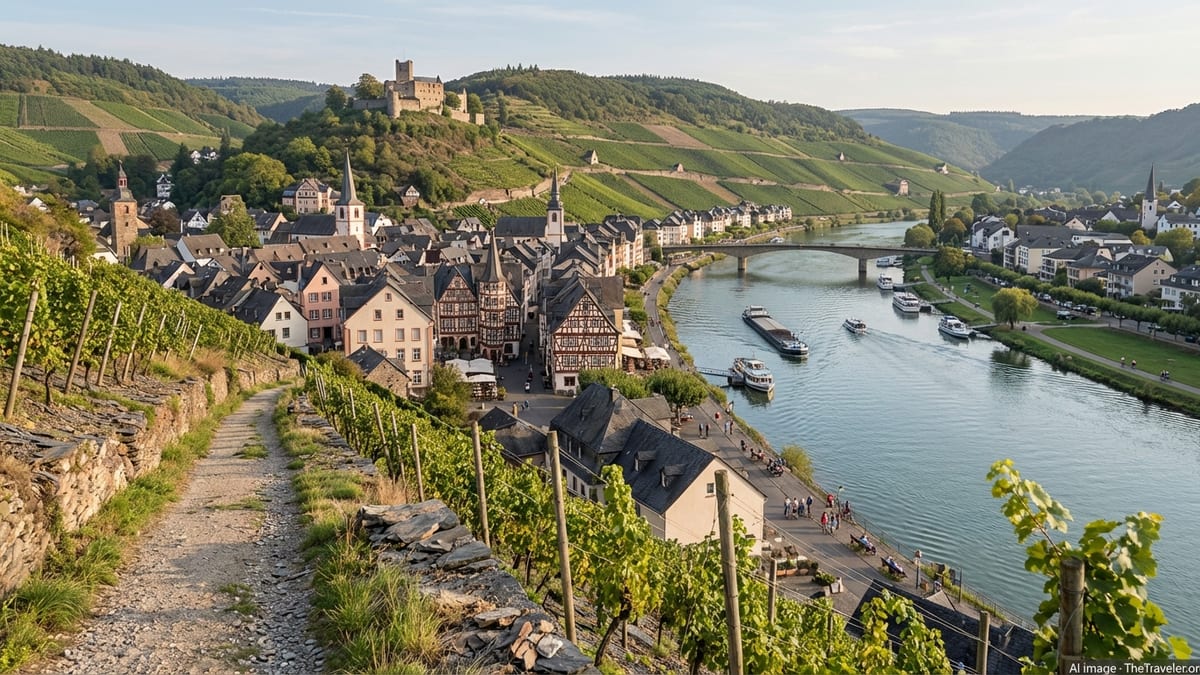
Bernkastel-Kues is a compact Moselle Valley town that rewards slow travel. Spread across both banks of the river and rising steeply into terraced vineyards, it combines one of Germany’s most atmospheric medieval old towns with an accessible riverfront and a network of hillside paths that seem designed for lingering.
Understanding the layout helps prioritize the main things to do in Bernkastel-Kues. From half-timbered squares and wine taverns to panoramic castle ruins, this is a place where the rhythm of the day is set by the light on the slate hillsides and the flow of the Moselle below.
Getting Oriented: A Town Between River and Vines
Bernkastel-Kues is effectively four districts in one: Bernkastel and Andel on the right bank of the Moselle, and Kues and Wehlen on the left. The historic core that most visitors picture lies in Bernkastel, squeezed between the river and steep vineyards where Riesling grapes cling to slate soil. Across the bridge, Kues feels quieter and more residential, with riverside promenades, wine estates and the scholarly legacy of the philosopher Nikolaus von Kues.
The town grew from a Roman riverside settlement into a fortified medieval trading place. Later, the prosperity of winegrowing funded the intricate half-timbered houses that still frame the market square. Above it all stand the ruins of Burg Landshut, a castle rebuilt and destroyed several times over the centuries. Today it provides the classic postcard view: red roofs clustered around church spires, barges gliding below, and geometric stripes of vines climbing the hillsides in every direction.
Because there is no railway station in Bernkastel-Kues itself, most visitors arrive by car, regional bus or river cruise. At this point, many travelers still wonder if Bernkastel-Kues is worth visiting or just a quick stop. That relative isolation works in the town’s favor. It has the infrastructure of a well-known holiday spot, yet outside the busiest festival weekends the atmosphere stays village-like. The riverfront paths, cobbled lanes and hillside trails link into a compact area that most travelers can navigate on foot, with only occasional short climbs.
Orientation comes quickly: the Moselle flows roughly southwest to northeast, the castle crowns the hill directly above the old town, and the bridge between Bernkastel and Kues is the practical and symbolic center. From there, it is easy to divide your time between three main zones: the old town’s lanes and squares, the promenades along both riverbanks, and the vineyards and forested hills that rise in tight folds behind them.
Exploring the Old Town: Lanes, Squares and Timber Frames
The heart of Bernkastel’s old town is the Marktplatz, a small, irregularly shaped market square surrounded by some of the most photogenic half-timbered facades on the Moselle. Many date from the 15th to 17th centuries and lean together above narrow ground floors that now house cafés, wine taverns and small shops. One of the most distinctive is the Spitzhäuschen, the pointed house. Built in 1416, it tapers upward from a much smaller base and has become an emblem of the town.
At the edge of the square stands the former Rathaus, an ornate red-and-white town hall that reflects late Renaissance and Baroque influences. Its decorative roofline and carved coats of arms speak to Bernkastel’s civic pride in its trading heyday. Look for the old pillory on the side wall, a reminder that public justice was once performed in full view of merchants and townspeople. Today the building contains a restaurant, demonstrating how seamlessly historic structures in Bernkastel-Kues have adapted to contemporary life.
From the Marktplatz, a web of side streets leads deeper into the old town. Many of these lanes change elevation quickly, stepping up toward the vineyards or sloping back to the river. Along the way you pass tiny chapels, projecting bay windows, wrought-iron signs advertising guesthouses and Weinstuben, and small inner courtyards. The Graacher Tor, a surviving medieval gate dating from around 1300, marks the old northern entrance to the town. It now houses a local museum that illustrates everyday life along the Moselle over past centuries.
Part of the pleasure of Bernkastel’s old town lies in its scale. It is large enough to sustain several distinct corners, from the busy riverfront Gestade to quieter residential alleys, yet small enough that unplanned wandering rarely leads you far from your bearings. Early morning and evening are especially atmospheric, when day-trippers have thinned and lamplight glows on slate roofs and timber beams. In those hours the old town feels less like a sightseeing backdrop and more like a lived-in neighborhood that happens to be unusually beautiful.
Life Along the Riverbanks: Promenades, Cruises and Atmosphere
The Moselle riverfront is where Bernkastel-Kues most clearly presents itself as a resort. On both banks run promenades lined with trees, benches and occasional sculptures, opening to views of barges, excursion boats and the checkerboard of vineyards beyond. In Bernkastel, the Gestade provides a string of terraces, cafés and seasonal kiosks where you can watch the water traffic over a glass of local wine or a coffee. In Kues, the opposite bank is a touch quieter, with grassy areas and moorings for pleasure craft and river-cruise vessels.
Regular boat tours depart from the town during the main season, typically from around Easter to late October depending on river conditions and operators. Short round-trip cruises give a different angle on Bernkastel-Kues itself, gliding under bridges and past vineyard slopes that look even steeper from water level. Longer excursions continue to neighboring wine villages or downriver to the Art Nouveau townscape of Traben-Trarbach. Onboard commentary usually touches on the history of Moselle winegrowing and the challenges of cultivating vines on such dramatic gradients.
The river also structures less formal activity. Cyclists follow the Mosel Radweg, a long-distance cycle path that passes directly through Bernkastel-Kues and connects it to villages up and down the valley. Families push strollers along the flat embankments, and anglers set up in quieter pockets away from the main piers. In summer, trees throw dappled shade over picnic tables, while in cooler months the promenades offer brisk walks with panoramic views of the bare vines and the castle rising above.
As daylight fades, the riverbanks take on a softer character. Lights from the old town and Kues reflect on the water, and the illuminated silhouette of Burg Landshut gives a focal point high above. Evening cruises, when available, underscore that sense of theatrically staged scenery, but even without them the simple act of crossing the bridge and watching the current from its midpoint can be one of the trip’s enduring memories. The river is not just a backdrop here. It is an active stage on which the town’s daily life quietly unfolds.
Up to the Hillsides: Castle Views, Trails and Vineyards
Bernkastel-Kues only fully reveals itself when you leave the river level and gain height on the surrounding hillsides. The most direct goal for many visitors is Burg Landshut, the ruined castle that crowns the hill immediately above the old town. The site has Roman and early medieval origins, but the current ruins largely reflect a 13th-century fortification that suffered several fires and conflicts before losing strategic value. Today, restored sections blend with the remaining walls to form a viewpoint platform and, in season, a hilltop restaurant.
The walk up to Burg Landshut from the old town takes around 30 to 45 minutes depending on your pace. Paths are steep in places but generally well maintained, zigzagging through vineyards and patches of woodland. Those not inclined to climb can use a seasonal shuttle bus that runs from near the center of Bernkastel up to the castle. Whichever way you choose, the reward at the top is the signature vista of the Moselle looping past clustered roofs, with rows of vines forming a graphic pattern on the opposite slopes.
Beyond the castle, a network of marked walking routes and vineyard trails extends along both sides of the valley. One popular option is the circular vineyard hike that loops above Bernkastel-Kues, passing through terraces, small wayside shrines and occasional viewing platforms. Another, more challenging path, the Maria-Zill Panoramaweg, climbs steeply through the Kallenfels valley to a refuge and viewpoints before descending through forest and vines. These routes underline how tightly interwoven nature and winegrowing are in the region, with plants and animals adapted to the sun-warmed slate slopes.
For many travelers, the most memorable hillside experiences are not the dramatic panoramas but the smaller moments: the rasp of gravel underfoot on an old vineyard lane, the smell of warm stone after a sunny afternoon, the view of Bernkastel’s church spires framed by a gap in the retaining walls. In autumn, workers harvesting by hand on near-vertical slopes underline how labor-intensive Moselle viticulture remains. In spring and early summer, the hillsides are greener and softer, with young leaves and wildflowers softening the geometry of the vines.
Wine Culture: Cellars, Festivals and Tastings
Wine is not just an export product in Bernkastel-Kues. It is a cultural presence that shapes the calendar, the landscape and the built environment. The town is particularly renowned for Riesling grown on steep slate slopes that reflect and retain heat, producing wines with pronounced acidity and mineral notes. Local labels range from dry, food-friendly bottlings to later-harvest wines with varying levels of sweetness, giving visitors ample ground for exploration.
In both Bernkastel and Kues, wine taverns and estates offer tastings that can be as informal or structured as you prefer. Some Weinstuben present a list of open wines by the glass alongside hearty regional dishes, while others focus on more in-depth sampling of specific vineyards or styles. The historic Cusanusstift in Kues, founded in the 15th century as a charitable foundation by Nikolaus von Kues, still operates as a wine estate, its cellar and buildings reflecting centuries of viticultural tradition.
Museums and cultural centers add context. The Moselle Wine Museum and associated wine-cultural institutions explore how viticulture developed along the river, from Roman times through medieval monastic cultivation to modern techniques. Exhibits explain the role of slate soils, river microclimate and south-facing slopes, while also addressing challenges such as erosion, manual labor on steep terrain and changing consumer tastes. Visitors who choose to join a guided wine walk or themed town tour can delve even more deeply into the stories behind famous sites like the Bernkasteler Doctor vineyard.
The annual Weinfest der Mittelmosel, usually held around the first weekend of September, is one of the largest wine festivals on the Moselle. For several days, the riverfront and town center fill with stalls from local estates, live music stages, food stands and a festive parade. A large fireworks display over the Moselle is a particular highlight, reflecting in the water and illuminating the terraced vineyards. Throughout the year, smaller street festivals, courtyard tastings and open cellar days give visitors other chances to experience wine culture at closer quarters and at a slower tempo.
Culture and Everyday Life: Beyond the Postcard Views
Although the tourist appeal of Bernkastel-Kues is obvious at first glance, much of its interest lies just beyond the postcard motifs. The town’s long history has left traces that reward a more inquisitive visit. The legacy of Nikolaus von Kues, a 15th-century thinker and churchman, is visible in the Cusanusstift complex in Kues, where an original library and historic hospital wings hint at centuries of scholarship and care. Today, parts of the complex host cultural events, exhibitions and religious services, connecting the town to broader intellectual currents in European history.
Local museums and small galleries reveal other layers. The Heimatmuseum in the Graacher Tor houses domestic objects, tools and documents that reconstruct daily life in the town over various periods, from traditional crafts to the early days of tourism. Contemporary sculpture trails and outdoor artworks, particularly on the Kues side, mark a more recent effort to blend modern creativity with the historic built environment. For visitors, these projects provide pleasant excuses to explore quieter residential streets and riverbank corners.
Daily life is most visible away from the main tourist lanes, especially in Kues and Andel. Here, small bakeries, butchers and grocery shops serve residents first, visitors second. Schoolyards, sports facilities and community halls speak to a town that functions year-round rather than as a seasonal stage set. The Moselle’s cycle paths are used by commuters as well as holidaymakers, and the bus system links Bernkastel-Kues to surrounding villages and larger hubs, underscoring its role as a service center for the wider region.
Visitors who stay overnight rather than on a day trip often find that these everyday rhythms shape their experience as much as the headline sights. A morning coffee in a nearly empty square, a weekday visit to a small wine estate or a walk through residential streets at dusk can leave as strong an impression as a castle view or fireworks display. Spending time beyond the peak afternoon hours lets the quieter, lived-in character of Bernkastel-Kues come through.
Planning Your Trip: Seasons, Practicalities and Staying Longer
The character of Bernkastel-Kues shifts with the seasons. Spring brings blooming trees along the river and the first outdoor café tables, with moderate temperatures that suit hiking and cycling. Summer is the busiest period, particularly on weekends and during school holidays, when river cruise ships, coach tours and independent travelers converge. The atmosphere is lively, and boat schedules, guided tours and wine-related events are at their fullest. Temperatures can climb, but the river’s presence takes the edge off the heat, and evening breezes along the embankments are often pleasant.
Late summer and early autumn, during harvest and festival time, are especially appealing for wine enthusiasts. Vines turn golden, activity in the vineyards intensifies, and festivals such as the Middle Moselle Wine Festival add a celebratory overlay. Accommodation in town and nearby can book out quickly on key dates, so planning ahead is essential. By contrast, late autumn and winter bring a quieter, more introspective feel. Some seasonal businesses close or reduce hours, and river cruises are limited, but the reduced crowds and atmospheric mists over the river have their own charm.
Reaching Bernkastel-Kues generally involves a combination of rail and road if you are arriving by public transport. Nearby towns on major railway lines connect via regional buses that drop passengers close to the riverfront. Drivers find parking areas along both riverbanks, with extra demand around festival dates and sunny weekends. Once you are in town, walking is the primary mode for exploring the old center, but bicycles are a practical option for trips along the Moselle valley, and boats or local tour services cover longer stretches.
Staying at least one or two nights allows you to experience the town at different times of day and to fit in both river and hillside excursions. A longer stay opens up options for day trips to nearby destinations such as Traben-Trarbach, Cochem or the volcanic Eifel region, reachable by car, bus, cycle paths or boat. Many guests choose to base themselves in a winegrower’s guesthouse or holiday apartment, integrating tastings more naturally into their stay and gaining insight into the seasonal rhythms of local viticulture.
The Takeaway
Bernkastel-Kues is not a destination of single blockbuster attractions but rather a place that builds its appeal from accumulated impressions: a gabled timber house overhanging a market lane, a glass of Riesling on a riverfront terrace, the change in perspective as you climb from cobbles to castle, the soft clink of glasses during a courtyard tasting. Its old town, riverbanks and hillsides fit together as parts of one coherent landscape shaped over centuries by wine, trade and the Moselle’s meandering course.
For travelers willing to slow their pace, the town offers a rich mix of experiences within a remarkably compact area. You can stroll medieval alleys in the morning, cycle along the water in the afternoon, visit a hillside ruin for sunset and end the day in a centuries-old wine tavern. The scenery is undeniably picturesque, but what lingers longest is the sense of continuity: a community that has adapted to new eras while remaining visibly rooted in its terrain and traditions.
Whether you come for a festival weekend, a stop on a longer Moselle journey or a quiet off-season escape, Bernkastel-Kues rewards curiosity. Look beyond the familiar images, walk a little higher up the slopes, cross the river a few extra times, and the town reveals depths that go far beyond its postcard-perfect facades.
FAQ
Q1: How many days should I spend in Bernkastel-Kues?
Most visitors find that one full day covers the main old town sights and a short river walk, but two to three nights allow time for a castle visit, a vineyard hike, a boat trip and relaxed wine tastings without rushing.
Q2: When is the best time of year to visit?
Late spring and early autumn offer a good balance of pleasant weather and manageable crowds, with vineyard color and wine-related events adding interest. Summer is livelier and busier, while winter is quiet but atmospheric, with fewer services and shorter days.
Q3: Is Bernkastel-Kues suitable for travelers without a car?
Yes. You can reach the town by regional bus from nearby railway hubs, and once there, the old town, riverfront and castle hike are all accessible on foot. Boat excursions and cycle rentals offer additional ways to explore the wider Moselle valley without driving.
Q4: How difficult is the walk up to Burg Landshut?
The walk is short but steep in sections, taking around 30 to 45 minutes from the old town. Paths are generally well maintained, though they can be uneven. Travelers with limited mobility can use a seasonal shuttle bus from near the town center to the castle area.
Q5: What kind of wines is the area known for?
Bernkastel-Kues is best known for Riesling grown on steep slate slopes, producing wines with pronounced acidity and mineral character. You will find a range from dry to sweet styles, along with smaller quantities of other white varieties and some reds and rosés.
Q6: Are there good options for hiking and cycling?
Yes. Marked trails lead through vineyards and surrounding hills, including circular routes with panoramic viewpoints. The Moselle cycle path runs along the river, offering mostly flat, well-surfaced riding to neighboring villages and towns in both directions.
Q7: Is Bernkastel-Kues family friendly?
The town suits families who enjoy walking, cycling and boat rides. The car-free old town lanes, riverfront promenades and gentle cycle paths are all accessible with children, though parents should consider the steepness of some hillside paths and castle routes.
Q8: Do I need to book wine tastings in advance?
For casual glasses in wine taverns and many small tastings, advance booking is usually not required. For more in-depth tastings at specific estates, or during busy festival periods, it is wise to make reservations to ensure space and time with the winemakers.
Q9: What should I wear for exploring the town and hillsides?
Comfortable walking shoes with good grip are essential, especially for cobbled streets and vineyard paths. Layered clothing works best, as temperatures can vary between shaded riverfronts and sunny hillsides, and weather along the valley can change quickly.
Q10: Can Bernkastel-Kues be combined with other destinations on the same trip?
Yes. Many travelers pair it with other Moselle towns such as Traben-Trarbach or Cochem, or with nearby regions like the Eifel or the Middle Rhine Valley. The town’s position along established driving, cycling and boating routes makes it an easy stop within a wider itinerary.