


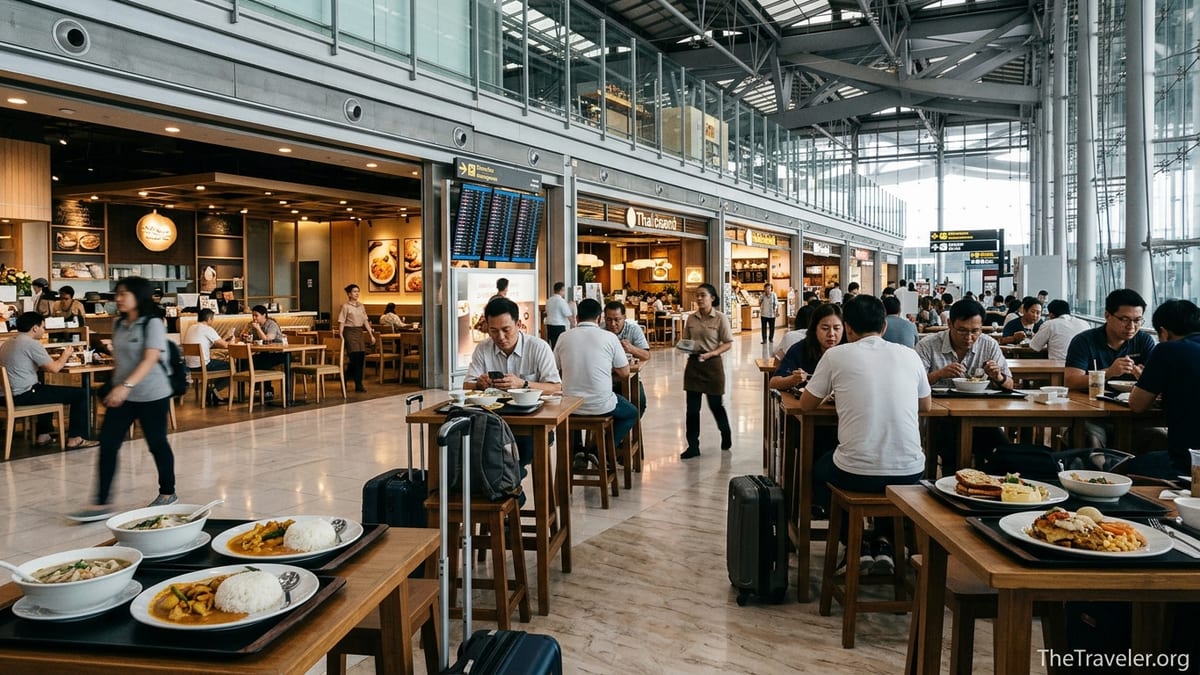
Bangkok Suvarnabhumi Airport is not just Thailand’s main international gateway, it is also one of Asia’s busiest hubs for connecting flights. That usually means one thing for travelers: long stretches of time in the terminal hunting for a decent meal. The good news is that Suvarnabhumi has steadily improved its food options, and today you can find everything from quick bowls of boat noodles to all-day brunch, halal-friendly Thai buffets and late-night street-food style snacks without ever leaving the airport. This guide walks you through the best restaurants and food spots actually worth seeking out, with concrete examples, typical prices and where to find them in the terminal.
Get the latest updates straight to your inbox!
How Dining Works at Suvarnabhumi: Layout, Hours and Prices
Suvarnabhumi’s main terminal is large and spread out, but the dining logic is fairly simple. Most international restaurants sit airside after security on Levels 3 and 4 of the concourses, while a more local and budget-friendly cluster of eateries is located landside on the basement Level B near the Airport Rail Link station. Almost all major outlets airside operate 24 hours or close to it, which is important because many long-haul departures leave after midnight.
Prices are higher than downtown Bangkok, but you can still eat at a range of budgets. As a rough guide, a sit-down Thai meal airside usually runs between 250 and 450 baht for a main and soft drink, while coffee shop breakfasts with a latte and pastry tend to fall around 180 to 260 baht. In the budget food court in the basement, simple rice and noodle dishes can still be found in the 60 to 120 baht range, which is only slightly above city prices.
When planning where to eat, consider where your flight departs from. The eastern concourses A, B and C serve more regional and Northeast Asian routes and tend to cluster Asian eateries, while the western concourses E, F and G lean more international, with European-style cafes and fusion options. If you have a tight connection, it is often safer to eat somewhere near your departure gate rather than trekking to a specific restaurant at the opposite end of the terminal.
Many of the better food options are technically inside lounges, particularly the Miracle network that sells pay-per-use access. If you are facing a long layover and expect to eat and drink more than a single main dish, it can sometimes be cheaper and more comfortable to pay for lounge access for two or three hours than to buy separate meals and coffees at different outlets.
Best for Authentic Thai Classics: Noodles, Rice Dishes and Street-Food Style Bites
If you want your last taste of Thailand to be something truly local, head for the Thai noodle and rice counters scattered across the concourses and in the basement food court. While individual brands change from time to time, you will almost always find stalls serving boat noodles, tom yum noodles and chicken rice, along with wok-fried rice and stir-fried basil chicken with rice. Expect to pay about 120 to 180 baht airside for a decent-sized bowl of noodles, or closer to 70 to 90 baht in the basement food court.
In the airside areas of Concourses A to D, look for compact noodle shops or mixed Thai eateries that operate on a semi self-service model. You typically order and pay at the counter, receive a buzzer, then pick up your food when it vibrates. Portions here are often slightly smaller than in the city but still satisfying, and they are a good fit if you want something quick before boarding. Many of these outlets keep vats of free condiments on the tables, including fish sauce with chilies, crushed peanuts and chili flakes, so you can tune the spice level yourself.
Downstairs on Level B, the cluster sometimes referred to by travelers as the “airport canteen” remains one of the best value spots in the terminal. You will find simple Thai curries over rice, stir-fries made to order and noodle soups in a food-court style setting where you load money on a card and pay at each stall. The setting is fluorescent and functional rather than atmospheric, but if you are transiting on a budget it is one of the few places you can still eat a full Thai meal for under 150 baht.
One practical tip if you are tight on time is to check the typical wait by peering at how many order slips are stuck on the kitchen rail. If each pan is already full of tickets and cooks look overwhelmed, you might be better off grabbing a ready-made rice dish from a Thai-style takeaway counter or convenience outlet rather than risk missing boarding.
Best All-Day Brunch and International Comfort Food
For travelers who just want something familiar and filling, Suvarnabhumi has a number of Western-style cafes and casual restaurants scattered across the concourses. Chains such as The Coffee Club, which usually offers eggs, pancakes, burgers and salads, are a common choice for morning flights because you can sit down to an all-day breakfast with a flat white and still keep an eye on boarding screens. A typical set of scrambled eggs with toast and coffee here usually lands in the 260 to 350 baht range.
Many of the better international restaurants at Suvarnabhumi take a hybrid approach, mixing Thai favorites with Western comfort food. It is common to see menus where pad Thai and green curry sit alongside chicken wings, pasta dishes and club sandwiches. For example, one of the popular sit-down restaurants in the central departure hall offers a “Thai set” with tom yum soup, fried spring rolls and rice for around 420 baht, next to a burger and fries set in a similar price band. Portion sizes tend to be generous enough to share if you are only mildly hungry.
Vegetarians and flexitarians will find improving options in these international outlets. Many now clearly label meat-free dishes such as stir-fried vegetables with tofu, vegetarian pad Thai or simple tomato pasta. If you are vegan, it is worth asking staff directly to omit fish sauce or oyster sauce, which are standard in many Thai recipes even if not listed on the English menu.
Families traveling with children often gravitate to these international restaurants for predictability. Children’s menus with fries, nuggets or simple pasta are fairly easy to find, and high chairs are usually available. The trade-off is price: a full meal for two adults and one child at a mid-range airside restaurant can easily approach 1,000 baht once you add drinks, so factor that into your budget if you have a long wait.
Miracle Lounges: Buffet Dining Worth Paying For
Miracle Lounge is not a single restaurant but a network of contract lounges spread across most concourses at Suvarnabhumi, including the newer satellite terminal. Recent guides place Miracle among the most accessible options for economy and premium economy passengers because you can either use membership programs such as Priority Pass or pay at the door for a fixed time slot that typically starts at two hours. The lounges are open 24 hours in most international concourses, and there is also a domestic lounge that operates from early morning until late evening.
From a food perspective, Miracle is often one of the most satisfying ways to eat in the airport. The buffets typically include a rotating range of Thai dishes such as green curry with rice, pad kra pao (stir-fried basil with minced pork or chicken), fried rice, stir-fried vegetables and at least one noodle dish, along with Western comfort staples like spaghetti, bread, soups and assorted pastries. Desserts might include cut fruit, cakes and Thai sweets. Soft drinks, coffee and tea are included, and many international locations serve beer, wine and simple mixed drinks at no extra charge.
Typical walk-up prices fluctuate with promotions, but many travelers report paying in the range of 1,000 to 1,500 baht for a two or three hour stay. If you plan to eat a full hot meal, snack on desserts, have a couple of coffees and perhaps a beer or glass of wine, that can compare favorably to ordering the same items separately in regular restaurants. The lounges also provide seating with power outlets, Wi-Fi and often runway views, which makes them appealing if you need to work or want a quieter space than the main terminal.
There are some important practical details. Not all Miracle locations have showers, so if you want to freshen up before a long flight, check signage or ask staff which branch offers shower access. At peak times close to major departure banks, food can be snapped up quickly, so arriving earlier in your time slot typically gives you the best selection and choice of seating. Dress codes are relaxed, and casual travel wear is perfectly acceptable.
Halal, Vegetarian and Other Special-Diet Options
Suvarnabhumi has gradually become more responsive to travelers with specific dietary needs, although you still need to be proactive if you keep halal, are vegetarian or have allergies. For halal travelers, one of the most reliable options inside the airport is to look for Thai restaurants and certain lounge buffets that clearly display halal certification for chicken and beef dishes. Some Miracle Lounge branches, especially in the international concourses, highlight a halal-friendly corner on their buffet line where meat dishes use certified suppliers and are labeled as such.
Outside the lounges, several Thai eateries in the main concourses offer seafood-based or vegetarian dishes that are easy to adapt. Classic options like pad Thai goong (with shrimp), fried rice with prawns or stir-fried morning glory are usually cooked fresh to order and can be requested without fish sauce or oyster sauce if that conflicts with your dietary practice. Prices for these dishes typically fall between 200 and 320 baht airside, depending on the restaurant’s positioning.
Vegetarian and vegan travelers will find it helpful to learn a couple of Thai phrases, such as asking for food “without fish sauce” or saying “jay,” which signals a style of Buddhist vegetarian cooking that avoids meat, seafood, eggs and strong-smelling plants like garlic in its strictest form. While Suvarnabhumi does not yet have a dedicated vegan restaurant in the terminal, many international cafes can assemble plant-based meals from sides and salads, such as avocado toast without eggs, French fries, green salads or grilled vegetables with rice.
For those with allergies, it is safest to stick to cafes and restaurants that have clear English menus and staff accustomed to international travelers. Nuts and shellfish are common in Thai cuisine, and cross-contamination in smaller noodle stalls is hard to avoid. Larger sit-down restaurants and lounge kitchens are usually better able to handle requests to exclude peanuts or specific shellfish, especially if you communicate your needs early and clearly.
Quick Coffee, Snacks and Late-Night Bites
Given the number of redeye and early-morning flights that pass through Bangkok, reliable coffee and snack options are essential. Suvarnabhumi delivers on this front with multiple international coffee chains and local cafes dotted along the concourses and in the main departures hall. Expect to pay roughly 90 to 130 baht for a standard latte or cappuccino, with small discounts sometimes available for simple Americanos or brewed coffee. Many outlets sell breakfast pastries, which usually cost around 40 to 80 baht per piece.
For something more substantial but still grab-and-go, look for bakery counters and sandwich bars near the central parts of Concourses D and E. Pre-made sandwiches, croissants stuffed with ham and cheese, or rice burgers can be eaten cold or lightly warmed and normally fall into the 120 to 200 baht range. These are a good solution if you only have 20 or 30 minutes before boarding and do not want to risk waiting for cooked food.
Suvarnabhumi’s 24 hour operations mean you can find food even at odd hours, but the mix shifts at night. Late at night, you will see more emphasis on noodle soups, instant-noodle cups with hot water dispensers and simple rice dishes that are easy to prepare. Convenience-style outlets also stock snacks like dried fruit, seaweed, chips and bottled drinks if you simply want something to tide you over until the in-flight meal.
If your layover includes the basement level near the Airport Rail Link, do not overlook the humble cafes there. They may not be as glossy as the airside brands, but they often serve straightforward Thai iced tea, instant coffee and light snacks at prices that are closer to the city, which can be a relief if you have been flying for many hours and are counting your remaining cash.
Money-Saving Tips and Practical Eating Strategies
While airport prices are higher than downtown Bangkok, there are ways to eat well at Suvarnabhumi without overspending. One of the simplest strategies is to eat a substantial Thai meal in the basement food court or a landside restaurant before passing security, then use airside cafes for smaller top-ups like coffee or snacks. Because landside prices are often 20 to 40 percent lower than airside equivalents, this can save a couple of hundred baht per person, which adds up for families or groups.
If you hold a travel credit card or premium banking product, check whether it offers complimentary or discounted access to contract lounges such as Miracle or The Coral. In many cases, a two or three hour lounge visit that includes full buffet meals and drinks can represent good value, especially on long layovers, provided the access is free or significantly discounted. It can also be a more pleasant place to charge devices, work or let children relax compared with the busy main seating areas.
Another money-saving tactic is to share dishes. Portions at many sit-down restaurants are generous, and there is no expectation that every person at the table must order a main. Ordering one curry, one stir-fried dish and a large plate of rice to share between two people can reduce your per-person cost while still giving everyone enough to eat. This is especially sensible if you know there will be a full in-flight meal a couple of hours after take-off.
Finally, remember that cash is still useful in some parts of the airport, particularly in the basement food court where you may need to load a prepaid card with baht. That said, most mid-range and premium restaurants, as well as the lounges, accept major credit and debit cards. If you are running low on cash, prioritize card-friendly outlets and keep a small amount of Thai baht for any stalls or vending machines that remain cash-only.
The Takeaway
Eating well at Bangkok Suvarnabhumi Airport is increasingly a realistic goal rather than wishful thinking. Whether you want one last plate of basil chicken and rice, a Western-style brunch, halal-friendly Thai dishes from a lounge buffet or simply a strong coffee and pastry at two in the morning, the terminal offers a practical mix of options spread across its concourses and basement level.
For many travelers, the decision comes down to whether to pay for lounge access or stick to regular restaurants and food courts. If you are facing a long layover and expect to eat, drink and work during that time, a two or three hour visit to a contract lounge with a decent buffet can be a smart choice. On shorter connections or tight budgets, landside food courts and quick-service noodle shops will serve you just fine.
The key is to think ahead. Check where your gate is located, decide how much time you realistically have, and match that to the style of meal you want. With a little planning, Suvarnabhumi can be more than just a stopover; it can also be the place you remember for that comforting bowl of noodles, quiet airport brunch or surprisingly good Thai dessert enjoyed just before your next flight.
FAQ
Q1. Can I find affordable food at Suvarnabhumi Airport, or is everything expensive?
Yes, there are affordable options. The basement Level B food court near the Airport Rail Link offers Thai dishes in the 60 to 120 baht range, which is closer to city prices than the airside restaurants.
Q2. Is it worth paying for lounge access at Bangkok Suvarnabhumi just for the food?
It can be worth it if you have a long layover and plan to eat a full meal, drink coffee and perhaps have alcoholic drinks. A two or three hour pass to a contract lounge with a buffet often compares well to buying separate meals and drinks at regular restaurants.
Q3. Are there good Thai food options after security, or should I eat before check-in?
You will find plenty of Thai food both landside and airside. Landside is usually a bit cheaper, but airside noodle shops and Thai restaurants still offer solid choices like boat noodles, curries and fried rice.
Q4. Can I get halal food inside the terminal?
Yes. Some restaurants and lounge buffets highlight halal-certified dishes, especially chicken and beef items. Look for visible halal signs and, if in doubt, confirm with staff before ordering.
Q5. Is vegetarian or vegan food available at Suvarnabhumi Airport?
Vegetarian food is fairly easy to find, particularly in international cafes and Thai restaurants that can cook dishes without meat. Vegan options exist but may require more customization, so clearly explain that you want meals without meat, eggs, dairy or fish sauce.
Q6. Do the restaurants and cafes operate 24 hours a day?
Most major airside outlets in the international departure area operate around the clock or close to it, to serve late-night and early-morning flights. Some smaller landside restaurants may keep shorter hours, especially in quieter periods.
Q7. How much time should I allow for a sit-down meal before my flight?
For a full restaurant meal airside, allow at least 60 to 90 minutes before boarding time. This covers being seated, ordering, waiting for food and eating without rushing, plus a margin to walk to your gate.
Q8. Are there places to sit and work while eating?
Yes. Many cafes have tables with power outlets and Wi-Fi, and contract lounges in particular are set up for work, with desks, charging points and quieter seating areas away from the main crowds.
Q9. Can I pay for food with a credit card, or do I need cash?
Most mid-range restaurants, lounges and international cafes accept major credit and debit cards. The basement food court and some smaller stalls may rely more on cash or prepaid cards, so keeping a small amount of Thai baht is helpful.
Q10. What is the best strategy if I have a very short connection and still want to eat?
If your connection is under two hours, prioritize quick-service outlets near your departure gate, such as noodle shops, bakeries or sandwich bars. Grab something that can be prepared fast or is already ready to go, and avoid venturing too far across the terminal.