


Culebrita looks tiny on the map, but once you factor in refuge rules, boat schedules, and the realities of wind and swell, it becomes very clear that you only have time for a handful of real experiences. On my one day out from Culebra, I focused on what independent guides and the U.S. Fish and Wildlife Service both agree are the heart of a responsible visit: Playa Tortuga, swimming, snorkeling, limited walking in permitted areas, watching wildlife, and, if the sea allows, a cautious visit to the natural pools known as Las Jacuzzis. This is what that day actually looked like in practice and how long each part truly deserved.
Get the latest updates straight to your inbox!
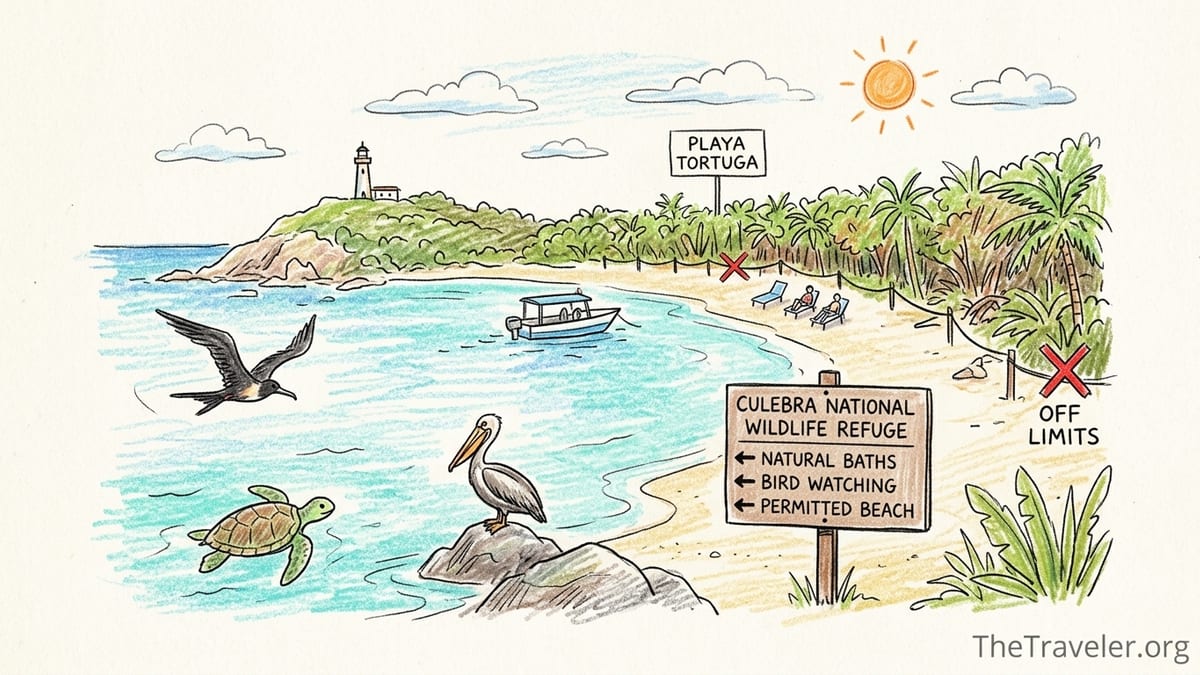
Understanding Culebrita’s Reality: A Refuge First, Beach Day Second
Culebrita is not a typical beach park. It is part of the Culebra National Wildlife Refuge, managed by the U.S. Fish and Wildlife Service as nesting and foraging habitat for seabirds, sea turtles, and endangered corals. Access is by boat only and visitors are generally funneled to a small set of beaches, most notably Playa Tortuga, with other refuge areas off limits without specific authorization because of ecological sensitivity and, in some cases, old military ordnance. In practical terms, that means your day is less about “conquering” the island and more about slowing down in a few permitted zones.
For most travelers already on Culebra, reaching Culebrita involves a 15 to 25 minute ride by licensed water taxi or small charter from Dewey, with boats such as H2O Water Taxi or similar local operators running on-demand or scheduled half day outings. Recent pricing examples during summer 2026 show basic round trip water taxis from around 30 US dollars per person for a simple drop off and pickup, while more hosted five hour excursions with shade, coolers, and gear can run close to 100 US dollars per person. These are reference points, not guarantees, and you should always confirm the current rate when you book.
The refuge rules shape everything you do once you arrive. Official materials emphasize beach-related recreation confined to certain sandy areas and explicitly note that other parts of the refuge require authorization to enter due to sensitive wildlife and the possibility of unexploded ordnance. That framework is why independent guides consistently describe a Culebrita day in terms of a few core experiences: time on Playa Tortuga, gentle snorkeling in the bay or just outside it when conditions are right, exploring tidal pools and natural rock baths, short walks along signed paths, and simply sitting still while pelicans, frigatebirds, and sea turtles do their thing offshore.
It is also important to understand that management decisions can change your plan entirely. In recent years, the refuge has announced temporary full closures of Culebrita during specific months for restoration work and invasive species removal. These closures are usually publicized in advance but they are a reminder that, when you plan a trip for a specific date, you should check for up to date refuge notices and be prepared for your operator to redirect you to another cay if access is suspended or sea conditions are deemed unsafe for landing.
Playa Tortuga: The Center of a One Day Visit
Playa Tortuga is the star of almost every Culebrita story for a reason. Boats from Culebra typically anchor in its calm, horseshoe shaped bay, and, for many hours, that beach becomes the entire stage on which your visit plays out. On my own day trip, the captain laid out a simple schedule: roughly four and a half hours on the island, with the first ten minutes devoted to unloading beach chairs and coolers before wading the last few steps to shore. Realistically, I recommend planning to spend at least three solid hours anchored in and around Playa Tortuga if you have a five hour outing.
The first hour disappeared almost instantly. Between getting oriented, securing a shaded spot back from the vegetation, applying reef safe sunscreen, and taking the first exploratory swim along the inside of the bay, you are suddenly 60 minutes closer to departure. This is the time to learn the lay of the land. On busier days there may be multiple boats stern anchored in the bay, but there are still big patches of open sand where you can spread out a towel and settle in. It is important to keep umbrellas and chairs off the dune vegetation, both for erosion control and to avoid areas where turtles may nest higher on the beach.
For the middle stretch of the day, Playa Tortuga becomes your base camp between swims, short walks, and possible forays to the tidal pools. This is when I found it most rewarding simply to slow down and watch the wildlife that the refuge was created to protect. Brown pelicans cruised low and occasionally plunged into the bay; small groups of frigatebirds circled overhead, and I twice spotted the blunt head of a green sea turtle breaking the surface in the deeper center of the bay. A good pair of polarized sunglasses does more for this kind of wildlife watching than almost any other piece of gear you can bring.
By the final hour, everyone on the beach seemed to converge again near the boats. The captain reminded us that there are no facilities on Culebrita: no restrooms, no freshwater, no snack kiosks. Once you leave the boat in the morning you are on your own supplies for the day. Operators differ in how much they provide, but reviews from 2025 and 2026 consistently stress the same point: plan your food, water, and bathroom strategy as if you were visiting a completely undeveloped backcountry beach, because in practice that is exactly what Playa Tortuga still is.
Swimming in the Bay: Calm Looks Can Be Deceiving
From shore, Playa Tortuga usually looks like a protected swimming pool: clear turquoise water, a sandy bottom, and waves that rarely appear intimidating on a normal trade wind day. Conditions can in fact be wonderfully gentle, especially in the morning before the wind builds, which is why most captains prefer early departures from Culebra for Culebrita runs. On my visit in late winter, the first hour of swimming was almost uniformly calm, with small waves that felt more like a hotel pool than an exposed Caribbean bay.
By late morning, the character of the water subtly changed. The breeze picked up, more boats arrived, and low, occasionally crossing swells made the outer half of the bay feel slightly more unruly. Even then it was still comfortable for confident swimmers, but newcomers and children tended to stay closer to the shore where the sand sloped very gradually. This pattern matches reports from other travelers: mornings usually offer the easiest conditions for relaxed, face in the water exploring, while the afternoon can bring chop and, during certain weather patterns, stronger currents outside the sheltered arc of the bay.
Because Culebrita is part of a wildlife refuge, there are no lifeguards. Boat crews are your de facto safety net, but they are also managing anchors, gear, and timetables, so risk management is primarily your responsibility. On my boat, the crew explicitly discouraged guests from swimming out of the bay entrance or around the outer rocky points, especially on days when the National Weather Service had posted rip current statements for the region. It is worth checking those marine forecasts yourself the evening before and morning of your trip, since high swell from distant storms can make the entrance of the bay significantly more dynamic even when the sand at your feet feels placid.
In terms of time allocation, I found that a relaxed visitor could easily spend an hour and a half across the day doing nothing more complicated than alternating between floating in waist deep water, wading along the shoreline, and taking occasional deeper dips out to chest or shoulder depth. While some guests attempted longer swims along the curve of the bay, many quickly realized that the sun, lack of shade in the water, and the cumulative tiredness of a travel day make two or three shorter swims far more enjoyable than one ambitious lap of the entire cove.
Snorkeling: Modest Reefs and Shifting Visibility
Snorkeling is often promoted as a highlight of Culebrita, but expectations should be calibrated. Playa Tortuga does offer patches of coral, sea grass, and rocky structure that hold fish, but this is not a remote barrier reef or an offshore wall. Independent guides who run daily snorkel outings describe Culebrita’s underwater scenery as pleasant, especially along the edges of the bay and near some of the rocky spurs, but not dramatically richer than several spots on Culebra itself. On my trip, the most interesting life appeared along the transition from sand to rock where small parrotfish, damselfish, and the occasional barracuda cruised the drop off.
Conditions also vary noticeably day to day. After a spell of calm weather, visibility in the bay can stretch far enough that you can easily see the sandy ripples and sea grass beds several meters below, making it ideal for beginners who are more interested in comfort than variety. After stronger winds or swell, fine sand and broken seagrass cloud the water, reducing how far you can see and making colors appear muted. Boat captains know these patterns well; on the day I went, ours warned us that “this week is better for the beach than for the snorkeling” due to several windy days in a row stirring up the underwater view.
Because of that variability, I would assign snorkeling perhaps one concentrated hour of your total time on Culebrita, spread across two or three short sessions. This feels like enough to explore both sides of the bay, check out the rocks near one of the points where fish congregate, and then decide whether you want to invest any more energy. Compared with some marketing photos, the real underwater experience can feel understated, but it pairs nicely with the overall slow rhythm of the day and is particularly good for travelers who want to practice using gear purchased at home before venturing into more complex sites.
It is also crucial to follow refuge friendly snorkeling etiquette. Operators increasingly emphasize the importance of not standing on coral heads, not chasing turtles, and keeping a comfortable distance from rays and schools of fish. Even a single careless fin kick on a fragile coral can undo years of slow growth. In a place where conservation is the explicit purpose of the refuge designation, treating the underwater landscape as a living museum that you pass through lightly, rather than a playground to touch and rearrange, is a key part of being a responsible guest.
Walking and Wildlife Watching in Permitted Areas
Once you leave the sand and waterline, Culebrita becomes more complicated. Because of the combination of sensitive habitats and its history as a former military training area, many parts of the island are not open to casual wandering. Official refuge materials describe the sandy beaches as the primary recreation zones, while other parts of the refuge require explicit authorization for access. Practically, this means that your walking options may be limited to short, well trodden paths behind Playa Tortuga or along the edges of the beach toward low headlands where you can gain a slightly higher vantage point.
On my visit, the captain made this very clear at the start. He pointed out the directional cues that local guides use: if the path looks newly worn but unmarked, or pushes into dense vegetation away from the beach, he preferred that guests avoid it unless accompanied by crew who knew that specific route. The focus instead was on a brief 20 to 30 minute stroll up a sandy, partially shaded track that rose behind the bay to a low ridge with expansive views of Culebra and the smaller cays scattered offshore. Even this modest walk felt surprisingly satisfying, especially when combined with pauses to spot birds.
Wildlife watching on Culebrita rarely requires binoculars, although a compact pair can reveal significantly more detail. Perched along the rocky points at the mouth of Playa Tortuga, I saw clusters of brown boobies and pelicans resting between fishing runs. Magnificent frigatebirds drifted overhead, barely moving their wings. In late winter and early spring, turtle activity in nearby waters tends to increase, and captains sometimes report seeing multiple green turtles surfacing over the course of a single swim period. Staying still on the sand for twenty minutes often produced more sightings than active walking, a reminder that “doing nothing” in a wildlife refuge can be one of the most rewarding choices.
In terms of time, I would allocate perhaps 45 minutes to one hour total for all walking and deliberate wildlife watching on Culebrita during a standard half day window. This includes a slow exploratory stroll behind Playa Tortuga if permitted that day, as well as bouts of sitting or standing quietly near the ends of the beach where seabirds tend to fly closest to shore. Attempting to circuit the island or push into unsigned interior paths does not fit the current refuge philosophy and can quickly lead you out of permitted areas or into terrain where footing, erosion, and habitat damage become real concerns.
Las Jacuzzis: When Sea Conditions Make the Natural Pools Possible
Las Jacuzzis are the famous natural rock pools on Culebrita where waves filter through gaps in the shoreline and create bubbling, spa like basins. In photographs and videos, they look like the obvious “must do” activity. In reality, both captains and refuge minded guides treat them as strictly conditional. On days with energetic swell or confused seas, safe access to the pools may be impossible, particularly for younger children or anyone not sure-footed on uneven volcanic rock. On my trip, the decision to attempt Las Jacuzzis was not made until we were already at anchor and the crew could see how the waves were breaking along that part of the coast.
Conditions that morning were marginal but acceptable. The captain observed the sets for a while, then gathered those of us interested and gave a clear safety talk: go in small groups, wear proper footwear with grip, carry nothing in your hands so you can use them for balance, and be prepared to back off entirely if the water looked too energetic on arrival. The walk from Playa Tortuga to the pools took around 15 to 20 minutes at an easy pace, including a short scramble over smooth, sloping rock. Even under those relatively favorable conditions, several people in our group decided to stop short and simply watch from a safer, higher vantage point.
Once at the pools, the gap between marketing image and reality became clear. Some basins were inviting and gently aerated by small waves spilling in. Others were repeatedly pounded by larger sets that sent whitewater foaming across the rocks. Our guide recommended that only confident adults and strong teen swimmers enter the most active pools and that everyone stay well back from any edge facing open ocean. At least one guest chose not to enter the water at all, content with photographs and the experience of simply being in such an exposed, raw corner of the island.
The return walk, combined with time spent evaluating and enjoying the pools, consumed almost exactly one and a half hours of our four and a half on the island. That is a significant chunk of a short day. If the sea had been rougher, the captain would have simply canceled that part of the outing and we would have spent those ninety minutes in and around Playa Tortuga instead. This is perhaps the key lesson about Las Jacuzzis: they are an optional bonus experience entirely at the mercy of the ocean and your operator’s judgment, not a guaranteed inclusion in a Culebrita itinerary, no matter what social media captions might imply.
Lighthouse Access and Other Experiences That May Not Happen
Older guidebooks and blogs often describe a hike up to the historic Culebrita lighthouse as a highlight of the island, but current guidance from refuge managers and operators frames it very differently. Over the years, structural decay, vandalism, and safety concerns have significantly changed how visitors are allowed to interact with the site. While the lighthouse still stands as a landmark visible from offshore and from some higher points on the island, access rules can be strict, focusing on safety and the protection of cultural resources.
On my own day trip, the lighthouse was discussed briefly by the captain during the orientation talk but clearly not offered as an activity. The combination of limited time, refuge priorities, and the state of the structure meant that our group remained focused on the beaches, limited paths, and intertidal features. This matched the instructions several operators had given me ahead of time when I asked: treat any possibility of walking near the lighthouse as a rare bonus that depends on current regulations, safety assessments, and the specific route your authorized guide is allowed to use at that moment.
The weather also quietly cancels more ambitions than you might expect. In the weeks surrounding my visit, local reports described multiple tours that skipped either Las Jacuzzis or certain walking routes because of heavy swell, rain squalls, or strong trade winds pushing high surf into the more exposed corners of the island. The same storm system that makes a mainland surfing video go viral often translates into red flag conditions on offshore cays where there are no lifeguards, no shelters, and only narrow windows of safe landing and departure.
All of this underscores why a one day Culebrita experience should be planned around what is almost always available within refuge rules: time on Playa Tortuga, simple swimming, modest snorkeling, and quiet wildlife observation. Anything beyond that is best understood as weather and regulation dependent. Building your expectations around that small but rich core set of experiences helps prevent disappointment when a captain, quite responsibly, announces that a much hyped hike or pool session will not be happening on your particular day.
The Takeaway
After one concentrated day on Culebrita, what stood out was not a checklist of attractions but the depth found in a very small number of experiences. Playa Tortuga carried most of the weight, offering a beautiful, undeveloped bay where hours of swimming, strolling, and watching birds and turtles never felt repetitive. Snorkeling provided pleasant, if modest, glimpses of underwater life, while a short, permitted walk behind the beach delivered spacious views and a sense of the island’s shape without intruding into more sensitive refuge zones.
Las Jacuzzis, when sea conditions and guide judgment align, can be a memorable side trip that adds drama and a dose of controlled adventure to the day. When they are off the table due to swell, the core of the experience scarcely suffers. Instead, your time simply redistributes into more relaxed swimming, more noticing of wildlife, and more appreciation of how rare it is in the Caribbean to spend a full day on an island with no bars, no paved roads, and no permanent residents.
The limits imposed by the wildlife refuge context also turned out to be a gift. By narrowing the menu of options to a handful of permitted activities, Culebrita encourages a style of travel that lingers rather than samples. To make the most of it, design your day around those simple pillars, respect any closures or captain’s calls without argument, and arrive with the mindset that you are entering a protected space first and a tropical photo backdrop second. Within that frame, one carefully spent day on Culebrita feels not small at all, but surprisingly complete.
FAQ
Q1. How long do I really need on Culebrita for it to feel worthwhile?
Most visitors find that four to five hours on the island, not counting boat travel from Culebra, is enough to enjoy Playa Tortuga, do some swimming and snorkeling, take a short permitted walk, and, if conditions allow, visit Las Jacuzzis without feeling rushed.
Q2. How much does it cost to reach Culebrita from Culebra?
Recent examples from 2026 show simple round trip water taxis starting around 30 US dollars per person, with more hosted excursions that include shade, drinks, and gear approaching 100 US dollars per person for a half day outing, though you should always verify current prices when booking.
Q3. Is snorkeling at Culebrita better than on the main island of Culebra?
Snorkeling at Playa Tortuga offers pleasant patches of coral, sea grass, and rocky areas with fish, but many guides consider it roughly comparable in quality to easier sites on Culebra rather than dramatically superior, so it is best viewed as a nice bonus to the beach day rather than the sole reason to go.
Q4. Are Las Jacuzzis always included on Culebrita tours?
No, access to the natural pools is entirely dependent on sea conditions, tides, and guide judgment on the day of your visit, so captains sometimes cancel that portion of the itinerary if waves are breaking too hard on the rocks or if they feel conditions are not safe for the group.
Q5. Can I hike freely around Culebrita or up to the lighthouse on my own?
Culebrita lies within the Culebra National Wildlife Refuge, which restricts access to many interior areas and treats the sandy beaches as the primary recreation zones, so you should assume that only short, obvious paths from Playa Tortuga and any routes specifically cleared by your guide are appropriate for visitors, with lighthouse access dependent on current safety and management rules.
Q6. Are there bathrooms, food stands, or freshwater on Culebrita?
No, there are no permanent facilities on the island, so you must arrive with all the drinking water, snacks or meals, and sun protection you will need, and plan bathroom breaks around the fact that your boat and the beach are your only options for the duration of the visit.
Q7. What is the best time of day to visit Culebrita for calmer water?
Morning departures from Culebra usually offer the calmest seas both for the boat crossing and for swimming or snorkeling inside Playa Tortuga, since wind and chop often increase through the afternoon, so many operators prefer to start earlier to maximize the gentlest conditions.
Q8. Is Culebrita suitable for young children or less confident swimmers?
The shallow, gently sloping sand at Playa Tortuga can be comfortable for families, but the lack of lifeguards, absence of shade structures, and possibility that Las Jacuzzis or longer walks will be off limits mean that parents should discuss conditions and expectations carefully with their captain and be prepared to keep activities close to shore.
Q9. How do weather and refuge closures affect Culebrita visits?
High winds, strong swell, or official refuge management decisions can temporarily close the island or make landing unsafe, in which case operators may reroute you to another cay or cancel the excursion, so it is wise to check marine forecasts, ask your operator about contingency plans, and remain flexible when scheduling.
Q10. What should I prioritize if I only get a short window on Culebrita?
If your time is limited, focus on Playa Tortuga itself: choose a shaded spot, enjoy at least one unhurried swim, take a short permitted walk for views if offered, and devote a few quiet stretches to watching birds and turtles, treating Las Jacuzzis and any additional hikes as optional extras only if conditions and timing clearly allow.