

Cabo da Roca is a place that feels like the edge of the world. The wind tastes of salt, the Atlantic pounds the cliffs hundreds of feet below and the lighthouse beam still sweeps across an ocean that once carried caravels toward uncharted maps.
As the westernmost point of mainland Europe, this headland in Sintra-Cascais Natural Park is celebrated less for beach lounging and more for vast horizons, raw cliffs and some of the most dramatic coastal views in Portugal.
With new access rules, bus routes and parking systems introduced in recent years, it is worth planning carefully so that you can focus on what matters most here: watching sea, sky and stone merge into a single unforgettable panorama.
Cabo da Roca at a Glance: Setting, Access and Orientation
Cabo da Roca lies on the Atlantic coast between Lisbon and Cascais, forming the western tip of the Sintra mountain range. The cliffs rise up to around 140 meters above the sea, offering sweeping views of the coastline north and south, including glimpses of remote coves such as Praia da Ursa. The site sits inside Sintra-Cascais Natural Park, a protected area where authorities periodically impose access restrictions to certain roads or trails due to fire risk, storms or erosion. These measures are subject to change and are meant to protect both visitors and fragile cliff ecosystems, so travelers should expect occasional detours or temporary closures, especially in summer and during periods of strong wind or heavy rain.
Most visitors combine Cabo da Roca with a wider circuit of Sintra or Cascais. Public transport connections are straightforward: regular buses link Sintra and Cascais to Cabo da Roca, typically taking 30 to 40 minutes depending on the route and time of day. For many travelers who arrive at Sintra by train from Lisbon, the bus to Cabo da Roca offers a convenient onward link and avoids driving restrictions now enforced in upper Sintra. Those arriving by taxi or ride share from Lisbon usually reach the cape in under an hour in normal traffic, with costs varying according to demand, time of day and season.
Arriving by private car is still possible but more structured than in the past. In response to rising visitor numbers, authorities and local councils have gradually eliminated informal roadside parking and introduced designated lots near the lighthouse and visitor facilities. In peak periods drivers should expect to pay hourly fees and may find spaces limited after mid morning. As in much of the Sintra area, there are also temporary restrictions when conditions are dangerous, such as high fire risk or storm warnings. Checking the latest guidance from local tourism information before setting out is prudent, particularly in summer and during winter Atlantic weather fronts.
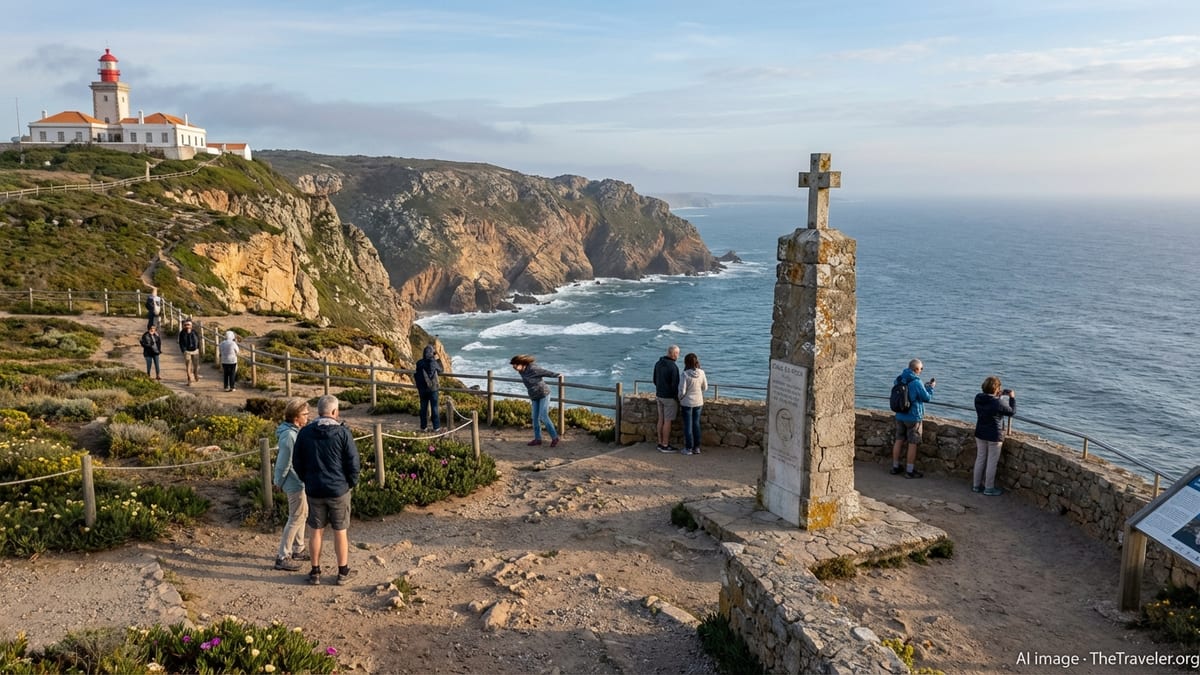
Despite these evolving logistics, the on site layout is simple. A main parking and bus area sits just inland from the cape. From there a short walk leads to the stone monument marking Cabo da Roca as the westernmost point, surrounded by low walls and railings overlooking the cliffs. The lighthouse complex occupies the slightly higher ground to the south, while informal coastal paths extend along the cliff tops in both directions. This compact arrangement means that even visitors with only a brief stop can experience some of the landmark views without strenuous hiking.
The Classic View: Westernmost Point Monument and Main Cliff Overlook
The central draw at Cabo da Roca is the lookout near the stone pillar inscribed with the latitude and longitude of the cape. From this vantage point the land simply drops away into the Atlantic, leaving nothing but wind, sky and sea. On clear days the views stretch far up the coast, with wave lines tracing the base of jagged headlands toward Praia da Adraga and beyond. The ocean dominates the scene, but close observation reveals intricate patterns on the cliff faces, where layers of rock have been twisted and broken over millions of years.
For many travelers this is their first encounter with the Atlantic in Portugal, and the scale of the vistas can be surprising. The sea here is rarely calm. Swells roll in from the open ocean, creating streaks of foam that give a sense of the height of the cliffs. The winds can be fierce at any time of year, especially in the afternoon, and temperatures feel several degrees cooler than in sheltered inland Sintra or Lisbon. Even in midsummer it is wise to bring an extra layer, and in winter a windproof jacket can mean the difference between a bracing visit and a rushed retreat to the car park.
The main viewpoint area is partially fenced with railings and low stone walls, but the edges beyond are unprotected. Over the years, erosion has undercut sections of the cliff top, and there have been accidents involving visitors venturing too close to unstable overhangs. Current safety messaging from local authorities and tour operators emphasizes staying inside marked areas, especially when taking photographs. The combination of strong gusts, loose gravel and distraction from dramatic scenery makes these cliffs unforgiving of missteps.
Photography from the central terrace is straightforward. Morning light often works well on the ocean surface and southern cliffs, while late afternoon and sunset can produce vivid colors and silhouettes. The sun sets over the Atlantic for much of the year, although in winter it shifts southward, sometimes dipping behind cloud banks before reaching the sea. On hazy days the horizon can blur into a band of light, giving the scene a softer, more atmospheric quality that suits longer exposures and wide angle compositions.
The Lighthouse Perspective: History, Grounds and Coastal Angles
Cabo da Roca Lighthouse stands on a slightly elevated plateau just south of the main monument. First lit in the 18th century and modernized several times since, it remains an active navigation aid, its red lantern and white tower a familiar symbol in photographs of the cape. While the interior is generally not open to the public except on specific heritage days, the surrounding grounds and access roads offer distinct perspectives on both the building itself and the surrounding coastline.
Walking around the perimeter roads near the lighthouse, visitors gain a sense of how exposed this promontory is. Low, salt burned vegetation clings to the rock, and there are few substantial trees to break the wind. This openness, however, is what makes the views so appealing. To the north the cliffs step away toward Praia da Ursa, their outlines sharpening as the late light picks out ridges and gullies. To the south, gentler slopes tumble down toward Guincho and Cascais, with the ocean gradually broadening into the horizon.
For photographers, the lighthouse offers scale and narrative. Wide frames that include the tower, keeper’s buildings and the drop to the sea can suggest the human effort required to guard ships from this coast. Telephoto views isolate architectural details, from weathered stone to signal equipment, against the blue of the Atlantic or the glow of evening sky. In stormy conditions, when cloud shelves race overhead and whitecaps multiply below, the scene can feel particularly dramatic, although visitors should watch forecasts closely and avoid cliffside paths in heavy weather.
Recent parking changes around the lighthouse have slightly altered how people move through this area. Newer pay to park zones confine cars to specific lots, leaving more of the immediate surroundings free of vehicles. While this may mean a longer walk to reach certain angles, it also improves the sense of isolation and uninterrupted views. It is worth taking time to explore side paths and viewpoints away from the busiest photo spots, where low walls and natural rises in the land create quieter corners and fresh compositions.
Ocean Panoramas and Cliff Top Trails
Beyond the central terrace and lighthouse roads, Cabo da Roca invites exploration along informal cliff top paths. These routes range from short, level strolls to more demanding sections where the ground drops and rises sharply. They reward curiosity with perspectives that few visitors see from the main lookout, revealing hidden coves, sea stacks and long sequences of cliffs sculpted by Atlantic storms.
To the north of the monument area, paths follow the rim toward the faint outline of Praia da Ursa. Here, the coastline becomes more jagged, with deep inlets and channels where waves funnel and explode into spray. In spring the cliff tops are carpeted with wildflowers, their bright colors contrasting with dark rock and deep blue water. In summer the vegetation dries and browns, but the sea remains strikingly clear on calm days, showing bands of turquoise over submerged reefs.
While these trails offer some of the finest views at Cabo da Roca, they also require care. The soil is often dry and sandy, and sections of path run close to steep drop offs where erosion may not be obvious from above. There are few formal signs or railings once you leave the central viewing platform. Local hiking guides and experienced visitors strongly recommend sturdy footwear, avoiding the very edge of the cliffs and keeping a safe distance from any overhangs that may be undercut from below. Parents should keep young children within arm’s reach, and everyone should be prepared to turn back if winds increase.
Timing matters for these walks. Early morning often brings calmer conditions and softer light, particularly in the shoulder seasons of spring and autumn. Midday can be bright and harsh, but the clarity is ideal for long range views and for appreciating the color shifts in the water. Late afternoon into sunset draws many visitors seeking golden light on the cliffs, yet the combination of crowds and fading visibility makes it even more important to stay within established paths. Regardless of the hour, travelers should bring water, sun protection and layers, as there are no shaded rest areas along the cliffs themselves.
Praia da Ursa Views: From Overlooks to the Beach Itself
One of the most remarkable viewpoints near Cabo da Roca is not on the cape itself but on the trail leading down to Praia da Ursa, a secluded beach framed by towering sea stacks. The beach is reachable only on foot via steep, sometimes slippery paths, but there are several elevated outlooks along the approach that provide classic postcard views of the cove without requiring the full descent. These vantage points show Ursa’s distinctive rock formations rising from the surf, backed by sheer cliffs that catch the last light before sunset.
There are two principal routes to Ursa from the road system near Cabo da Roca. One follows a more winding, scenic line that zigzags down the cliff, offering multiple chances to stop and gaze at the beach from different heights. The other is more direct, dropping more quickly and generally favored by those focused on reaching the sand. Both take around twenty minutes for experienced hikers, although conditions such as mud after rain or loose sand can slow progress. Above the steepest parts, hikers reach a natural balcony where the entirety of Praia da Ursa opens below, making this an ideal turnaround point for visitors who want the view without committing to the scramble.
For those who continue to the shore, the rewards are substantial. From beach level the cliffs tower overhead, and the sea stacks become sculptural monoliths, their shapes altered by angle and tide. The sense of remoteness is striking, especially outside peak summer weekends when fewer people make the effort to come down. However, the descent and the return climb are demanding. Parts of the path require three point contact on rock or the use of fixed ropes that local hikers have added for support. Reports from recent seasons consistently stress the importance of good shoes, caution on wet or sandy surfaces and respect for personal limits, particularly on the way back up when legs are tired.
Swimming at Praia da Ursa is generally not recommended due to frequent strong currents, powerful shore breaks and the absence of lifeguard services. Visitors can paddle at the edge in calm conditions but should avoid going beyond waist depth and should never turn their back on incoming waves. The beach is best appreciated as a place for photography, tide pooling at low water and simple contemplation of one of Portugal’s wildest coastal landscapes. Most travelers find that the elevated viewpoints on the upper trail provide the most photogenic angles, especially in late afternoon when the sun drops behind or beside the sea stacks.
Weather, Seasons and Safety Considerations
Weather at Cabo da Roca is strongly influenced by the Atlantic and can differ markedly from conditions just a short drive inland. Even on hot days in Lisbon, the cape may be cool, foggy or extremely windy. Spring and autumn are often considered the most pleasant times to visit, with moderate temperatures, longer daylight hours and relatively stable conditions. In these shoulder seasons, morning mists sometimes lift to reveal crisp blue skies, and the low sun angles intensify colors on the cliffs and water throughout the day.
Summer brings longer days and a higher probability of clear skies, but also larger crowds and more intense midday sunshine. Despite the cooling effect of the wind, ultraviolet exposure remains high, and the lack of shade near the viewpoints can quickly lead to sunburn or heat stress for unprepared visitors. Carrying water, wearing a hat and using sunscreen are essential, especially for those planning to walk the cliff top routes or descend toward Praia da Ursa. The cape can also experience strong afternoon winds in summer, which increase the risk around exposed cliff edges and can make tripod based photography challenging.
Winter conditions at Cabo da Roca are mixed. Many days are mild and clear, offering luminous light and small visitor numbers. At other times, Atlantic systems bring heavy rain, low cloud and powerful swells that crash into the base of the cliffs. While such storms are impressive from a distance, they make coastal hiking risky, particularly where paths cross gullies or lead near overhangs that may be undercut by wave action. Visitors should avoid cliffside walks during or immediately after intense storms and be prepared for trails to become muddy and slippery for days afterwards, especially on the north facing slopes toward Ursa.
In recent years local authorities and tour operators have emphasized a safety culture based on preparation and common sense. That includes staying within designated viewing areas in the main monument zone, avoiding shortcuts off established trails, keeping children close and never stepping over railings for photographs. The park’s protected status also means visitors are expected to leave no trace: carrying out all litter, not disturbing vegetation and refraining from building rock stacks or carving into surfaces. Drones are heavily regulated within Sintra-Cascais Natural Park, and travelers considering aerial photography should check current aviation and park rules, as unauthorized flights may incur fines and can disturb nesting seabirds.
Planning Your Visit: Transport, Crowds and Amenities
Practical planning can greatly improve the experience of Cabo da Roca’s viewpoints. The timing of your arrival is one of the most important choices. Early morning visits often provide quieter conditions, easier parking and a more contemplative atmosphere, especially outside high summer. Midday brings tour buses and larger groups, particularly in peak season, while late afternoon and sunset hours are popular with independent travelers and photographers. Allowing enough time before sunset to walk back to parking areas or bus stops in full light is wise, as coastal paths are poorly lit and can be confusing in darkness or fog.
Public buses from Sintra and Cascais remain a sensible option for many visitors. They avoid the stress of finding parking and navigating periodic road restrictions that now apply throughout the Sintra area. Timetables vary across the year, with more frequent services in summer than in winter. Travelers should check schedules close to their travel date and pay attention to the timing of the last return services to avoid being stranded after dark. For those coming from Lisbon who prefer not to drive, a combination of train to Sintra or Cascais and bus to Cabo da Roca works well and keeps the focus firmly on the scenery rather than the road.
Facilities at the cape are modest but adequate for short stays. There is typically a small tourist office or kiosk, basic restrooms and at least one café or snack outlet near the main parking area, though hours and offerings can vary by season and day of the week. There are no services along the cliff top trails or at Praia da Ursa, and no lifeguards at the nearby wild beaches, so visitors heading away from the central viewpoint should bring all water, snacks and any personal medication they may need.
Because Cabo da Roca sits within a protected natural park, visitors should also be prepared for unexpected access changes. Local authorities may temporarily close particular trails, lookout points or even the access road in the event of high fire risk, landslides or severe storms. Tour operators that specialize in Sintra and coastal excursions often adjust their routes on short notice when such closures occur. Independent travelers should check local news, visitor center updates or their accommodation hosts for the latest information before setting out, especially in high summer and during periods of extreme weather.
The Takeaway
Cabo da Roca is not a subtle landscape. It is a place of sweeping gestures: cliffs that plunge without warning, winds that arrive in sudden gusts, waves that flash white against rock and then vanish into deep blue. Within this drama, however, are countless quieter details. The faded paint on the lighthouse walls, the texture of lichen on the stones, the small paths that twist between shrubs to reveal new fragments of coastline. Together these elements make the cape more than a single famous viewpoint and turn it into a layered destination where each turn of the head offers a fresh composition.
The best views at Cabo da Roca are not confined to one platform or signposted lookout. They unfold as you walk: from the official westernmost point monument, around the lighthouse precincts, along the undulating cliff top paths and out toward the overlooks of Praia da Ursa. Each vantage point brings a different balance of ocean, sky and land, whether you are watching a calm morning horizon, a blazing summer sunset or winter storm light breaking through cloud. With thoughtful preparation, respect for the elements and an unhurried schedule, travelers can experience Cabo da Roca not just as a tick box on a coastal itinerary but as a place where Europe truly feels to end in rock and wind and sea.
FAQ
Q1. What is the best time of day to visit Cabo da Roca for views?
The most rewarding times are early morning and late afternoon into sunset, when the light is softer and colors on the cliffs and ocean are richer. Morning usually brings fewer crowds and calmer winds, while sunset can be spectacular but busier, so you should arrive early enough to find parking and walk the viewpoints in daylight.
Q2. Can I reach Cabo da Roca easily by public transport?
Yes. Regular buses connect Cabo da Roca with both Sintra and Cascais, typically taking around 30 to 40 minutes. Many travelers ride the train from Lisbon to Sintra or Cascais and continue by bus. It is important to check current timetables close to your visit and note the time of the last return service.
Q3. Is it safe to walk along the cliff top trails?
The main paths are widely used and generally safe for people who stay on established routes and keep clear of the edges. However, the cliffs are high, the ground can be loose or muddy and the wind is often strong. You should wear sturdy footwear, avoid venturing onto overhangs or informal shortcuts and keep children close at all times.
Q4. How difficult is the hike down to Praia da Ursa?
The hike is usually rated as moderate but includes steep, uneven sections where you may need to use hands for balance and in places rely on fixed ropes. It is manageable for fit visitors with good shoes and no serious mobility issues, but it can be challenging in wet or very dry, sandy conditions. Many people choose to stop at upper viewpoints that overlook the beach rather than descending all the way to the sand.
Q5. Are there lifeguards or swimming areas at Cabo da Roca and Praia da Ursa?
No. Cabo da Roca itself is a cliff top viewpoint with no direct beach access, and Praia da Ursa is a wild, unguarded beach. The Atlantic here is powerful, with frequent strong currents and heavy shore breaks. Swimming is not advised and, if you enter the water at all, you should stay very shallow and watch the waves closely.
Q6. Do I need to pay for parking at Cabo da Roca?
In recent seasons, parking near the lighthouse and main viewpoint has been moved into designated lots where fees are commonly charged during the day, especially in peak months. Charges and rules can change, so you should check signs on arrival and consider arriving early in the morning when spaces are more plentiful and conditions are calmer.
Q7. Is Cabo da Roca suitable for children and older travelers?
The main viewpoint area near the monument and lighthouse is accessible to most visitors, including families with children and older travelers, as long as they are comfortable with uneven ground and strong winds. The more demanding cliff top trails and the Praia da Ursa hike may not be suitable for very young children, people with vertigo or anyone with significant mobility issues.
Q8. Can I fly a drone at Cabo da Roca?
Cabo da Roca lies within Sintra-Cascais Natural Park and near sensitive coastal ecosystems, so drone use is heavily restricted. Pilots generally require formal authorization from aviation and park authorities, and recreational flights are often prohibited. Travelers should assume drones are not allowed unless they have obtained clear official permission before their visit.
Q9. What should I bring for a visit focused on the best views?
You should bring layers of clothing for wind and temperature changes, sturdy closed shoes, sunscreen, a hat, drinking water and any snacks you may want. For photography, a wide angle lens helps capture the breadth of the cliffs, while a telephoto lens is useful for compressing the lighthouse against the horizon or picking out details on distant headlands.
Q10. Can Cabo da Roca be visited on the same day as Sintra’s palaces or Cascais?
Yes. Many visitors combine Cabo da Roca with either a morning in Sintra’s historic center and palaces or an afternoon in Cascais. However, road and parking restrictions around Sintra mean you should plan routes carefully and allow generous time for bus or train connections. If you want to enjoy the cliff top views and perhaps the Praia da Ursa overlook without rushing, dedicating half a day to Cabo da Roca alone is ideal.