

More news on this day
British Airways passengers heading to or transiting through the Middle East are facing an unpredictable patchwork of cancellations, diverted routes and extended journey times as conflict-driven airspace closures ripple far beyond the region.
Get the latest news straight to your inbox!
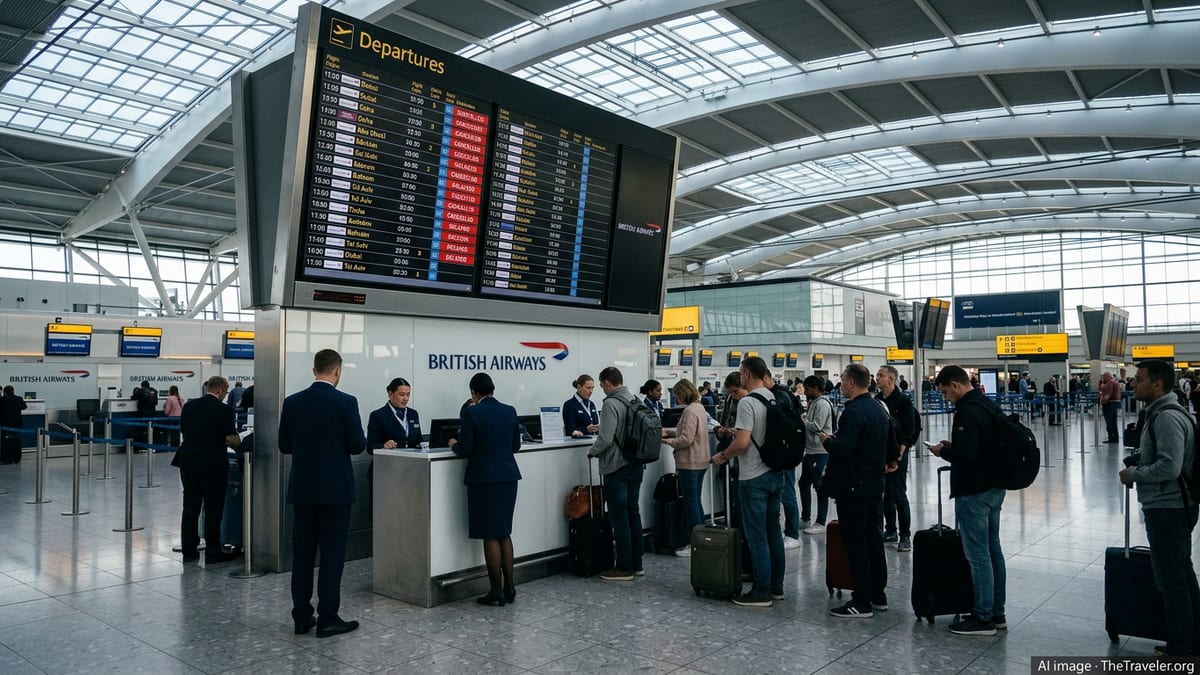
Rapid Escalation Leaves British Airways Schedules in Flux
British Airways has become one of the most heavily affected European carriers as the latest round of Middle East tensions has closed or restricted key airspace corridors over Iran, Iraq and parts of the Gulf. Publicly available industry reports show that the airline suspended its entire Gulf network on 8 March 2026, halting flights to Abu Dhabi, Bahrain, Doha, Dubai and Tel Aviv for at least a week while it reassessed route safety and operational viability.
Data compiled by aviation analysts indicates that the decision came after United States and Israeli strikes on Iran at the end of February, which triggered a cascading series of airspace closures and military risk notices. Schedules that were already constrained by a long running suspension of services to Israel have now been further disrupted, leaving British Airways with far fewer options to operate its normal pattern of services between London, the Gulf and onward destinations in Asia and Africa.
According to airline schedule trackers, more than twenty three thousand flights across the Middle East have been cancelled since 28 February, affecting millions of seats on routes that include some of British Airways’ busiest long haul corridors. While some rival carriers have begun to restore limited services using lengthy detours, British Airways is moving more cautiously, keeping many flights grounded and rerouting others via alternative hubs such as Cyprus or Turkey.
For travellers, the result is a constantly shifting timetable where flights may appear on sale, then disappear or be retimed at short notice. Passengers with fixed travel dates in early and mid March are among the hardest hit, as the airline prioritises safety assessments and regulatory compliance over maintaining published schedules.
Tel Aviv and Israel Services Remain Exceptionally Volatile
British Airways flights to Tel Aviv have been disrupted repeatedly since the outbreak of the Gaza conflict in October 2023. The carrier initially suspended services later that month after a series of security incidents, then extended the suspension multiple times into 2024 and 2025 as the situation deteriorated and regional tensions widened.
Industry coverage details how the airline pushed back its planned return to Israel several times, with interruptions linked to missile and drone attacks, including strikes targeting the vicinity of Ben Gurion Airport and a widely reported attack on the airport in May 2025. A brief resumption of service in April 2025 was quickly reversed when new threats emerged, leading British Airways to prolong its suspension through much of that year.
Although some reports suggest that British Airways and partner carriers have mapped out future dates for a gradual restoration of Tel Aviv flights, these plans are explicitly described as conditional on security assessments and regulatory guidance. Each new spike in regional tension, including the most recent confrontation involving Iran, has forced further reviews, highlighting just how fragile any timetable for full reinstatement remains.
For travellers, this means that tickets to or from Tel Aviv on British Airways are likely to remain subject to change, cancellation or rebooking for many months. Those who still choose to travel to Israel are being advised by consumer advocates and travel agents to maintain flexible itineraries, avoid tight connections and monitor both airline updates and official travel advice closely.
Knock-On Effects for Asia, Africa and Beyond
The turbulence in Middle Eastern airspace is not only affecting point to point routes. British Airways also relies heavily on air corridors over the region for flights linking London with destinations in India, Southeast Asia and parts of East Africa. With Iranian and Iraqi airspace either closed or restricted, many of these services now require extensive detours around the conflict zone.
Aviation route analysis indicates that some long haul flights are being re-routed via more southerly tracks over the Arabian Sea or northwards over Turkey and the Caucasus, adding three to five hours of flying time in some cases. This has implications for crew duty limits, aircraft availability and connection windows at Heathrow, which in turn can lead to retimed departures, missed onward flights and congestion in key terminals.
Passengers travelling between the United Kingdom and destinations such as Mumbai, Bangkok or Singapore may not immediately realise that their journeys depend on the stability of Middle Eastern airspace. However, published operational updates from airlines and air navigation providers underline that the loss of the traditional East West corridor over the Gulf puts pressure on remaining routes and can cause knock on disruption far from the conflict itself.
Even where flights are operating, travellers are reporting longer block times, tighter connections and an increased risk of baggage delays, particularly for itineraries that rely on quick transfers at Heathrow. Travel experts point out that this adds another layer of uncertainty to trips that might already involve complex arrangements, such as cruises, tours or business meetings in multiple countries.
Government Advisories and Safety Notices Shape Airline Decisions
The evolving security environment is being closely monitored by governments and aviation regulators, whose advisories significantly influence British Airways’ operations. Recent guidance from the United Kingdom government has urged nationals in several Middle Eastern states, including Bahrain, Israel, Kuwait, Lebanon, Palestine, Qatar and the United Arab Emirates, to register with consular services and to keep abreast of rapidly changing travel advice.
Parliamentary briefings and Foreign Office updates describe the situation across parts of the Middle East as highly volatile, with explicit references to recent military strikes and the possibility of further escalation. In parallel, the United Kingdom Civil Aviation Authority has issued emergency advisories cautioning against non essential travel to or through Gulf hubs until there is greater clarity on operational safety.
Airlines such as British Airways are required to factor these advisories into their risk calculations, along with information from international aviation bodies and real time data on missile activity, radar signals and air defence operations. While detailed security assessments are not made public, the broad direction of travel is visible in route suspensions, diversions and the continued absence of services to certain destinations.
For passengers, this intertwining of geopolitics and aviation safety means that flight status can change even when airports remain technically open. A route may be commercially viable and in demand, but if government guidance or insurer requirements tighten, carriers may pull back at short notice to avoid exposing passengers and crews to elevated risk.
What British Airways Passengers Can Expect in the Coming Weeks
Travellers booked with British Airways in March 2026 and beyond should prepare for an environment in which flexibility is essential. Industry reporting suggests that the airline is offering rebooking options, refunds or credit vouchers on affected Middle East routes, consistent with consumer protection frameworks such as European and United Kingdom regulations on lengthy delays and cancellations.
However, with thousands of passengers competing for limited alternative seats, the practical process of rebooking can be slow and frustrating. Travel agents and consumer groups recommend that passengers regularly check their booking status, use the airline’s online tools where possible and consider adjusting departure dates or routings to avoid the most heavily affected hubs.
Those planning new trips that would normally route through the Gulf may wish to explore itineraries via alternative regions, even if they are longer or more expensive. Some carriers have increased capacity on routes that bypass the Middle East, but seats can sell out quickly as demand shifts. Travellers connecting between Europe and Asia should also build in longer transfer times and avoid same day connections to cruises, rail journeys or important events.
Looking further ahead, analysts note that the resilience of global aviation networks has improved since the shocks of the early 2020s, but the current Middle East turmoil remains a stark reminder that geopolitical risk can reshape flight paths overnight. For British Airways customers, staying informed, booking with flexibility and monitoring developments closely will be key to navigating a period where the map of global air travel is being redrawn in real time.