


More news on this day
A new overnight rail link between Brussels and Malmö is scheduled to launch in April 2028, promising to stitch together the Benelux countries, northern Germany and Scandinavia with one of Europe’s most ambitious open-access night train routes.
Get the latest news straight to your inbox!
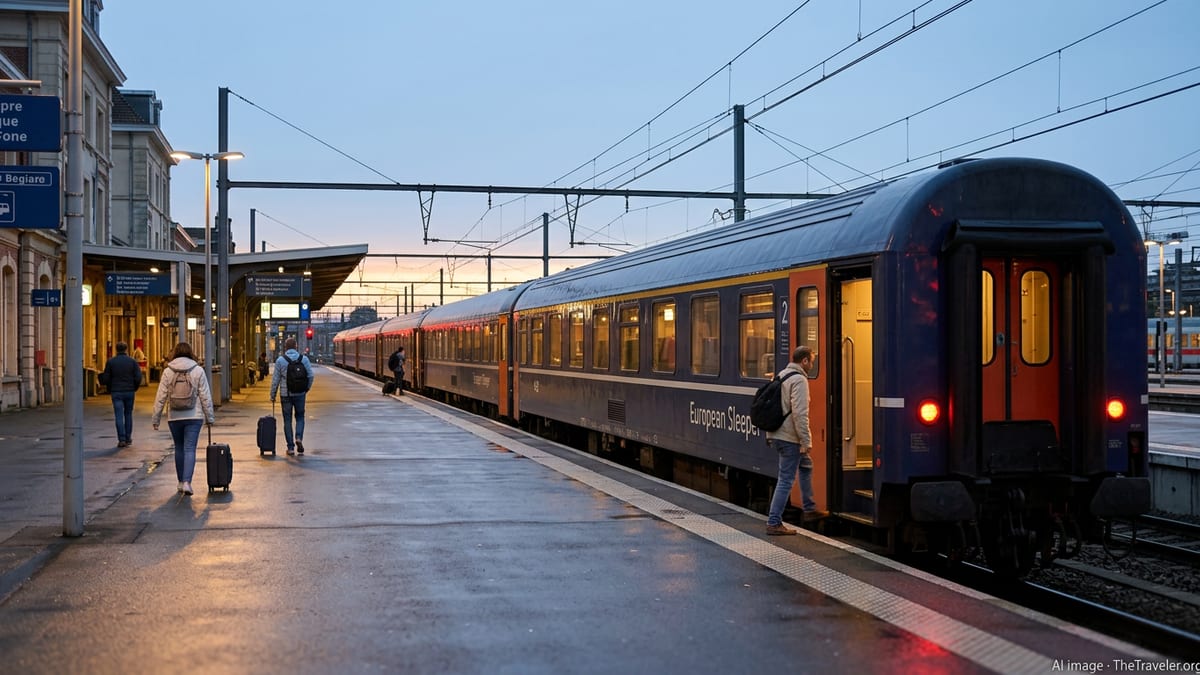
A Direct North–South Spine From Brussels to Scandinavia
Publicly available regulatory filings in Belgium and the Netherlands indicate that cooperative operator European Sleeper plans to start a Brussels–Malmö night train on 1 April 2028. The new service is described as an international-only connection between Brussels-South railway station and Malmö, routed via the Netherlands, Germany and Denmark.
Details published by the Belgian Regulatory Body for Railway Transport and Brussels Airport show that the train will operate as an open-access service, separate from state-supported domestic operations. The notification specifies that the link is conceived as a cross-border night train, targeting passengers traveling between Benelux cities and southern Scandinavia rather than short-haul commuters.
Additional information on European Sleeper’s own platforms presents the Brussels–Malmö line as an extension of its young but growing overnight network, which already includes routes such as Brussels–Prague, Paris–Berlin and a forthcoming Brussels–Milan train. The Malmö service is framed as the company’s first step into Scandinavia and part of a broader north–south corridor for night trains.
Route via Amsterdam, Copenhagen and the Øresund Corridor
According to service descriptions published by European Sleeper, the future train will connect Brussels, Antwerp, Rotterdam, The Hague and Amsterdam with Malmö, providing a one-seat ride from the Benelux region into southern Sweden. From the Netherlands, the route is expected to continue across Germany and Denmark before reaching Copenhagen and crossing the Øresund corridor into Malmö.
European Sleeper notes that the service is being jointly developed with German operator RDC, which will support operations along the German section of the line. Timetable work is under way with infrastructure managers along the corridor, ahead of a formal capacity application planned for April 2027. This step is required to secure suitable night-time train paths across several busy freight and passenger networks.
Preliminary plans outlined on company channels envisage departures three times per week from both Brussels and Malmö at around 19:00, with arrivals at approximately 10:00 the following morning. The schedule is being marketed as offering a full night’s rest while effectively replacing daytime flying or multi-leg daytime rail journeys between Benelux cities and southern Scandinavia.
Capacity, Rolling Stock and Regulatory Hurdles
Reports tracking the project underline that the Brussels–Malmö train faces similar challenges to other recent European night services: limited availability of modern sleeping-car rolling stock, complex cross-border approvals and competition for track capacity on heavily used corridors. Commentaries on the sector point to bottlenecks in Germany, Denmark and the Netherlands, where dense daytime traffic constrains the number of reliable overnight slots available.
European Sleeper has previously relied on refurbished coaches and partnerships with established operators to expand its network. Industry coverage suggests a comparable approach for the Scandinavian service, with RDC’s involvement expected to ease some operational and regulatory barriers in Germany. Nonetheless, the multi-country nature of the route requires coordination of safety certifications, staff training, and technical compatibility across several national systems.
The capacity application scheduled for 2027 will be a key milestone. National regulators and competition authorities are currently examining the economic impact of the new service on existing concession-based operators, as required by European Union rules for open-access trains. Notices published by regulatory bodies invite infrastructure managers and affected stakeholders to submit evidence if they believe the service could affect the “economic equilibrium” of subsidised contracts along parts of the route.
Environmental and Market Impact on European Travel
The Brussels–Malmö project emerges amid a wider revival of night trains across Europe, driven by climate policies and passenger demand for lower-carbon alternatives to short- and medium-haul flights. Rail advocates highlight that an overnight train linking Benelux, northern Germany and southern Scandinavia could significantly reduce air travel on city pairs such as Brussels–Copenhagen and Amsterdam–Malmö.
Sector analyses emphasize that the route will plug into existing and planned cross-border links, including improved lines in northern Germany and the Øresund rail corridor, enabling smoother north–south flows. By offering a direct sleeper connection rather than a patchwork of daytime transfers, the service is expected to appeal to both leisure travelers and business passengers who value the ability to arrive in city centers early in the morning.
Travel industry observers also point to a competitive dynamic, with other operators planning or operating services that touch similar markets, such as the Stockholm–Berlin night train and future long-distance daytime services between Germany, Denmark and Norway. The Brussels–Malmö service positions itself as part of this emerging long-distance rail network, focusing on comfort and overnight city-to-city connectivity rather than speed alone.
Building a Benelux–Scandinavia Night Train Network
European Sleeper presents the Malmö link as one element in a broader strategy to build a network of overnight routes radiating from Brussels. The company’s communications describe Malmö as a “gateway” to Scandinavia, from which passengers can continue towards other Swedish destinations and the wider Nordic region using domestic and regional services.
The operator has also highlighted plans for additional long-distance night routes in the second half of the decade, including a Brussels–Barcelona train that would push its reach deep into southern Europe. Coupled with the existing and planned routes to Prague, Berlin, Milan and now Malmö, this creates the outline of a north–south and west–east matrix centered on the Belgian capital.
Specialist rail platforms note that this emerging grid mirrors broader European Union ambitions for more integrated cross-border rail, including pilots focused on night trains. While exact ridership forecasts for the Brussels–Malmö line have not been made public, commentators anticipate that success will depend on competitive pricing, reliable timetables and seamless connections to local and regional services at each end of the journey.
Regulatory Body for Railway Transport and Brussels Airport – Brussels–Malmö night train notice Netherlands Authority for Consumers and Markets – notification of new Brussels–Malmö passenger service European Sleeper – Malmö night train route information European Sleeper – official routes overview Aviation.Direct – coverage of Brussels–Malmö night train plans