


More news on this day
Business travel has largely recovered in volume, but a new wave of delays at airports, in ground transport and during post landing logistics is quietly eroding productivity and pushing up the true cost of corporate mobility worldwide.
Get the latest news straight to your inbox!
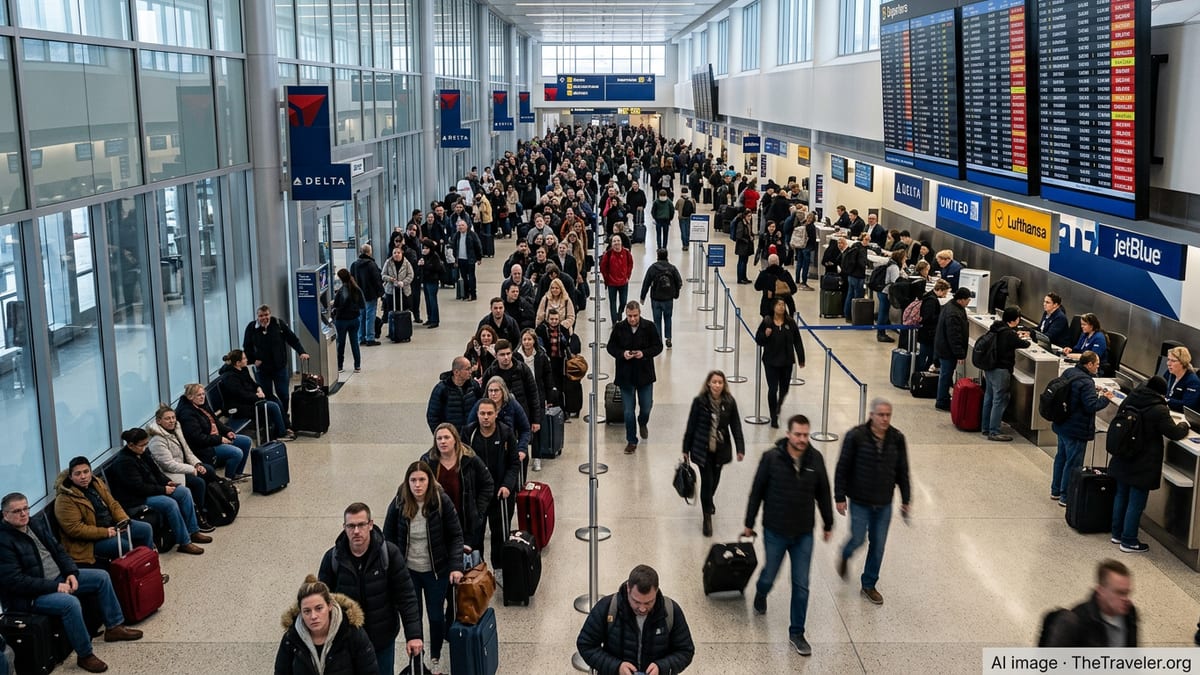
Delays Surge Even as Corporate Travel Budgets Rebound
Recent industry outlooks indicate that corporate travel spending is rising again, yet reliability across the air travel system is not keeping pace. Forecasts from global travel associations and consulting firms show business travel outlays growing through 2026, with many companies planning higher budgets even as they seek tighter cost control and emissions reductions. At the same time, consumer watchdog analyses of U.S. operations report that 2025 delivered the weakest on time performance in more than a decade, with tarmac waits sharply higher than in previous years.
European network data point to small gains in early morning punctuality, but analysts note that airline driven delays from crew, maintenance and ground handling remain the dominant disruptors. These upstream issues ripple through the day’s operations, amplifying the risk that evening flights arrive late and trigger curfew or crew duty limit complications. For corporate travelers booked on tight schedules, those knock on disruptions quickly translate into missed meetings, unplanned hotel nights and extended days away from home.
In the United States, flight delay studies based on transportation statistics estimate that travelers collectively lost well over a million hours to late operations in 2025 alone. While extreme weather remains a factor, a significant share of delays is attributed to causes within airlines’ control, such as technical issues, staffing shortages and slow baggage handling. With business travel volumes now at or above pre pandemic levels on many routes, the margin for error has narrowed, and every hour lost in transit carries a higher opportunity cost.
The result is a widening gap between headline travel budgets and the real economic impact of trips. Published analyses of disruption costs suggest that a meaningful share of corporate travel spend is now being consumed by the fallout from cancellations and delays, including extra hotel stays, rebooking fees, additional ground transport and overtime payments for employees forced to work around disrupted itineraries.
Ground Transport and Airport Friction Become Silent Cost Centers
While flight disruptions often dominate attention, corporate travel specialists increasingly point to ground transport and airport processes as major hidden drivers of lost productivity. Industry benchmarks for managed corporate ground programs now target near perfect on time pickup performance and minimal cancellation rates. Yet reports from mobility providers suggest that reliability gaps remain common, especially in large urban markets and during peak arrival windows.
When airport pickups fail or cars arrive late, travelers face cascading impacts. Missed connections between terminals, late arrivals to client sites and last minute changes to internal meetings all consume productive time and internal resources. Ground transport failures can also trigger premium last mile spending, as travelers switch to surge priced taxis or ride hailing services just to stay on schedule. Over a full year of global travel, these incremental decisions can add substantial unplanned cost to corporate mobility programs.
Airport layouts and congestion compound the problem. Rankings of major hubs for business travelers highlight that executives prize not only flight options and lounges but also short walking distances, efficient security and fast transfers between terminals. Survey data from travel management firms show that nearly two thirds of travel managers cite delays and cancellations as their top airport frustration, but long lines at security and immigration, crowded boarding areas and slow baggage delivery are close behind. Each of these pinch points extends the unproductive portion of the travel day.
In some cases, post landing waits now rival in flight time on shorter routes. Traveler accounts describe aircraft parked on the tarmac for more than an hour awaiting open gates or ground crew, followed by lengthy queues at passport control and further delays at baggage carousels. For employees trying to prepare for same day meetings or connect to regional rail and car services, that combination of small setbacks often eliminates any buffer time built into their schedule.
Post Landing Chaos Undercuts the “Last Mile” of Corporate Trips
The period between touchdown and arrival at a hotel or meeting venue has emerged as a critical weak link in global corporate mobility. Publicly available data and traveler reports point to several recurring bottlenecks: gate unavailability, staffing shortages in ground handling, rideshare pickup congestion and fragmented communication between airlines, airports and transport providers. When these elements break down simultaneously, even a nominally on time flight can devolve into hours of post landing uncertainty.
Analyses of U.S. airport performance based on recent flight delay datasets show that some major hubs now see more than a quarter of all operations disrupted by delays or cancellations, with peak summer months particularly strained. Weather events often serve as the initial trigger, but network observers note that the real damage comes from the system’s limited ability to recover. Once aircraft and crews are out of position, later flights face rolling delays, connections misalign and arriving passengers confront congested gates and overburdened infrastructure.
For business travelers, this chaos frequently appears at the very moment when productivity should resume. Instead of using arrival time to prepare for presentations or connect with colleagues, many spend it refreshing airline apps, queuing for assistance desks or negotiating with ground transport providers. If travel policies restrict the use of flexible alternatives such as same day rail or rental cars, options to recover lost time can be further constrained.
This pattern is not limited to North America. European air traffic data show that improvements in early morning punctuality do help reduce knock on delays, yet disruptions later in the day still force detours, missed connections and late night arrivals at secondary airports. In Asia and the Middle East, rapid growth in passenger volumes is testing terminal capacity and border control resources, occasionally producing long queues that catch corporate itineraries off guard. Across regions, the common theme is that post landing processes are lagging behind the recovery in demand.
Productivity Erosion Reshapes Corporate Travel Strategy
As the hidden costs of disruption accumulate, corporate travel policies are evolving. Recent corporate travel surveys indicate that cost control and traveler wellbeing now rank alongside revenue generation as primary objectives. Some companies report redirecting budgets from volume increases into resilience measures, including higher class tickets on critical routes, preferred partnerships with more reliable carriers and expanded use of flexible fares that simplify rebooking.
Travel managers are also revisiting trip justification models. Rather than approving all in person meetings that fit budget thresholds, organizations are weighing the full productivity impact of likely disruption. Internal guidance in some firms encourages consolidating meetings into fewer trips, scheduling key sessions away from known high congestion periods and favoring hubs with stronger on time records, even when fares are slightly higher. For frequent travelers, this can mean fewer but longer trips designed to maximize on the ground output per flight taken.
Technology tools are gaining prominence as another line of defense. Advanced booking platforms now integrate real time disruption alerts, predictive delay analytics and automated rebooking workflows. Some travel programs are experimenting with centralized “command center” style oversight for major events and peak seasons, with dedicated teams monitoring network conditions and proactively adjusting itineraries. The aim is to reduce the window in which delays convert into idle time, missed connections and emergency spending.
At the traveler level, expectations are shifting as well. Surveys and anecdotal accounts suggest that frequent business flyers increasingly plan for disruption by carrying backup work, reserving flexible meeting slots and insisting on clearer communication from travel providers. Lounges and quiet airport workspaces are no longer viewed as perks but as essential productivity infrastructure that helps offset unavoidable waiting time.
From Hidden Friction to Measurable Risk in Global Mobility
The growing body of data on delays and disruptions is prompting companies to treat reliability as a formal risk category within global mobility. Forecasts for 2026 from global business travel associations caution that while passenger traffic growth is expected to stabilize at more sustainable rates, operational capacity in many markets remains tight. Any combination of severe weather, labor actions or infrastructure outages can therefore trigger outsized disruption.
Some organizations are responding by embedding delay assumptions into their financial planning. Instead of budgeting only for ticket prices and hotel rates, they are modeling likely overruns tied to cancellations, missed connections and extra nights on the road. Industry analyses estimate that disruption related spending can account for several percentage points of total business travel budgets in large markets, a figure likely to grow if on time performance fails to improve.
The shift toward hybrid work and virtual collaboration is another factor in this recalibration. As more meetings can be conducted remotely, the threshold for approving travel has risen. In this context, the intangible costs of fatigue, stress and lost focus from repeated delays gain more weight. Companies that can quantify those impacts are better positioned to decide when the benefits of face to face contact justify the operational risk.
Looking ahead, experts in aviation and corporate mobility suggest that pressure will continue to build on airlines, airports and ground transport providers to prioritize reliability over aggressive scheduling. For global businesses, the immediate imperative is to map where hidden friction resides in their travel patterns and to adapt policies, supplier choices and traveler support accordingly. Until systemic improvements arrive, treating delays, ground transport gaps and post landing chaos as core strategic risks, rather than incidental annoyances, is likely to define the next phase of business travel management.