


More news on this day
Travel across parts of the Middle East and eastern Mediterranean has been hit by a fresh wave of disruption, with 25 flight cancellations and 1,108 delays reported in a single day at Antalya and five additional regional airports, according to live flight-tracking data and industry reports.
Get the latest news straight to your inbox!
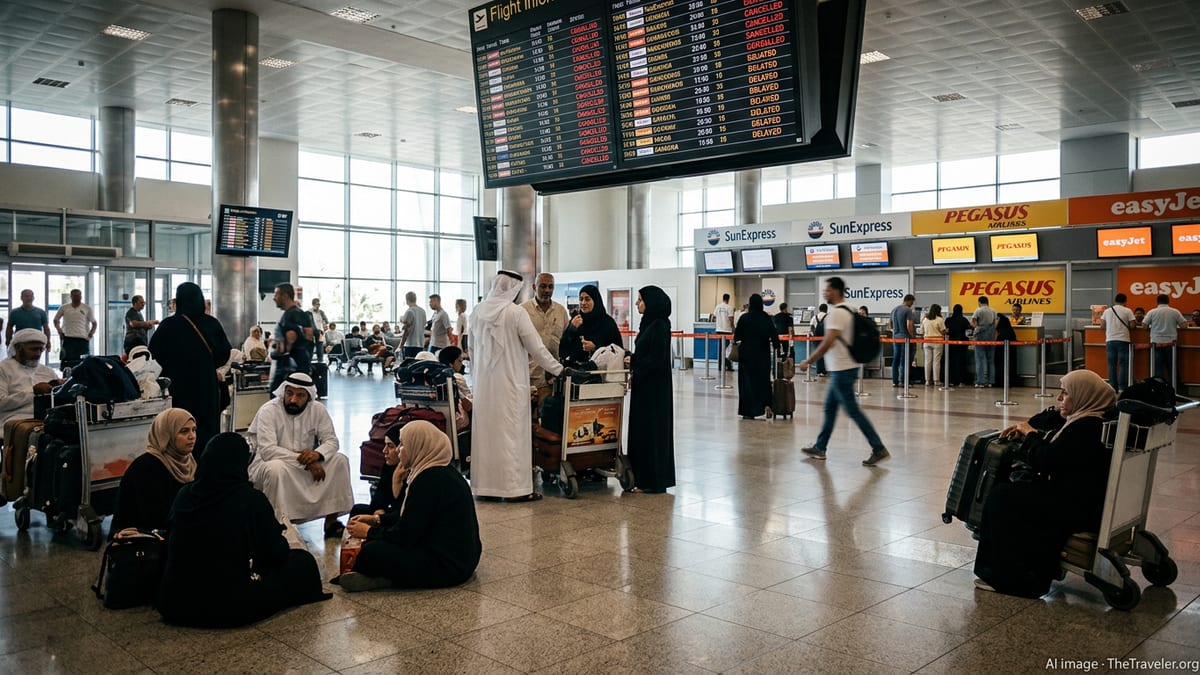
Airspace Restrictions Ripple Across Regional Hubs
Publicly available flight-tracking data and aviation industry coverage indicate that escalating regional tensions and intermittent airspace restrictions have continued to affect routes connecting Turkey with the wider Middle East. Airports serving as gateways between Europe, the Gulf and South Asia have faced particular strain, with Antalya emerging as one of the most affected Turkish hubs.
The tally of 25 cancellations and 1,108 delays in a 24 hour period reflects how even limited closures or reroutings of air corridors over conflict zones can cascade across schedules. Aircraft and crews forced to take longer routes, wait for new slots or divert around restricted areas often cause knock-on disruption at secondary airports hours later.
Analysts note that the pattern seen at Antalya and the five other impacted airports mirrors wider disruption reported this year at major hubs across the region, where hundreds of daily delays have become common during peaks in geopolitical tension. While many flights still operate, the margin for recovery when something goes wrong has narrowed significantly.
Although each airport publishes its own operational updates, the overall picture compiled from airline status pages and tracking platforms shows similar pressure points: morning banks of departures pushed back into midday, evening arrivals bunching together, and some short haul flights scrubbed altogether to free aircraft for long haul services.
Antalya’s Strategic Role in East West Connectivity
Antalya is best known internationally as a leisure gateway on Turkey’s Mediterranean coast, but in recent seasons it has also taken on a growing role as a transfer point linking European cities with destinations in the Middle East and beyond. This dual identity has made the airport particularly sensitive to regional airspace shocks.
According to published route maps and schedule data, Antalya sits on several busy corridors that normally cross or skirt Middle Eastern airspace. When those corridors are constrained, rerouted traffic often competes for the same arrival and departure windows, crowding the airport’s peak hours and raising the likelihood of rolling delays.
Industry coverage of recent disruption episodes in Turkey indicates that Antalya has periodically experienced spikes in delays tied not to local weather or infrastructure problems, but to restrictions and congestion hundreds of miles away. These indirect effects can be difficult for travelers to anticipate, as their tickets may not show any destination in a conflict zone.
Airlines operating through Antalya have responded in different ways, from retiming certain departures to temporarily trimming frequencies on selected regional routes. Schedule data suggests that carriers have tried to preserve core trunk services while using secondary flights as a buffer when aircraft and crews run out of legal operating hours.
Five Additional Airports See Knock On Disruption
The same data sets that highlight Antalya’s difficulties also point to significant disruption at five other airports in the Turkey Middle East travel network. While their individual totals vary, combined figures underline how closely linked the region’s aviation system has become.
Reports from aviation news outlets and traveler forums describe patterns of delayed departures, extended tarmac times and late night arrivals at several secondary Turkish airports and nearby international hubs. In some cases, aircraft originating in the Gulf or Levant arrived hours behind schedule, forcing rapid turnarounds or missed connections on onward European services.
Operational summaries shared by airlines show that even airports not directly overflying restricted airspace can suffer when inbound aircraft are rerouted or held at origin. A delayed arrival at one hub often translates into a missed departure window at another, which then requires new slots and ground handling resources.
The aggregate impact across these six airports Antalya plus the five additional affected gateways has been to stretch staffing, gate availability and baggage handling capacity. Travel industry reporting notes that some airports have resorted to prioritizing long haul and heavily booked services during the worst of the disruption, leaving thinner regional routes more vulnerable to cancellation.
Travelers Face Longer Journeys and Uncertain Connections
For passengers, the numbers behind the latest disruption translate into longer travel days and elevated risk of missed connections. Accounts shared on public travel forums describe itineraries that once involved straightforward connections now requiring extended layovers, overnight stays, or complete rerouting through alternative hubs.
Consumer advisories from travel organizations recommend that passengers connecting through affected airports build in additional buffer time, particularly when their journeys involve multiple carriers or separate tickets. Travelers are also urged to monitor flight status frequently in the 24 hours before departure, as same day schedule changes have become more common during periods of heightened tension.
Public information from airlines highlights flexible rebooking policies in some cases when flights are disrupted by airspace closures or security assessments. However, news coverage and traveler reports indicate that policies vary widely between carriers and ticket types, leaving some passengers with limited options beyond accepting significant delays.
Experts in air passenger rights emphasize that eligibility for compensation in such situations often depends on local regulations and whether disruptions are categorized as extraordinary circumstances beyond an airline’s control. In practice, many travelers affected by cancellations linked to regional instability are receiving schedule changes, meal vouchers or hotel accommodation rather than direct financial redress.
Outlook: Volatile but Functional Air Links
Aviation analysts tracking the Middle East and eastern Mediterranean market describe the current environment as volatile but functional. Despite notable spikes in cancellations and delays such as the 25 cancellations and 1,108 delays recorded across Antalya and the other affected airports the majority of scheduled services continue to operate, albeit with reduced punctuality.
Published commentary from airline and airport executives across the region suggests that carriers are continuously recalibrating networks in response to evolving risk assessments and operational constraints. That can mean rapid changes in preferred routings, day of week frequencies or equipment types on routes touching the Middle East.
For now, industry forecasts still point to strong underlying demand for travel linking Europe, the Gulf and South Asia, driven by tourism, business ties and large diaspora communities. The challenge for airlines and airports will be to meet that demand while navigating intermittent airspace closures and the operational chain reactions they trigger.
Travel planners note that as long as regional tensions remain elevated, passengers transiting through Antalya and other nearby hubs should treat schedules as subject to change, remain flexible with routing options, and keep documentation and contact details for airlines and insurers close at hand.