


More news on this day
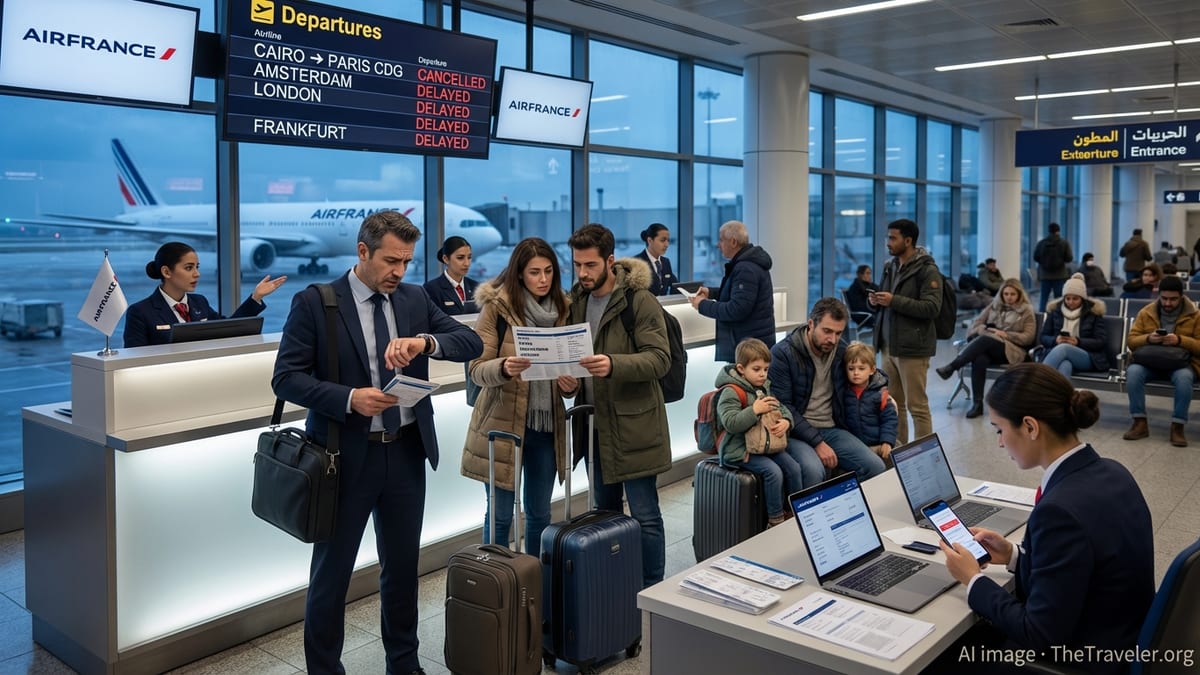
A sharp spike in flight disruptions at Cairo International Airport has left thousands of travelers facing hours-long delays and cancellations, as more than 80 scheduled departures were reported delayed or grounded and regional connections struggled to absorb the fallout.
Get the latest news straight to your inbox!
Sudden Operational Breakdown Hits Key Regional Hub
Cairo International Airport, one of the Middle East and North Africa’s busiest hubs, experienced a sudden operational breakdown that cascaded across its departure schedule. Publicly available performance data and live flight-tracking dashboards showed more than 80 departures delayed or canceled in a short window, far above the airport’s usual baseline of disruption.
Independent aviation trackers monitoring Cairo’s operations described a pattern of rolling delays building through the day, pushing departures back in increments and forcing airlines to consolidate, reroute, or cancel services. For many travelers, this translated into missed connections, unexpected overnight stays, and rapidly changing flight information displayed across terminal screens.
The spike comes at a time when Cairo has been under close scrutiny from industry analysts who track the resilience of busy hubs facing tight capacity, rerouted regional airspace, and higher-than-usual traffic volatility. Recent assessments of Cairo’s performance have already highlighted vulnerability to knock-on delays when any part of the system, from ground handling to air traffic management, comes under strain.
While detailed technical explanations had not yet been fully outlined in official technical bulletins at the time of writing, the pattern of disruption suggested a complex combination of operational bottlenecks rather than a single isolated incident.
Disrupted Departures, Missed Connections, and Stranded Passengers
Flight-data services tracking departures from Cairo indicated that dozens of flights left significantly behind schedule, in some cases more than two hours late, while others were withdrawn from the departure boards entirely. The overall impact translated into approximately 83 delays and cancellations combined, according to aggregated snapshots of departure performance compiled from airport statistics and airline feeds.
International and regional services bore much of the brunt, with departures to key destinations in Europe, North Africa, and the Gulf facing extended waits. Travelers connecting onward from Cairo to other African, Middle Eastern, and Asian hubs faced a particularly challenging situation, as missed onward flights quickly filled available seats on remaining services.
Reports from passenger-rights organizations and compensation advisory platforms noted a marked uptick in inquiries from travelers who had been held at the airport for long periods or were forced to rebook after overnight disruption. These groups, which routinely monitor schedule reliability and passenger claims, pointed to Cairo as one of several regional hubs where performance has been under pressure during the current travel season.
Though operations continued, the uneven departure pattern created congested gate areas and queues at service desks, with passengers seeking rebooking options, hotel vouchers where applicable, and updated information about onward connections.
Regional Ripple Effects Across Middle East and North Africa Routes
The Cairo disruption unfolded against a backdrop of already strained regional airspace. Recent industry outlooks have underlined how shifts in flight paths, geopolitical tensions, and capacity adjustments have increased the sensitivity of Middle East and North Africa routes to any local breakdown at major hubs. Rerouted traffic patterns and longer flight times have left less slack in schedules when airports face sudden spikes in delays.
Analysts tracking flows between Europe, the Gulf, and East Africa noted that Cairo’s position as a key connection point means that disruption at this single airport can send ripples across multiple networks. When a wave of nearly 80 to 90 delayed and canceled departures hits within hours, aircraft and crews can end up out of position, forcing schedule reshuffles on subsequent days.
Some regional flights using Cairo as an origin, destination, or transfer point arrived late from previous sectors, compounding the problem. Public data on punctuality for certain routes into Cairo has already shown relatively low on-time departure rates this season, suggesting that the system may have had limited resilience before the latest spike in disruption.
Capacity planning documents and fleet deployment updates from regional airlines have emphasized efforts to modernize aircraft and add new services, but these improvements take time to filter into day-to-day reliability, especially when external pressures on airspace and traffic flows remain high.
Passenger Rights, Rebooking Options, and Practical Advice
The latest disruption at Cairo has also refocused attention on what recourse travelers have when flights are heavily delayed or canceled. Passenger-compensation specialists that track airport-level performance frequently remind travelers that eligibility for reimbursement or compensation depends on multiple factors, including the airline’s home jurisdiction, the route, and the precise cause of disruption.
For flights departing Cairo to the European Union or operated by EU carriers, some passengers may have protections under European-style passenger-rights frameworks, depending on circumstances. However, for many regional routes, compensation rules vary and may offer more limited support, concentrating instead on rebooking options, meals, or accommodation during long waits.
Travel advisories and independent travel guides generally recommend that passengers flying through Cairo build additional buffer time into itineraries, especially when booking separate tickets for onward travel. The latest wave of disruption will likely reinforce that advice, as tight connections were among the first to unravel when the airport’s departure schedule began to slip.
Experts who monitor aviation trends suggest that travelers passing through Cairo in the coming days closely track their flight status via airline apps and departure boards, stay alert to gate changes, and keep documentation of expenses in case they qualify for reimbursement under airline policies or local regulations.
Longer-Term Questions for Egypt’s Aviation Ambitions
The meltdown in Cairo’s departure schedule arrives at a sensitive moment for Egypt’s broader aviation ambitions. In recent months, sector overviews and regional reports have highlighted a multibillion-dollar program to expand capacity at Cairo and strengthen Egypt’s role as a regional aviation hub. These plans include infrastructure upgrades, fleet renewals, and efforts to attract more connecting traffic through the capital.
Industry observers note that such ambitions rely heavily on consistently reliable operations at Cairo International Airport. Episodes of mass delays and cancellations, even when short-lived, risk undermining traveler confidence and raising concerns among airlines considering additional services. Business travelers and tour operators, in particular, tend to scrutinize on-time performance statistics when choosing routings and preferred hubs.
Regulatory and multilateral aviation organizations have recently reaffirmed Egypt’s strategic role in regional air transport and stressed the importance of resilient airport infrastructure and air traffic management. The latest disruption at Cairo will likely feature in upcoming performance reviews and technical discussions, as stakeholders look for ways to reduce the risk of similar breakdowns during peak travel periods.
For now, travelers using Cairo International Airport are urged by travel advisories and independent monitoring platforms to anticipate possible residual delays as airlines work through backlogs, reposition aircraft and crews, and attempt to restore the tightly timed schedules that keep a major regional hub running on time.