


I picked up the Sun Country Visa Signature credit card with a simple question in mind: is it actually a good deal for a typical traveler, or just another airline-branded card that sounds rewarding but quietly drains value through fees and fine print? To find out, I spent time flying Sun Country, running the numbers on real itineraries, and comparing what I earned to what I paid. Here is what I learned when I tried to calculate the real value of the Sun Country Visa Signature card.
Get the latest updates straight to your inbox!
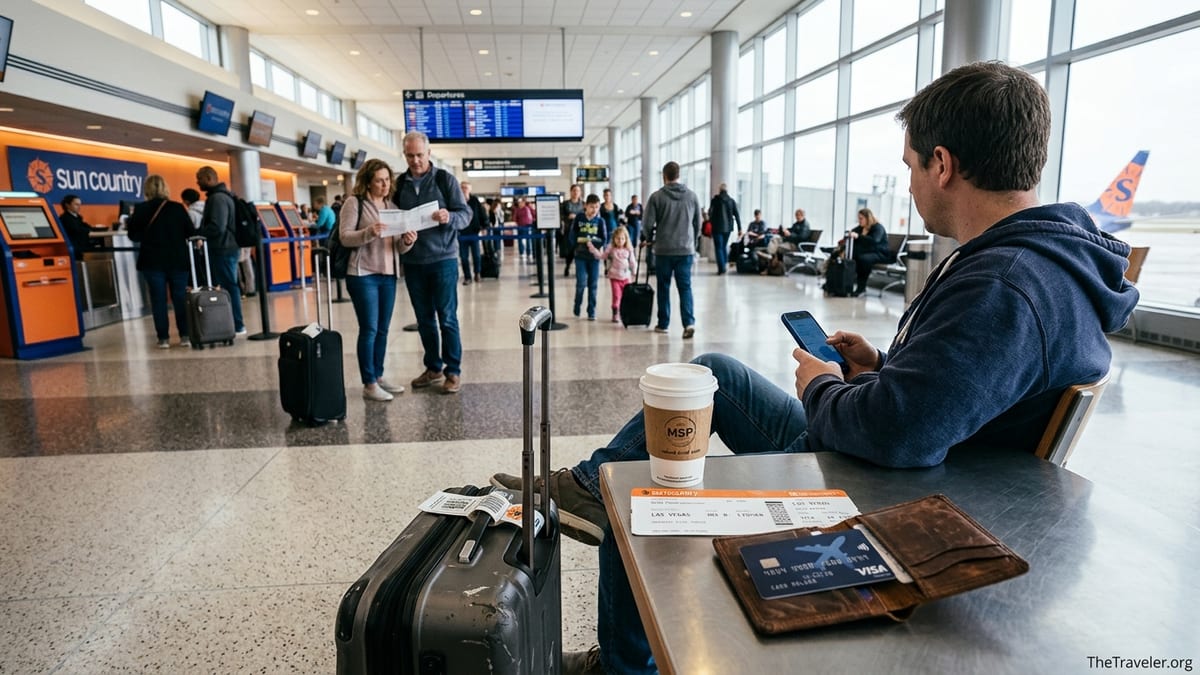
How the Sun Country Visa Signature Card Actually Works
The current Sun Country Visa Signature card is issued by Synchrony Bank and carries an annual fee of about $89 as of early 2026. In exchange, it offers a suite of airline-focused benefits aimed at travelers who fly Sun Country at least a couple of times per year. The headline perks are boosted earning on Sun Country tickets, discounts on bags and seats, and a solid anniversary bonus if you put enough spending on the card.
On the earning side, the structure is straightforward. You earn 3 Sun Country Rewards points per dollar on eligible Sun Country purchases put on the card, 2 points per dollar at gas stations and grocery stores, and 1 point per dollar on everything else. Separately, Sun Country Rewards members earn points when they actually fly, and cardholders get an extra layer of points here too. Put simply, if you buy a Sun Country ticket with the card and then take the flight, you can reach a combined earning rate of up to roughly 5 points per dollar on that purchase when you add card spend and flight miles together.
Crucially, points earned with the Sun Country Visa Signature card do not expire as long as your card account remains open and in good standing. That is an important distinction because regular Sun Country Rewards points can otherwise expire after inactivity. For an infrequent leisure traveler planning a big family trip every couple of years, this non-expiration feature is one of the more quietly valuable aspects of the card.
Beyond points, the card layers in operational perks: 50 percent off your first checked bag when purchased in advance on Sun Country’s website, 50 percent off Best and Standard seat selection fees, preferred boarding in Zone 2, a complimentary premium drink on each flight, 25 percent off in-flight food and beverages, and a 10,000-point anniversary bonus if you spend $10,000 in a cardmember year. This bundle is what I focused on when I tried to attach a real-world dollar value to the card.
Putting a Dollar Value on Sun Country Points
Before I could decide whether the card is worth its fee, I needed a working value for a single Sun Country point. Sun Country redemptions typically start around 5,000 to 7,500 points for short hops in the Upper Midwest during off-peak periods, and often creep up for peak dates or more in-demand routes. When I priced out several Minneapolis to Las Vegas and Minneapolis to Phoenix runs in the spring shoulder season, I repeatedly saw one-way fares around 90 to 130 dollars that were also available for roughly 7,500 to 10,000 points plus taxes.
If I take a sample one-way flight priced at 120 dollars or 10,000 points, ignoring security fees, that puts a rough value of about 1.2 cents per point. On another route, Minneapolis to Fort Myers in early May, I found a 140 dollar ticket available for 12,000 points, or about 1.16 cents per point. Across a handful of similar examples, the average hovered just a shade above 1 cent per point. Because prices and award rates shift frequently, I treat 1.1 cents per point as a cautious working estimate instead of a promise.
Using that 1.1 cents figure, the 3 points per dollar you earn on Sun Country purchases with the card work out to a theoretical 3.3 percent back toward Sun Country flights. Gas and grocery spending at 2 points per dollar is about 2.2 percent back, and all other spend at 1 point per dollar is roughly 1.1 percent back. Those are competitive earn rates compared with many no-fee cash back cards, but with one major trade-off: you are locked into redeeming for Sun Country travel rather than taking a statement credit or cash.
Now apply that point value to the anniversary bonus. If you spend $10,000 on the card in your membership year, you earn a 10,000-point bonus, which is essentially a $110 Sun Country travel credit at a 1.1 cent valuation. That alone more than offsets the $89 annual fee on paper, as long as you are comfortable running at least $10,000 through the card and redeeming those points for Sun Country flights.
What I Earned on Real Flights
To see how this translated into practice, I ran the card through two very typical Sun Country use cases: a Minneapolis based traveler flying to Las Vegas for a long weekend, and a family from Minnesota flying to Orlando during school spring break. Rather than looking at hypothetical spend, I used ballpark prices from recent searches to keep the math grounded.
On the Minneapolis to Las Vegas example, a common sale fare for a round-trip economy ticket has been around $260 including taxes when booked a couple of months in advance. Assume I buy that ticket at Sun Country’s site with the card and earn 3 points per dollar, or about 780 points, which I value at roughly $8.60 in future travel. Separately, the flight itself earns Sun Country Rewards points, often close to 2 points per dollar spent before taxes. If that works out to another 500 to 600 points, the combined earn for the trip is roughly 1,300 to 1,400 points, or about $14 to $16 in value.
The side perks start to matter more once you look at fees. On that Las Vegas trip, Sun Country typically charges around $30 to $35 each way for a checked bag bought pre-flight and about $15 to $25 each way for a standard or Best seat near the front of the cabin, depending on the route and season. With the card’s 50 percent discount, a checked bag priced at $35 drops to about $17.50, and a $20 seat assignment becomes $10. Over a round trip, a single checked bag and assigned seat could easily save $50 or more. Add a couple of 7 to 10 dollar in-flight snack boxes and drinks discounted by 25 percent, and it is realistic to recoup $60 to $70 in pure discounts on a single weekend trip.
On the Orlando family trip example, prices spike. I used a sample four-person booking from Minneapolis to Orlando during late March, where base fares often run about $220 to $260 round trip. A total ticket cost of around $1,000 for four people is a fair conservative estimate. Charging that to the card earns about 3,000 points from the card alone, worth roughly $33, plus flight-based points that might add another 1,500 to 2,000 points. With four travelers each checking a bag for both outbound and return, pre-flight bag fees can easily approach $240 or more without the card’s discount. A 50 percent cut lowers that to around $120, a clean $120 savings on one vacation. For a family that takes one big Sun Country trip per year, that bag discount is arguably the single biggest reason to keep the card.
Annual Fee Versus Real-World Savings
With the earning structure and some real flight scenarios in hand, the next step in my calculation was simple: can the average Sun Country flyer recoup an $89 annual fee through these perks alone, without playing games or taking extra flights just for the sake of benefits? Looking strictly at the examples above, the answer for a regular Sun Country customer is often yes.
On the Las Vegas weekend, I might save roughly $50 to $70 on bags, seats, and onboard discounts, while earning perhaps $15 in point value. That pushes the total value from one short trip close to $70 to $85. A second Sun Country trip in the same year, even a cheap $180 hop to Denver or Phoenix with one checked bag and paid seat each way, might add another $40 to $60 of value. Two modest vacations a year could easily generate $120 to $150 in combined savings and rewards, comfortably ahead of the annual fee.
Where it becomes more compelling is when you factor in the 10,000-point anniversary bonus for $10,000 in annual spend. Imagine you put $10,000 of mixed spending on the card, with half of that in gas and groceries at 2 points per dollar and half in unbonused everyday categories at 1 point per dollar. That would earn 15,000 points from spend itself, plus the 10,000-point bonus, for a total of 25,000 points. Using the 1.1 cent value per point, that bundle is worth around $275 in future Sun Country travel. Subtract the $89 fee and you are left with about $186 of net value, assuming you use all of those points efficiently.
For a traveler deeply loyal to Sun Country and based in a core airport like Minneapolis, that equation is pretty favorable. But the picture changes quickly if you only occasionally fly the airline or spread your credit card spending across multiple cards. If it takes you two years to reach $10,000 in spend, you will never trigger the anniversary bonus. If you check bags on Sun Country once every couple of years and usually carry on, the discounts are interesting but not transformative. In that world, the annual fee feels harder to justify, especially when there are no-fee cash back cards that offer 2 percent back everywhere in cash instead of airline-specific points.
How It Compares With Other Travel Cards
To really understand the value of the Sun Country Visa Signature card, I had to compare it with cards that compete for the same wallet space. Someone based in Minneapolis could just as easily carry a flat-rate 2 percent cash back card issued by a major bank, or a well-known travel card like Chase Sapphire Preferred that earns flexible points and frequently offers 2 to 3 points per dollar on a wide swath of travel and dining purchases.
Take that same $260 Minneapolis to Las Vegas Sun Country ticket. If I used a generic 2 percent cash back card, I would earn $5.20 in cash. With the Sun Country Visa Signature, my 3 points per dollar at a 1.1 cent value work out to roughly $8.60 toward future Sun Country travel, plus separate flight-earned points. In pure earn-rate terms on the ticket price, the Sun Country card wins for people who are happy to keep flying Sun Country and redeeming with them.
The comparison flips when you look at non-travel spend. On $5,000 in random online shopping, subscriptions, and restaurant bills that only earn 1 point per dollar on the Sun Country card, I would end up with 5,000 points worth about $55 in flights. The same spend on a 2 percent cash back card gives me $100 in cash that can be used on any airline, grocery bill, or utility payment. To justify running general spend through the Sun Country card, you really need to be targeting that $10,000 threshold for the anniversary bonus or chasing Plus status via spending.
That is another dynamic unique to this card: spending your way to Sun Country Plus status. Sun Country’s Plus tier, introduced in late 2025, can be earned either by flying 10 qualifying Sun Country flights in a calendar year or by putting $10,000 of spend on the Sun Country Visa Signature card. Plus status offers an extra point per dollar on Sun Country flights and operational perks like priority check-in and enhanced boarding. For someone who flies Sun Country infrequently but puts heavy spend on a single card, qualifying via spending could be an efficient way to get that extra layer of recognition and elevated earning without constantly hopping on Sun Country planes.
Who Actually Wins With This Card
When I laid all the numbers out, a clear profile emerged of who is most likely to come out ahead with the Sun Country Visa Signature card. At the top of the list are travelers who live near Sun Country’s core markets, especially Minneapolis, and fly the airline at least twice per year with checked bags. Families who take one substantial Sun Country vacation a year, such as a spring break trip to Florida or a winter escape to Arizona, and who value checked bag discounts can also come out ahead fairly easily.
To put a concrete example on it, picture a family of four from Minnesota that flies Sun Country to Orlando every March and to Phoenix every November. On each round-trip, all four travelers check bags and choose standard seats toward the front of the cabin. It would not be hard for that family to save around $200 per year in cumulative bag and seat discounts alone. Add in the value of a couple of thousand points per trip, anniversary bonus potential if they use the card for groceries and gas, and the occasional free premium drink and discounted snack, and the card starts to look like a modest but real money-saver.
Frequent solo travelers and couples who fly light but value comfort also come out reasonably well. If you are based in Minneapolis, fly Sun Country for long weekends several times a year, care about boarding a bit earlier to secure overhead bin space, and like having an alcoholic beverage or upgraded snack on board, the preferred boarding, half-price seat fees, and premium drink benefit feel pleasantly tangible. Over a handful of trips, those soft perks plus the earning rate on tickets can quietly offset the annual fee even before you look at the anniversary bonus.
On the other hand, occasional Sun Country flyers who are primarily using other airlines or who rarely check bags will struggle to justify this card long term. If you book a single Sun Country flight every two or three years, travel with only a carry-on, and do not care about seat selection or a free drink, then the Sun Country Visa Signature card’s unique perks may go largely unused. For that traveler, a flexible no-fee card with broad rewards is likely the better financial choice, even if it looks less exciting on paper.
Hidden Costs, Limitations, and Risks
In calculating the real value of the Sun Country Visa Signature card, it is important not to overlook the friction points. The card ties your rewards closely to a single airline, which is inherently limiting. Sun Country does not have the global network of a major legacy carrier or the breadth of partners that come with some flexible travel currencies. If your travel patterns change or Sun Country reduces service in your home market, you might find yourself sitting on a pile of points that are less convenient to use.
The annual fee is another factor that can erode value if you are not attentive. With a fee near $89, the card demands that you use benefits every year. If you forget about the anniversary date, reduce travel for a season, or end up booking flights on another airline because schedules work better, you could easily see a year where you pay the fee and get little back. For people who want a “set it and forget it” card that does not require strategy, this is not it.
There is also the reality of airline pricing to consider. Bag fees, seat fees, and even onboard snack prices are not fixed, and airlines can adjust them quickly in response to demand and competitive pressure. If Sun Country raises bag fees, then the absolute dollar amount you save with a 50 percent discount could rise too, which is good, but it also means your base cost of travel increased. Conversely, if Sun Country runs more fare bundles that include bags or seats, you might find that the a la carte discounts available through the card matter less. In other words, the intrinsic value of the card’s benefits sits on top of a moving target.
Finally, like any airline cobranded card, the Sun Country Visa Signature exposes you to changes in the loyalty program itself. Sun Country could adjust point earning on flights, tweak redemption charts, or change how many points are required for specific routes. It has already made changes in recent years, such as the introduction of the Plus status tier. If future adjustments make points less valuable or shift more value to higher-status members, the effective return on your spending could fall without any change in your own behavior.
The Takeaway
After running the numbers through multiple real-world examples, my conclusion is that the Sun Country Visa Signature card is a niche but genuinely useful tool for a specific type of traveler. For people living near a Sun Country hub who take at least one or two trips a year with checked bags and who do not mind being loyal to a single airline, it is realistically possible to derive $150 or more in annual value between bag and seat discounts, onboard savings, anniversary bonuses, and points you earn from flights and card spending. In that scenario, the roughly $89 annual fee can be a fair trade.
For infrequent Sun Country flyers, people who rarely check bags, or travelers who prefer maximum flexibility with their rewards, the story is different. Once you strip away the airline-specific perks and focus purely on the earning rate for non-bonused everyday spending, plenty of no-fee cash back and general travel cards will beat the Sun Country Visa Signature card on simplicity and long-term value. The card’s strength is tightly linked to how often you fly Sun Country, which routes you fly, and how heavily you use optional services like checked bags and paid seat assignments.
If you are considering the card, the best approach is to look at your past 12 months of travel, price out two or three of those trips as if you had the Sun Country Visa Signature in your wallet, and assign a conservative value to the points you would have earned and the fees you would have saved. If that total significantly exceeds the annual fee and you see yourself maintaining similar travel patterns, the card can be a smart, targeted addition to your travel toolkit. If not, you are better off with a more flexible option, even if its perks look less colorful in the marketing copy.
FAQ
Q1. What is the annual fee for the Sun Country Visa Signature card?
The Sun Country Visa Signature card has an annual fee in the neighborhood of $89 as of early 2026, though exact pricing can vary slightly over time and with issuer updates.
Q2. How many points do I earn per dollar with the Sun Country Visa Signature?
You generally earn 3 points per dollar on eligible Sun Country purchases, 2 points per dollar at gas stations and grocery stores, and 1 point per dollar on most other purchases made with the card.
Q3. Are Sun Country points earned from the card worth more than cash back?
In many cases Sun Country points redeem for just over 1 cent per point toward flights, which can beat a simple 2 percent cash back card on Sun Country tickets but not necessarily on everyday non-travel spending.
Q4. Do Sun Country points from the Visa Signature card expire?
Points tied to the Sun Country Visa Signature card generally do not expire as long as your card account remains open and in good standing, which can be helpful for infrequent travelers.
Q5. How does the 10,000-point anniversary bonus work?
If you spend about $10,000 on eligible purchases with the card in a 12-month period starting on your account’s anniversary date, you earn 10,000 bonus points that typically post within one or two billing cycles.
Q6. What kind of baggage benefits does the card offer?
The card offers 50 percent off your first checked bag for you and a travel companion on the same reservation when you purchase the bag in advance through Sun Country’s website, which can translate to substantial savings on family trips.
Q7. Can I use Sun Country Visa Signature points on airlines other than Sun Country?
No, points earned with the Sun Country Visa Signature card are primarily intended for Sun Country flights and related travel, and cannot generally be transferred to or redeemed with other airlines.
Q8. Is the Sun Country Visa Signature a good primary everyday credit card?
It can be if you are focused on hitting the $10,000 annual spend threshold and frequently fly Sun Country, but many travelers will get more flexible value from a general cash back or broad travel rewards card.
Q9. How does spending on the card help me qualify for Sun Country Plus status?
Sun Country allows you to earn its Plus status either by taking a set number of flights in a calendar year or by putting around $10,000 of eligible spending on the Sun Country Visa Signature card in that same year.
Q10. Who should seriously consider applying for the Sun Country Visa Signature card?
Travelers based in Sun Country focus cities, especially Minneapolis, who fly the airline at least once or twice a year with checked bags and are comfortable redeeming points exclusively with Sun Country are the most likely to benefit.