


Sun Country Airlines has relaunched its co-branded Sun Country Visa Signature credit card with Synchrony Bank, promising richer rewards on flights and new Visa Signature travel protections. But with an $89 annual fee and plenty of competing travel cards on the market, the real question for travelers is simple: are you getting enough value to justify the cost, or quietly overpaying for a card that does less than you think?
Get the latest updates straight to your inbox!
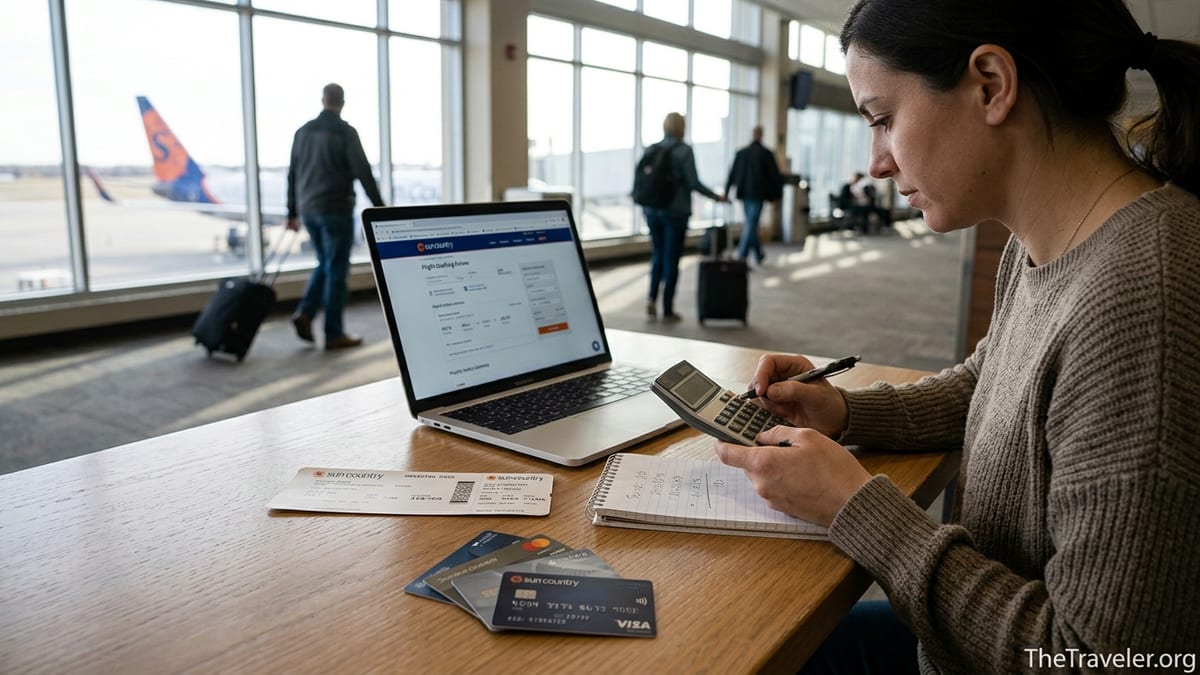
What the Sun Country Visa Signature Card Actually Offers
The latest version of the Sun Country Visa Signature credit card is positioned as a mid-tier airline card with a sub-$100 annual fee. According to recent card disclosures and Sun Country’s own marketing materials, the card carries an $89 annual fee and earns elevated rewards on Sun Country purchases along with lower rewards on everyday spending. Exact earning rates can vary by promotion, but the headline pitch is the ability to earn up to about 5 points per dollar on Sun Country purchases and 1 point per dollar on non-bonus spending, all in the Sun Country Rewards ecosystem.
In practice, this means that a Minneapolis-based traveler who spends roughly $1,200 a year on Sun Country flights to destinations like Phoenix, Las Vegas, or Cancun might expect to earn around 6,000 Sun Country points from the airline spending alone. With Sun Country points generally worth somewhere in the ballpark of 1 cent each toward flights, those 6,000 points could translate to about $60 in flight value, assuming average redemption conditions and no sales.
The card also layers in typical Visa Signature benefits, such as travel protections and access to a concierge service. While the specific coverage levels are set out in the card’s benefits guide, travelers can usually expect things like travel accident insurance, rental car collision damage coverage when you decline the rental agency’s policy, and in some cases trip delay or baggage delay assistance. These features can be valuable, but their real-world benefit depends heavily on how often you travel and whether you already carry another card with similar or stronger protections.
On the surface, then, the Sun Country Visa Signature card is designed to deepen loyalty to a single low-cost carrier rather than operate as a do‑everything travel card. The key to avoiding overpaying is understanding how much of your spending realistically runs through Sun Country, and how much you value airline-specific perks compared with more flexible rewards.
The True Cost: Annual Fee, Interest, and Opportunity Cost
Many travelers focus on the $89 annual fee and stop there. In reality, the true cost of carrying the Sun Country Visa Signature card includes not just the annual fee but any interest charges and, less obviously, the rewards and protections you give up by not using a different card. These opportunity costs can be significant over a few years.
Consider a traveler who spends $8,000 a year on everyday purchases and $1,500 a year on Sun Country flights, charging everything to the Sun Country card. If everyday purchases earn roughly 1 point per dollar and flight purchases earn around 4 to 5 points per dollar, that traveler might earn about 8,000 points from regular spending and about 7,000 points from flights, or around 15,000 points total in a typical year. If those points redeem at approximately 1 cent each toward flights, that is about $150 in flight value against an $89 annual fee, before considering any sign-up bonus.
On paper, that looks like a win. But compare it to a no-annual-fee 2 percent cash back card that would earn $190 in cash on the same $9,500 in spending, with no restriction on where that value can be used. The difference is not enormous, but the cash back card effectively yields more flexible value without locking you into a single airline and without an $89 fee. This illustrates the opportunity cost: every dollar you put on the Sun Country card is a dollar not earning potentially higher or more flexible rewards elsewhere.
The equation can worsen if you ever carry a balance. Airline cards like this often have variable interest rates in the low to mid twenties. If you revolve even a few hundred dollars month to month, the interest costs can easily wipe out the value of your points and negate any benefit from the annual fee. In other words, to avoid overpaying, the Sun Country Visa Signature card should generally be used only by travelers who pay their statement in full every month and can quantify enough ongoing value to clear the $89 hurdle.
When the Card Makes Sense for Sun Country Loyalists
The Sun Country Visa Signature card can be a reasonable choice for a specific slice of travelers: those who fly Sun Country regularly from its core markets, book direct with the airline, and care more about flight discounts and airline status than about flexible, transferable points. For these travelers, the combination of elevated earning on Sun Country tickets, airline-specific benefits, and the potential to support Plus status can tilt the math in favor of keeping the card.
Imagine a Minneapolis business traveler who flies Sun Country from Minneapolis–St. Paul to Las Vegas once a month for work, paying an average of $250 per round trip. That is about $3,000 a year in Sun Country flight spending alone. If those purchases earn roughly 5 points per dollar, that traveler would rack up around 15,000 points from flight spending, potentially another 10,000 or more from general spending, and possibly a sign-up bonus in the first year. Those 25,000 or more points could realistically cover a round-trip to a Sun destination such as Fort Myers or Phoenix in the off season, effectively paying for a vacation flight every year in exchange for the $89 fee.
In addition, Sun Country’s rewards ecosystem ties into status earning. Plus status has typically been available either through a set number of qualifying flights or by putting about $10,000 a year in spend on the Sun Country Visa Signature card. For flyers who struggle to hit the flight requirement but can comfortably channel $10,000 a year in card spend, the credit card becomes a backdoor to status benefits such as earlier boarding, potential seat selection advantages, or small discounts on ancillary fees. The precise perks vary by program update, but the core idea is that the card can help you keep modest elite-like benefits without dramatically changing your travel patterns.
In these loyalty-heavy scenarios, the $89 fee is not just an annual cost but an investment into a broader Sun Country strategy. If you know you will redeem your points for Sun Country flights at fair value, regularly use the airline, and care about status, the card can be sensible. The danger is assuming those conditions will hold if your home airport, airline preferences, or life circumstances change, which is where many travelers end up overpaying in years two and three.
When You Are Likely Overpaying for the Sun Country Visa Signature
For many occasional Sun Country flyers, the card’s math simply does not hold up. The most common overpayment scenario is the casual traveler who signs up for the card during a flight or online promotion, chases the initial sign-up bonus, and then keeps paying the annual fee even though they only fly Sun Country once a year or less. In this case, those $89 payments can quietly stack up while delivering little ongoing benefit.
Take a family in Des Moines who visits relatives in Minneapolis once a year on Sun Country because it happens to be the cheapest nonstop option for their dates. They sign up for the card inflight to save on that day’s baggage fees and earn a welcome bonus, then continue to carry the card. In the second and third years, however, they charge perhaps $500 a year in Sun Country flights and less than $3,000 a year in everyday spending. That might generate fewer than 8,000 points annually, roughly $80 in value at a 1-cent-per-point estimate. After subtracting the $89 fee, they are effectively paying the airline for the privilege of holding the card, while earning less than they could with a basic 2 percent cash back card.
Another overpayment risk comes from assuming that “Visa Signature” automatically means premium travel value. Many banks issue Visa Signature cards with no annual fee that include comparable or better travel protections and stronger everyday rewards. For example, some credit unions offer Visa Signature cards with 2 percent or more cash back and no annual fee, still with rental car collision coverage and purchase protection. In that context, the Sun Country card’s $89 annual fee looks steep unless you are truly maximizing airline-specific rewards.
The result is that travelers who value flexibility, travel on multiple airlines, or only occasionally book Sun Country often pay more in annual fees and forgone rewards than they get back. Unless you can clearly articulate how you will recoup more than $89 in value every year through flight discounts, rewards, and protections that you would not otherwise have, you are likely overpaying for the Sun Country Visa Signature card.
Comparing Sun Country Visa Signature to Other Travel Cards
To understand the Sun Country card’s true value, it helps to stack it up against some real-world alternatives. One natural comparison is a mainstream travel rewards card with a modest annual fee and broad travel categories, such as a typical mid-tier travel Visa card that charges about $95 per year and earns 2 or 3 points per dollar on travel, dining, and gas, plus 1 point per dollar on everything else. These cards often come with more robust travel protections, including trip interruption coverage, primary rental car insurance in some cases, and no foreign transaction fees.
Imagine you split $10,000 of annual spending into $2,500 of flights, $2,500 of dining and travel incidentals, and $5,000 of general purchases. On a general travel rewards card offering 3 points per dollar on travel and dining and 1 point per dollar on everything else, you could earn roughly 15,000 points from travel and dining and another 5,000 from other spending, or around 20,000 points total. Many programs peg those points at or above 1 cent each toward travel, meaning you could be looking at $200 or more in flexible travel value for a similar annual fee, usable on any airline or hotel rather than just Sun Country.
Contrast that with the Sun Country Visa Signature card, where the same $10,000 in spending might generate around 12,000 to 16,000 airline-specific points, depending on how much is spent directly with Sun Country. While those points are useful if you routinely fly Sun Country out of Minneapolis, they are less helpful if your future trips involve airlines like Delta, Southwest, or United. You may end up booking flights with other carriers and leaving Sun Country points idle, which is effectively wasted value.
Even outside the travel card scene, simple cash back cards can outperform the Sun Country Visa Signature for many people. A 2 percent cash back card with no annual fee turns $10,000 in yearly spending into $200 in cash that can be applied to any travel purchase, groceries, or a utility bill. If your Sun Country card is generating similar or fewer rewards after the annual fee, you are effectively overpaying for the privilege of earning airline-locked points.
Real-World Scenarios: Keeping, Downgrading, or Canceling
Evaluating whether you are overpaying for the Sun Country Visa Signature card comes down to how you use it over time. Several typical scenarios help illustrate when it makes sense to keep, downgrade, or cancel the card.
First, consider a frequent Sun Country flyer based at Minneapolis–St. Paul who takes six or more Sun Country trips a year and charges at least $12,000 annually to the card. For this traveler, the combination of elevated earning on Sun Country purchases, ongoing points redemptions for flights to leisure destinations like Florida and Mexico, and the possibility of using card spend to help secure Plus status can justify the $89 fee. In this case, keeping the card is reasonable as long as they continue redeeming points efficiently and paying balances in full.
Next, imagine a traveler who originally lived in Minneapolis, flew Sun Country multiple times a year, and signed up for the card when the benefits aligned well with their routine. Two years later, they relocate to a city where Sun Country has limited or seasonal service, and most of their trips are now on Delta or American. The card’s value for them drops sharply, but the annual fee keeps posting. In this scenario, downgrading to a no-fee card from a different issuer or switching everyday spending to a general travel or cash back card will usually save money, even if it means slowly burning down a remaining Sun Country points balance.
Finally, for travelers who used the card mainly for the initial sign-up bonus and rarely fly Sun Country afterward, canceling before the second annual fee posts is often the smartest move. For example, if you signed up during a promotion that offered a one-time bonus, used the card heavily in the first few months, and have not flown Sun Country again in a year, you may find that your ongoing spending and upcoming trips no longer justify an $89 fee. In that case, moving to a no-annual-fee card with broad rewards can prevent you from quietly overpaying year after year.
Strategies to Maximize Value if You Keep the Card
If you decide the Sun Country Visa Signature card fits your situation, there are concrete strategies to avoid overpaying and instead squeeze maximum value from it. The most important is to concentrate your Sun Country purchases on the card and to avoid using it for non-bonus everyday spending unless necessary. That means charging Sun Country flights, seat selection fees, and onboard purchases to the card to capture the airline’s highest earning rates while sending groceries, gas, and general shopping to more rewarding cash back or travel cards.
Another smart move is to plan redemptions for flights where Sun Country pricing is competitive and cash fares are moderately high. For example, if a March round-trip from Minneapolis to Palm Springs is pricing at around $350, redeeming points for that flight may yield better value than using points on a deeply discounted off-peak fare. By targeting redemptions where the cents-per-point value is strong, you make the most of the rewards you earn from the card’s annual fee and ongoing spending.
It is also wise to track your eligibility for status-related benefits. If spending $10,000 on the card in a calendar year will help you achieve or retain Plus status, and that status meaningfully improves your travel experience through benefits like earlier boarding or reduced fees, you can treat that $10,000 target as a deliberate strategy rather than an accident. However, you should be honest about whether you truly value those benefits enough to justify concentrating that volume of spending on a single airline card.
Finally, review the card’s benefits guide at least once a year to ensure you are taking advantage of Visa Signature protections. For instance, if the card’s rental car collision coverage applies when you pay for a rental car and decline the agency’s insurance, using the Sun Country card for rentals on trips where you are already flying Sun Country can save you the cost of the rental company’s damage waiver. This kind of benefit can add up over several trips and help offset the annual fee in a very tangible way.
The Takeaway
The revamped Sun Country Visa Signature card offers a mix of airline-specific rewards, Visa Signature travel protections, and a mid-range annual fee that can be appealing at first glance, especially for travelers frequently flying out of Sun Country’s core hubs. For dedicated Sun Country loyalists who pay their balances in full, fly the airline multiple times each year, and can either use card spend to support status or redeem points for consistently solid value, the card can justify its $89 annual fee and deliver meaningful savings on flights.
For many other travelers, however, the card’s restricted rewards, opportunity costs, and ongoing annual fee mean they are quietly overpaying. If you only fly Sun Country occasionally, prioritize flexibility to choose among airlines, or can earn more on everyday spending through simple cash back or general travel cards, the Sun Country Visa Signature card is likely an expensive way to earn airline-locked points. The key is to run the numbers on your own travel patterns, compare realistic rewards to the annual fee, and be willing to downgrade or cancel if the math no longer makes sense.
FAQ
Q1. Is the Sun Country Visa Signature card worth the $89 annual fee?
The card can be worth the fee if you frequently fly Sun Country, redeem points regularly for flights, and can use card spending to support status. If you fly the airline only once or twice a year or prefer flexibility to choose among airlines, you may be better off with a general travel or cash back card that offers broader rewards and no or similar annual fees.
Q2. How many points do I need to earn each year to break even on the annual fee?
While exact break-even math depends on the value you get per point, a rough rule of thumb is that you would want at least $90 to $100 in usable flight value per year from points and benefits to justify the $89 fee. For many travelers, that means earning and redeeming at least 9,000 to 10,000 points at around 1 cent per point, or more if you value flexibility highly and compare against a 2 percent cash back alternative.
Q3. Do the Visa Signature travel benefits make this card competitive with other travel cards?
The Visa Signature label brings a baseline of solid travel protections, such as rental car collision coverage and some forms of travel assistance. However, many no-fee or low-fee Visa Signature travel cards from other banks offer similar protections plus more flexible rewards. The travel benefits alone usually are not enough to justify the Sun Country card’s annual fee unless you are also getting strong value from airline-specific rewards.
Q4. What happens to my Sun Country points if I cancel the credit card?
Your Sun Country points are typically held in your airline loyalty account, not on the credit card itself. Canceling the card does not usually erase your existing points, but you will stop earning via card spend and could lose any card-linked benefits such as status shortcuts. It is wise to confirm current program rules and consider redeeming or using points before closing the account, especially if you do not plan to fly Sun Country often in the future.
Q5. Is this card a good choice if I am trying to build or rebuild credit?
The Sun Country Visa Signature card is generally not marketed as a starter or credit-building product. Travelers who are building or rebuilding credit may be better served by lower-fee or no-fee cards that focus on simple cash back and straightforward approval criteria. Once your credit profile improves and your travel patterns are clearer, you can re-evaluate whether an airline-specific card makes sense.
Q6. Can I use the Sun Country Visa Signature card for non-travel spending?
Yes, you can use the card for everyday expenses like groceries, gas, and online shopping, but the earning rates on non-bonus categories are typically modest. For many types of everyday spending, a flat-rate cash back card or a general travel card that offers higher rewards on dining and groceries will provide more long-term value than routing everything through the Sun Country card.
Q7. How does this card compare to a typical 2 percent cash back card?
A 2 percent cash back card with no annual fee turns every $1,000 of spending into $20 in unrestricted cash. To beat that with the Sun Country card, you generally need to earn more than 2 percent in flight value on a consistent basis after subtracting the $89 annual fee. That is possible if you heavily use Sun Country and redeem points at good value, but many casual travelers will find the simple cash back option both easier to manage and more rewarding.
Q8. Does Sun Country status make the card more valuable?
Yes, if you can realistically use card spending to qualify for or maintain Plus status and you actually value the associated perks, such as earlier boarding or reduced fees, the card’s value improves. In that case, part of the annual fee can be thought of as a status-supporting cost. If you rarely fly or do not care much about status perks, this added value diminishes and the card becomes harder to justify.
Q9. What should I do if I signed up for the card for a bonus but no longer fly Sun Country often?
If you earned the initial sign-up bonus and now rarely fly Sun Country, evaluate whether your expected points earnings and redemptions in the coming year will exceed the $89 fee. If not, you may want to redeem or plan to use your existing points on a trip, then cancel the card before the next annual fee posts and move your everyday spending to a more flexible card that better matches your current travel habits.
Q10. How can I avoid overpaying if I decide to keep the Sun Country Visa Signature card?
To avoid overpaying, use the card primarily for Sun Country flights and eligible airline purchases where it earns the highest rewards, pay your balance in full each month to avoid interest, and regularly compare your total yearly rewards and benefits to the $89 fee. If you find that your net value is shrinking or your travel patterns change, be prepared to switch to a no-fee or general travel card instead of keeping the Sun Country card out of habit.