


More news on this day
Security advisories can be useful for trip planning, but when they are condensed into a single alarming headline, they risk flattening Cambodia into a one-note narrative that does not match how most visitors actually travel through the country.
Get the latest news straight to your inbox!
What the latest warnings actually say
In mid-September 2026, updated government travel advisories for Cambodia emphasized heightened risk near the Cambodia-Thailand border, with guidance that discourages travel within a defined buffer zone because of tensions and the potential for armed incidents. The practical message across multiple advisories is geographic: the greatest concern is concentrated in border areas, not across the entire country.
Publicly available advisory language also points out an important operational detail for travelers: consular assistance can be limited in areas where conflict risk is higher or access is restricted. That matters for itinerary design, because it affects how quickly help could arrive in a worst-case scenario.
In the United Kingdom, the travel advice page for Cambodia similarly distinguishes between parts of the country and broader safety cautions, rather than treating Cambodia as a single, uniform risk zone. Travelers reading the full text, not just the headline, will see a pattern: avoid specific locations, keep situational awareness, and plan responsibly.
Why headlines can distort a traveler’s mental map
Travel advisories are written to be conservative and scenario-focused. Headlines, by contrast, are optimized for speed and impact, and can unintentionally imply that an entire destination is unsafe when the guidance is far more targeted. For Cambodia, that compression can shift perception away from the places most visitors spend their time, including Phnom Penh, Siem Reap, and coastal areas.
Cambodia’s tourism story in recent years has been about recovery, renewed infrastructure, and the return of demand, even as regional security developments periodically reshape traveler sentiment. When an alert about a specific border corridor becomes the dominant takeaway, it can override more granular realities on the ground, such as how visitors move between airports, city centers, and established tourism zones.
That distortion matters because Cambodia is often paired with Thailand, Vietnam, and Laos on multi-country routes. A reader who sees only a stark warning may cancel a Cambodia segment that is logistically distant from the risk area, even though a more precise interpretation would suggest rerouting to keep distance from the border rather than abandoning the country entirely.
Tourism remains a major pillar, even amid caution
Official tourism reporting for 2024 recorded 6.70 million international tourists and about USD 3.637 billion in international tourism receipts, underscoring how central travel remains to Cambodia’s economy. That scale also helps explain why shifts in perception can have outsized effects: a change in bookings does not only affect major hotels, but also guides, drivers, restaurants, markets, and small businesses.
At the same time, Cambodia’s visitor landscape is not static. Coverage in 2026 has described softer conditions in some areas, including reported declines in recorded visitors in Siem Reap earlier in the year compared with the same period the year before. For travelers, this can translate into more availability and less crowding at certain times, but it also means local tourism ecosystems may be more sensitive to abrupt demand shocks triggered by alarming narratives.
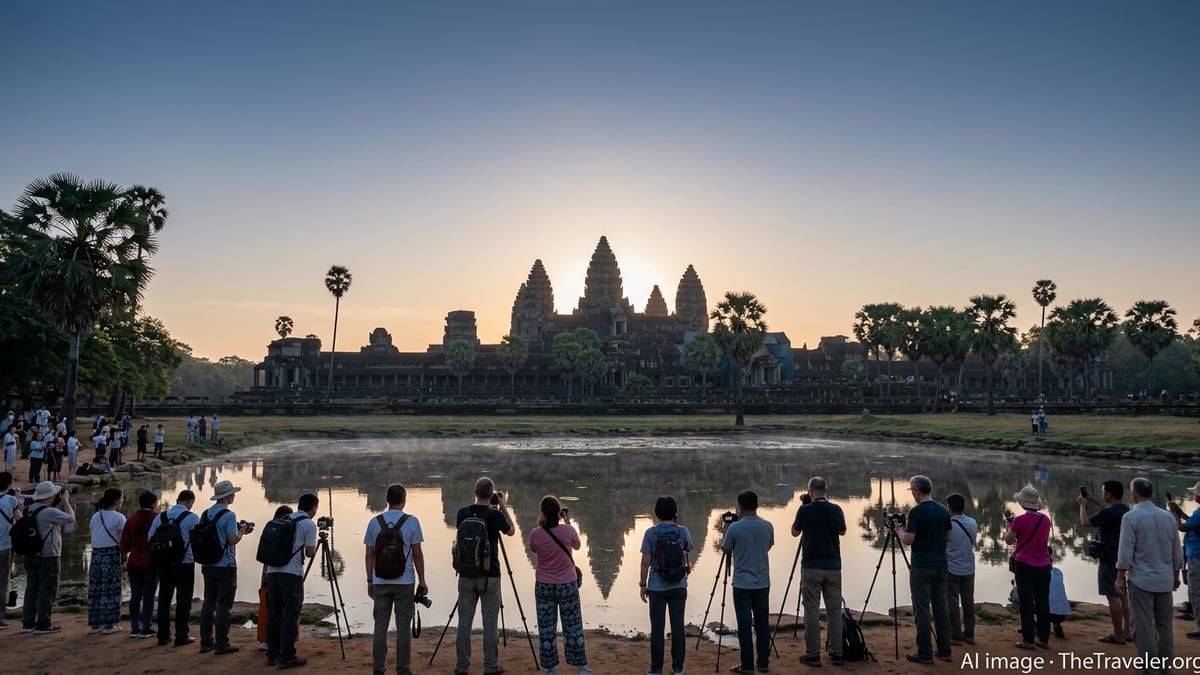
Infrastructure developments continue to shape how travelers enter and move around Cambodia. Siem Reap-Angkor International Airport has been positioned as a key gateway for Angkor and the surrounding region, and Phnom Penh has pursued major airport investment as well. These changes do not remove security considerations, but they do indicate a tourism strategy that extends beyond any single news cycle.
How travelers can respond without overreacting
The most useful way to treat a security warning is as a planning constraint, not a verdict. For Cambodia right now, that means reading the full advisory text, noting exactly which provinces or distance-from-border rules are referenced, and building an itinerary that keeps a clear buffer from the areas flagged for heightened risk.
It also means tightening trip fundamentals that matter everywhere: comprehensive travel insurance that covers medical evacuation where applicable, a plan for reliable communications, and a conservative approach to late-night travel in unfamiliar areas. If you are considering overland crossings near the Cambodia-Thailand frontier, consider alternative routes via major airports or crossings that are not covered by elevated warnings, and verify your transport plan close to departure.
Finally, travelers should keep expectations realistic about what an embassy or consulate can do in a rapidly changing situation. Advisory language often emphasizes that assistance may be constrained in higher-risk areas, which is another reason to avoid treating a border-region warning as a countrywide stop sign, but also a reason not to test the boundaries of the guidance.
Seeing Cambodia beyond the alert banner
Cambodia is not a monolith, and its risks are not evenly distributed. Travelers can acknowledge that a border warning is serious while still recognizing that the country contains diverse destinations and travel styles, from Angkor-area cultural tourism to Phnom Penh’s urban itinerary and coastal breaks that are far from frontier tensions.
The responsible takeaway is not that Cambodia is “safe” or “unsafe” in the abstract. It is that travelers should map risk precisely, make location-specific choices, and avoid letting a simplified headline define a destination whose day-to-day travel patterns often occur far from the zones highlighted in the latest advisories.