

More news on this day
Australia is sharpening its focus on the Canberra to Sydney rail corridor, with fresh planning work and policy signals positioning long-discussed upgrades as a central plank in efforts to strengthen national connectivity and unlock new economic growth along the country’s east coast.
Get the latest news straight to your inbox!
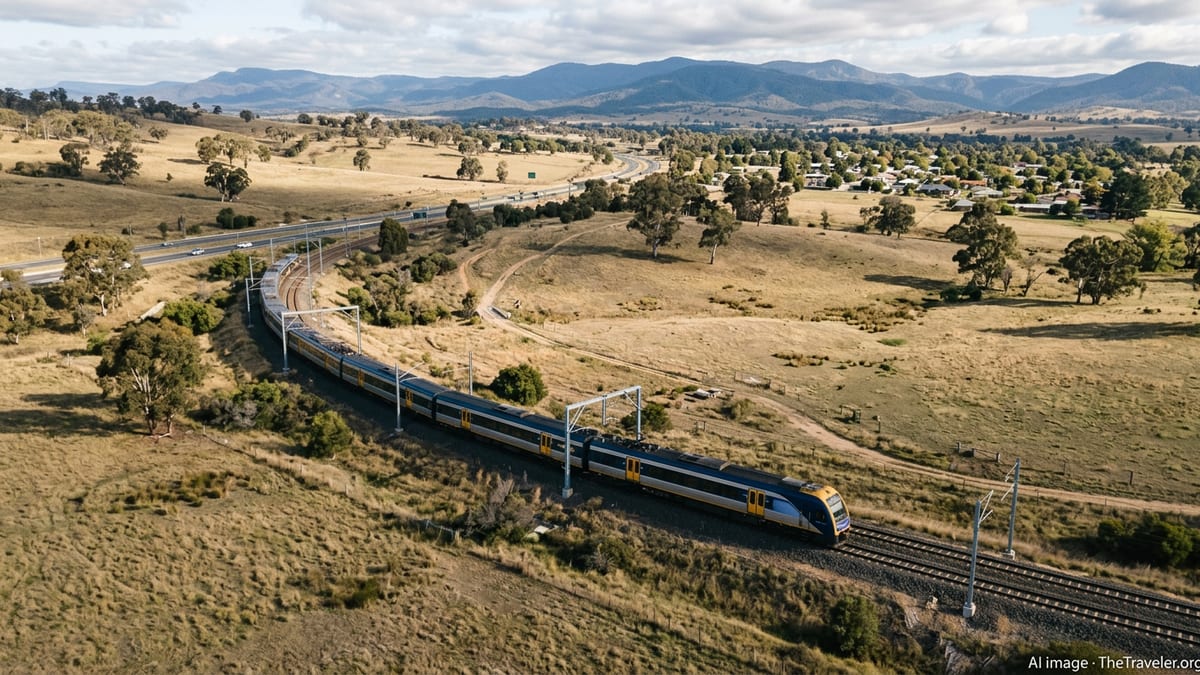
A Strategic East Coast Link Gains New Momentum
The rail line between Canberra and Sydney has long been viewed as underperforming for a national capital corridor, with travel times of around four hours that lag behind global standards for intercity links. Publicly available information from infrastructure agencies and state and territory planning documents indicates that governments now increasingly see the route as a missing piece in a broader east coast network connecting Brisbane, Sydney, Canberra and Melbourne.
The establishment of the national High Speed Rail Authority and its remit to plan an integrated fast rail spine along the eastern seaboard has reframed the Canberra–Sydney line as more than a regional service. Policy papers and recent analysis describe the corridor as a strategic connector between the federal capital, New South Wales growth centres and major coastal routes, with potential to share rolling stock, maintenance facilities and skills with new high capacity lines elsewhere on the network.
Infrastructure Australia’s existing priority listing for Sydney–Canberra rail connectivity and capacity highlights the corridor’s role in supporting business travel, tourism and freight, and calls for staged improvements that can deliver benefits ahead of any full high speed build. Current work on high speed planning between Sydney and Newcastle is being closely watched by advocates, who argue that lessons in corridor protection, governance and funding could be rapidly applied to the Canberra direction.
Transport and planning experts cited in national media coverage have also suggested that the Canberra–Sydney leg may be one of the more technically straightforward early candidates for substantial speed and reliability gains, given sections of relatively unconstrained alignment and the ability to upgrade existing track in stages while planning for future dedicated fast rail segments.
From “Snail Rail” to Faster, More Frequent Services
For many rail users in the Australian Capital Territory and southern New South Wales, the current service has come to symbolise decades of underinvestment. The route is frequently described in local debate as slow and prone to delays, with limited daily frequencies constraining both commuter and visitor travel. According to past ACT infrastructure planning documents, the quality of the link has been identified as a constraint on the region’s economic development and visitor economy.
Recent public commentary from regional leaders, advocacy groups and transport analysts has put renewed pressure on governments to move from studies to delivery. Published coverage in Australian outlets has described a push to reframe the Canberra–Sydney line as a “fast, frequent and reliable” service that can offer competitive travel times against driving and domestic aviation, particularly on a corridor where flying involves airport transfers at both ends.
Technical proposals canvassed in reports and expert submissions include targeted realignments to smooth curves, duplication of single-track sections, modern signalling, and new or upgraded passing loops to support higher speeds and more frequent services. Some specialists have argued for a staged approach that begins with these upgrades to lift speeds and punctuality, while preserving the option of transitioning sections of the corridor to true high speed infrastructure over time.
Advocacy groups have also pointed to international examples where conventional lines were progressively upgraded toward high speed capabilities, suggesting that a similar path on the Canberra–Sydney route could deliver visible gains by the end of the decade while longer-term high speed planning continues.
Economic Growth, Housing and Regional Development Potential
Improving rail between Canberra and Sydney is increasingly framed as an economic development strategy rather than a standalone transport project. Government planning material and think tank analysis link a faster corridor to higher labour mobility, expanded tourism flows, and stronger business ties between the capital and New South Wales regional centres along the line.
National discussion about high speed rail more broadly has emphasised the potential for new stations and upgraded hubs to anchor housing and employment precincts. A recent business case released for the separate Sydney–Newcastle high speed section, widely reported by major Australian media, pointed to tens of billions of dollars in additional economic activity and large numbers of new homes enabled by better rail access in that corridor. Analysts suggest that similar dynamics, at a different scale, could emerge along an improved Canberra–Sydney line if planning for housing, public transport and services is coordinated around upgraded stations.
In the ACT, previous infrastructure plans have highlighted the importance of better intercity connections for attracting investment and highly skilled workers. Stronger rail links are seen as a way to widen Canberra’s effective catchment for both commuters and visitors, easing pressure on roads while supporting the city’s role as a national policy, education and services hub.
Regional towns in New South Wales are also watching developments closely. Faster, more reliable services could support population growth, tourism businesses and decentralised employment, particularly if timetables are designed to support both daily commuting and weekend leisure travel. For the tourism sector, a more attractive rail option is viewed as an opportunity to package multi-day itineraries that connect Canberra’s cultural institutions with regional food, wine and nature experiences en route to or from Sydney.
Corridor Protection and Long-Term Network Planning
One of the decisive steps in moving from aspiration to delivery is protecting future rail corridors before competing development makes construction more difficult and expensive. The ACT government has already reserved land for potential high speed rail alignments into Canberra, including options that would link a future station more closely with the city centre. Publicly available planning information shows that these reservations are being factored into broader land use decisions to avoid blocking future rail options.
On the New South Wales side of the border, coordination between state agencies, the national rail track corporation and the High Speed Rail Authority is viewed as critical. Infrastructure Australia has previously stressed that preserving alignments and key nodes ahead of time can reduce both costs and community disruption when major rail works eventually proceed. Stakeholders arguing for a Canberra–Sydney upgrade have seized on this point, pressing for earlier decisions on priority corridors even if full funding for construction is still some years away.
National high speed rail planning has so far focused on the Sydney–Newcastle section as the first segment to move toward delivery, backed by federal funding for business case work and corridor preservation. However, recent commentary by rail advocates and transport researchers has argued that confirming a clear pathway for the Canberra–Sydney corridor in parallel would provide greater certainty for investors, local governments and communities along the route.
That approach, proponents say, would help align local land use strategies, station precinct planning and regional economic initiatives with an eventual higher capacity rail service, reducing the risk that short-term decisions foreclose long-term national connectivity objectives.
Balancing Ambition, Cost and Climate Goals
Any substantial upgrade to the Canberra–Sydney railway will involve difficult decisions about cost, scope and timing. Australian coverage of the emerging high speed program has highlighted the scale of potential investment and the pressure on public budgets already committed to major metro and road projects in Sydney, Brisbane and Melbourne. As a result, analysts expect intense scrutiny of business cases, patronage forecasts and value-for-money assessments for each new rail segment.
At the same time, the potential climate benefits of shifting more passengers from short-haul flights and private cars to electrified rail are gaining prominence in national debate. Numerous studies cited in recent reporting conclude that well-patronised intercity rail can significantly reduce transport emissions, especially on corridors with high existing travel demand and relatively short distances like Canberra to Sydney.
For the tourism and travel sector, a faster, more reliable train is viewed as an increasingly important part of a low-emissions mobility offering. Industry commentary suggests that visitors, particularly younger and international travellers, are showing growing interest in rail options that are comfortable, time-competitive and marketed as climate-conscious choices.
How quickly upgraded services appear on the Canberra–Sydney line will depend on the pace of detailed planning, funding negotiations and environmental approvals. However, with the corridor now more firmly embedded in national connectivity and growth strategies, observers describe a noticeable shift: after decades of concepts and studies, the capital’s rail link to Australia’s largest city is moving closer to the centre of the country’s transport priorities.