


More news on this day
Travelers at Hartsfield-Jackson Atlanta International Airport faced mounting frustration today as regional carrier Jazz Aviation and major airlines including Delta Air Lines and Southwest Airlines canceled several departures and delayed scores more, briefly stranding passengers across concourses and upending connections to major international destinations.
Get the latest news straight to your inbox!
Targeted Cancellations and a Wave of Delays
Operational data from flight-tracking services on Wednesday indicates that at least four departures operated by or marketed through Jazz Aviation, Delta and Southwest were canceled out of Atlanta in a relatively short window, while around 80 additional flights showed knock-on delays. The figures represent only a slice of the airport’s daily schedule but were concentrated enough to create visible bottlenecks at departure gates and customer service desks.
The disruption followed a familiar pattern for the busy hub, where even a modest cluster of schedule changes can swiftly ripple through connection-heavy itineraries. Publicly available information from monitoring platforms showed departure holds building through the morning and early afternoon, with many services posting delay increments of 30 to 90 minutes.
Federal aviation dashboards for Hartsfield-Jackson reported generally light traffic-management delays, suggesting that the worst of the disruption was airline specific rather than the result of a formal ground stop or broad airspace constraint. In practice, passengers experienced extended waits at gates and crowded seating areas while airlines re-sequenced their operations.
Customer posts on social media platforms, along with independent travel forums, described long lines at rebooking counters and congested concourses as travelers sought alternatives to salvaging missed meetings, family events and onward international connections.
Impact on Key International Routes
Among the flights most closely watched were transatlantic and regional international services that funnel through Atlanta as a primary U.S. gateway. Monitoring tools showed schedule changes and extended gate times touching departures to London and Frankfurt, two of Atlanta’s busiest European markets, as well as services bound for Toronto and Mexico City.
Published route data highlights how central these links are to the airport’s global network, with Delta operating primary nonstops from Atlanta to London Heathrow and Frankfurt and sharing the market with partner and competitor carriers on certain days. When outbound departures fall behind schedule, inbound flights to Atlanta the following day can also face rotations that are tighter than planned, setting up further rolling delays.
Cross-border connections to Toronto Pearson and Mexico City are similarly significant. Travel analytics show that Delta and partner airlines routinely carry hundreds of thousands of passengers annually between Atlanta and those cities, so even a single cancellation or multi-hour delay can strand large numbers of travelers mid-journey. On Wednesday, passengers connecting from smaller U.S. cities reported particular concern about missing the last long-haul or international departures of the day.
For many affected travelers, the immediate consequence was an unplanned overnight stay in Atlanta or a re-routing through alternate hubs such as New York, Chicago or Houston. Some reported being shifted onto later transatlantic flights or onto partner airlines in order to maintain at least an approximate arrival time in Europe or Latin America.
Why a Handful of Cancellations Matters at the World’s Busiest Hub
Hartsfield-Jackson Atlanta International Airport consistently ranks as one of the world’s busiest by total passengers and aircraft movements. According to recent traffic reports, Delta Air Lines alone accounts for the majority of operations, with Southwest and other domestic and regional carriers adding to the dense schedule. In such an environment, even a handful of canceled flights can have an outsize effect.
Industry analyses and prior episodes in Atlanta show that small pockets of disruption can cascade when aircraft and crews are tightly utilized. A weather cell drifting across the Southeast, an unexpected mechanical issue, or staffing shortages in a particular work group can all trigger a sequence of delays as airlines juggle aircraft rotations and flight crews to keep as much of the schedule intact as possible.
Public documents reviewing earlier bouts of irregular operations at Atlanta this year point to similar dynamics: when storms or operational challenges slow arrivals into the hub, aircraft may wait on taxiways for gates to clear, departures are held to manage congestion, and crews can time out under duty rules, forcing airlines to cancel or combine flights. Once this happens on a day with many full flights, rebooking options quickly diminish.
Data from aviation information services on Wednesday showed that while the overall percentage of canceled flights at Atlanta remained relatively low, the delays and targeted cancellations were heavily focused on certain banks of departures. For passengers caught in those windows, the experience was indistinguishable from a much larger meltdown.
Passenger Experience: Crowded Concourses and Scrambling for Options
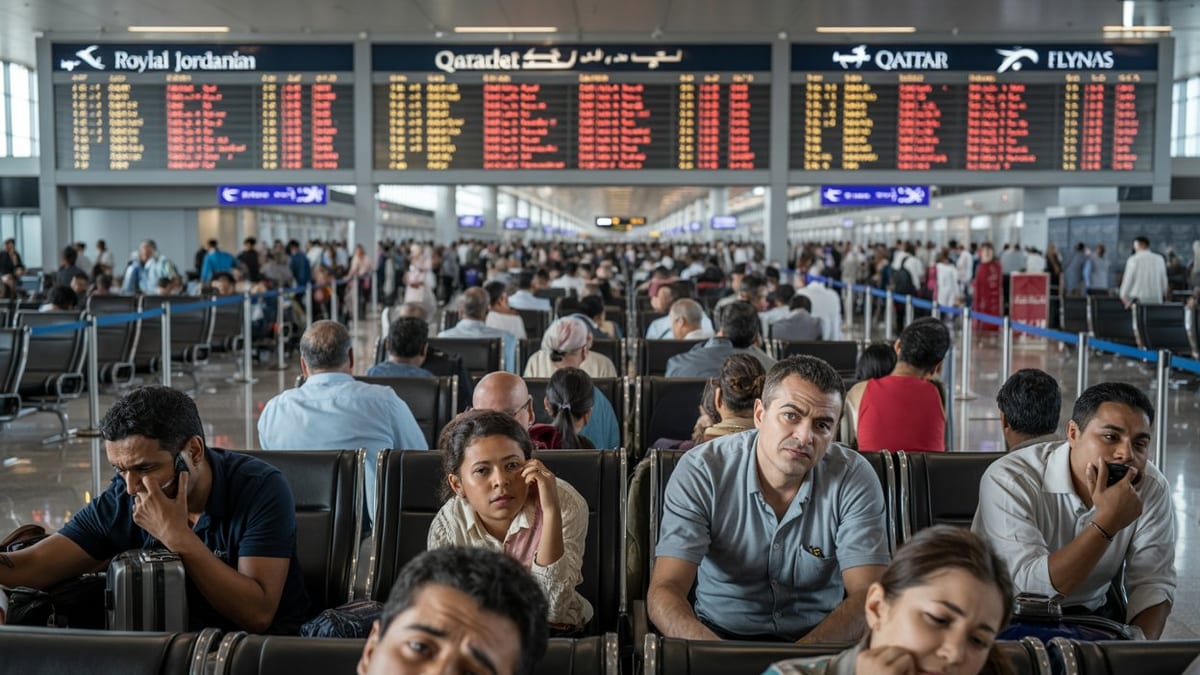
Travelers at Atlanta described concourses filling during the morning and midday as departure boards refreshed with fresh delay estimates. With four flights canceled and dozens running late, gate agents faced lines of passengers seeking earlier alternatives, same-day standby, or rerouting around the disruption to reach Europe and Latin America.
Some customers shared images and accounts on social channels of children sleeping across rows of seats, business travelers working on laptops on the floor near power outlets, and impromptu queues forming at airline help centers. Others reported that the airport’s constant background soundtrack, including the soft jazz often played around the central atrium, seemed at odds with the mounting tension among stranded passengers.
Reports from consumer advocates and frequent-flyer communities highlighted the usual mix of outcomes. Some travelers were rebooked quickly at no additional cost, particularly those with flexible itineraries or elite status. Others struggled to reach call centers or stood in line for extended periods, particularly when their journeys involved multiple carriers whose responsibilities for hotel vouchers and meal compensation can be more complex.
As the day wore on, flight-tracking services showed some of the delayed services gradually departing, alleviating the worst of the congestion. However, with many aircraft leaving Atlanta late, new pockets of disruption appeared downstream at connecting airports, continuing the cycle of inconvenience for travelers elsewhere in the network.
What Travelers Can Do When Atlanta Backs Up
Consumer travel guidance consistently recommends that passengers facing disruptions at major hubs such as Atlanta monitor both airline apps and independent flight-tracking tools for the latest status changes. These platforms often update schedules before airport departure boards and can reveal patterns, such as widespread delays on a particular route or carrier, that help travelers make informed decisions.
Publicly available airline policies indicate that when a flight is canceled or experiences a substantial delay, customers are typically entitled to be rebooked on the next available service at no additional fare. In some circumstances, airlines may offer hotel or meal support, especially when the disruption is within their control, although exact rules and practices vary by carrier and ticket type.
For time-sensitive international trips, travel experts often advise booking earlier departures out of Atlanta to provide a buffer against cascading delays, especially during seasons when thunderstorms or operational constraints are more common. Passengers with tight connections to London, Frankfurt, Toronto or Mexico City may also consider alternative routings through other hubs when booking, trading a slightly longer journey for added resilience.
While Wednesday’s pattern of four cancellations and dozens of delays at Hartsfield-Jackson was modest compared with the most severe disruptions seen in recent years, it underscored how quickly conditions at one of the world’s busiest hubs can deteriorate from routine to highly stressful for individual travelers whose flights happen to be caught in the affected window.