


More news on this day
Air Canada is signalling one of its strongest autumns on record as robust demand for business class and premium economy cabins on long-haul routes to Europe and Japan drives higher revenue expectations for the Canadian flag carrier.
Get the latest news straight to your inbox!
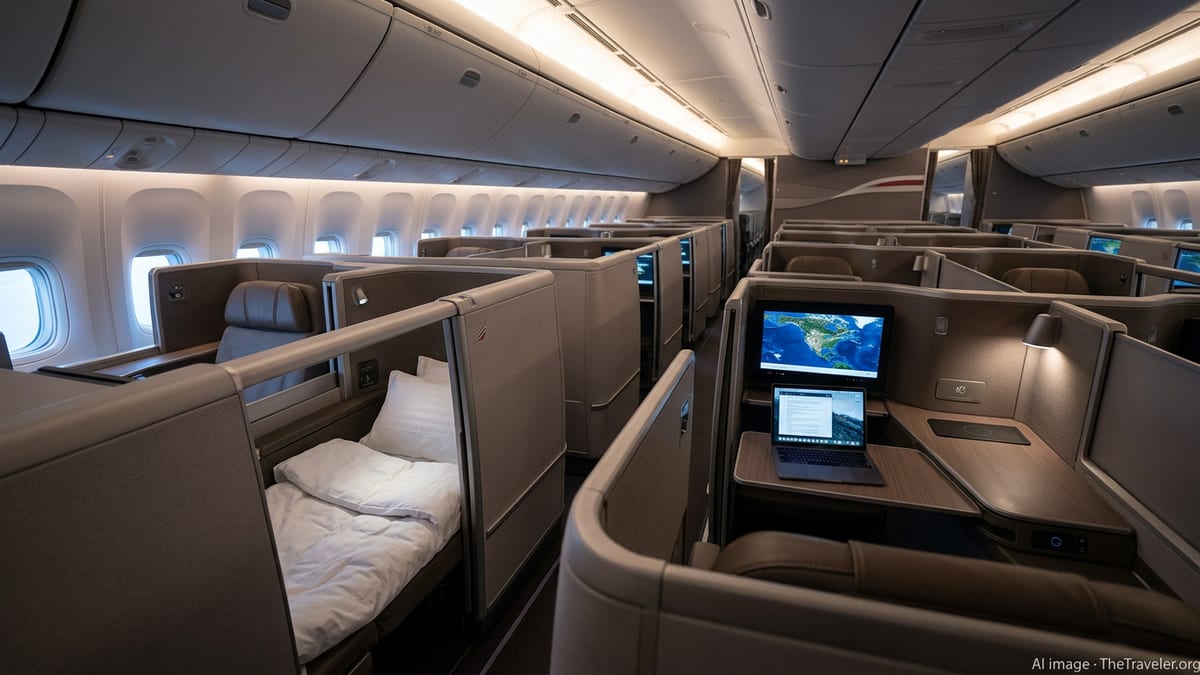
Premium Cabins Drive Revenue Outperformance
Recent financial disclosures and earnings commentary point to premium products sitting at the heart of Air Canada’s growth strategy. Publicly available information from the airline’s 2025 results indicates that premium-class revenue grew faster than economy revenue and now represents roughly one-third of total passenger takings. That mix shift is significant, as revenue from business class and premium economy typically carries substantially higher yields than standard economy seating.
According to published coverage of Air Canada’s February 2026 outlook, the carrier is forecasting core profit for 2026 slightly above analyst expectations, supported by strong long-haul bookings and resilient premium-cabin demand on international routes outside the United States. Reports indicate that demand for front-cabin seats has remained firm even as some North American markets experienced pockets of softness, helping the airline sustain pricing on key transatlantic and transpacific services.
Broader industry analysis underscores this tilt toward the front of the aircraft. A recent study on premium cabins across North American and European networks shows that business and first class have contributed a growing share of airline revenue since before the pandemic, even when passenger numbers fluctuated. For carriers such as Air Canada, that trend makes premium segments a critical buffer against cost inflation and cyclical swings in leisure demand.
With that backdrop, Air Canada is entering the autumn travel period with a network and fare structure increasingly designed to monetise demand for added space, privacy and elevated service, particularly on flights connecting Canada with Europe and Asia.
Europe Emerges as a Corporate and Leisure Hotspot
Corporate traffic patterns are shifting in Air Canada’s favour on transatlantic routes. Business-travel industry reports on the carrier’s recent performance describe nearly a 30 percent increase in corporate traffic to Europe and the Pacific over the past year, reflecting Canadian companies’ efforts to diversify trade corridors and strengthen ties with European markets. This tilt has supported higher premium-cabin load factors on routes from Toronto and Montreal to major hubs such as London, Paris and Frankfurt.
Network data from Air Canada’s 2025 annual report shows that the airline has been steadily reinforcing its European presence with additional frequencies and seasonal routes, capitalising on the geography of its hubs that sit naturally on flows between Europe and the Americas. As capacity has been restored and in some cases expanded, premium demand has remained strong, allowing the carrier to protect yields even as more seats return to the market.
Industry statistics from international aviation bodies indicate that Europe–Asia and Europe–North America flows have been among the most dynamic long-haul corridors in early 2026, with double-digit year-on-year growth in traffic and cargo volumes. For Air Canada, these trends translate into sustained appetite for higher-fare cabins on flights linking Canadian cities with European capitals popular among both corporate and high-spend leisure travellers.
As autumn booking curves build, published forecasts suggest that transatlantic business and premium economy fares are likely to see modest upward pressure, reflecting both the strength of demand and constrained availability in smaller front cabins. This environment positions Air Canada to convert strong seat demand into record seasonal revenue on its European network.
Japan and North Asia Fuel Premium Leisure Momentum
Japan has re-emerged as one of the hottest long-haul destinations in Air Canada’s portfolio, particularly for travellers seeking premium seats. Frequent-flyer and award-travel communities have highlighted how difficult it has become to secure business-class reward seats to Japan on Air Canada or its partners, noting that many itineraries require booking nearly a year in advance. That scarcity reflects how quickly premium inventory is being snapped up by paying passengers on routes to Tokyo and other major Japanese gateways.
Industry demand data for early 2026 shows that traffic on Europe–Asia routes, including services touching Japan, has grown at one of the fastest rates globally, outpacing capacity additions. While scheduled capacity from some Asian markets, including Japan, is expected to remain tight, demand for outbound and inbound travel continues to recover strongly, particularly in higher-yield cabins. Air Canada, with its established transpacific presence and connecting traffic from the United States via Canadian hubs, is well positioned to benefit.
Analysts describe a powerful blend of premium leisure and small-business travel driving this surge. Travellers combining work trips with extended stays, along with tourists prioritising comfort on long overnight sectors, are opting for premium economy and business cabins in greater numbers. That behaviour is especially evident on flights from Vancouver, Toronto and Montreal to North Asia, where longer flight times make upgrades more attractive.
For the upcoming autumn season, this combination of constrained capacity, strong Japanese inbound tourism and rising North American appetite for Asia itineraries is expected to keep front cabins particularly tight. That dynamic supports higher average fares and provides a meaningful tailwind to Air Canada’s revenue outlook.
Network Expansion and Product Strategy Underpin Growth
Air Canada’s ability to capture premium demand in Europe and Japan is closely tied to recent network and product decisions. The carrier’s international schedule for summer 2026, announced in late 2025, introduced new routes across Europe and Asia while upgrading select seasonal flights to year-round operation. While these additions are focused on peak and shoulder periods, they also reshape traffic flows and connectivity into the autumn by building awareness of new one-stop options through Canadian hubs.
The airline has also continued to refresh cabins and refine its long-haul product. Corporate filings describe ongoing investments in cabin refurbishment programs, including updated seating, lighting and in-flight connectivity in premium cabins on widebody aircraft. These improvements are aimed at maintaining a competitive edge against European and Asian rivals that have likewise poured resources into business-class suites and enhanced premium economy offerings.
On the commercial side, Air Canada has experimented with more granular fare families in its premium cabins. Travel-industry reports in mid-2026 have highlighted the introduction of “basic” business-class fares on some routes, giving price-sensitive corporate buyers and affluent leisure passengers a lower entry point into the front cabin by stripping out certain extras such as lounge access or flexibility. This type of unbundling is intended to stimulate incremental premium demand without materially diluting the value of fully flexible fares.
Alongside fare innovation, a series of targeted discount campaigns in 2026 has included promotions across business class and premium economy, often excluding the lowest economy buckets on Europe and Asia-Pacific routes. Observers view these sales as tools to manage seasonality and load factors, nudging travellers into higher cabins while preserving the revenue premium versus standard economy.
Positioning for a Record Autumn and Beyond
Air Canada’s forward guidance for 2026 signals confidence in the sustainability of international demand, particularly in premium cabins. The airline has indicated that it plans to grow available seat miles by roughly 3.5 to 5.5 percent for the year, with a focus on long-haul flying outside the United States. This growth is calibrated rather than aggressive, suggesting a strategy of protecting yields rather than chasing volume at any cost.
Global aviation forecasts for 2026 point to steady increases in international passenger traffic, with premium-class demand expanding at a slightly slower pace than economy but still contributing disproportionately to revenue. Europe–Asia traffic, which underpins many of the itineraries connecting Canada with Japan and continental Europe via partner networks, is projected to remain one of the strongest-performing corridors in the near term.
For travellers, the backdrop of sustained demand and disciplined capacity means that autumn may bring higher fares and less last-minute availability in premium cabins, especially on popular dates around business conferences and school holidays. For Air Canada, however, the same forces translate into an opportunity to set new revenue benchmarks on its transatlantic and transpacific networks.
If current booking trends persist into the shoulder season, analysts expect Air Canada to move through autumn with one of the healthiest international revenue profiles among North American carriers, anchored by powerful premium travel demand across Europe and Japan.