

More news on this day
More than two dozen flights across mainland China have been cancelled this week, disrupting key domestic and regional routes served by China Southern, China Eastern, Shenzhen Airlines and other carriers, and adding fresh pressure on already busy hubs in Beijing, Shanghai, Guangzhou, Chengdu, Shenzhen and Hangzhou.
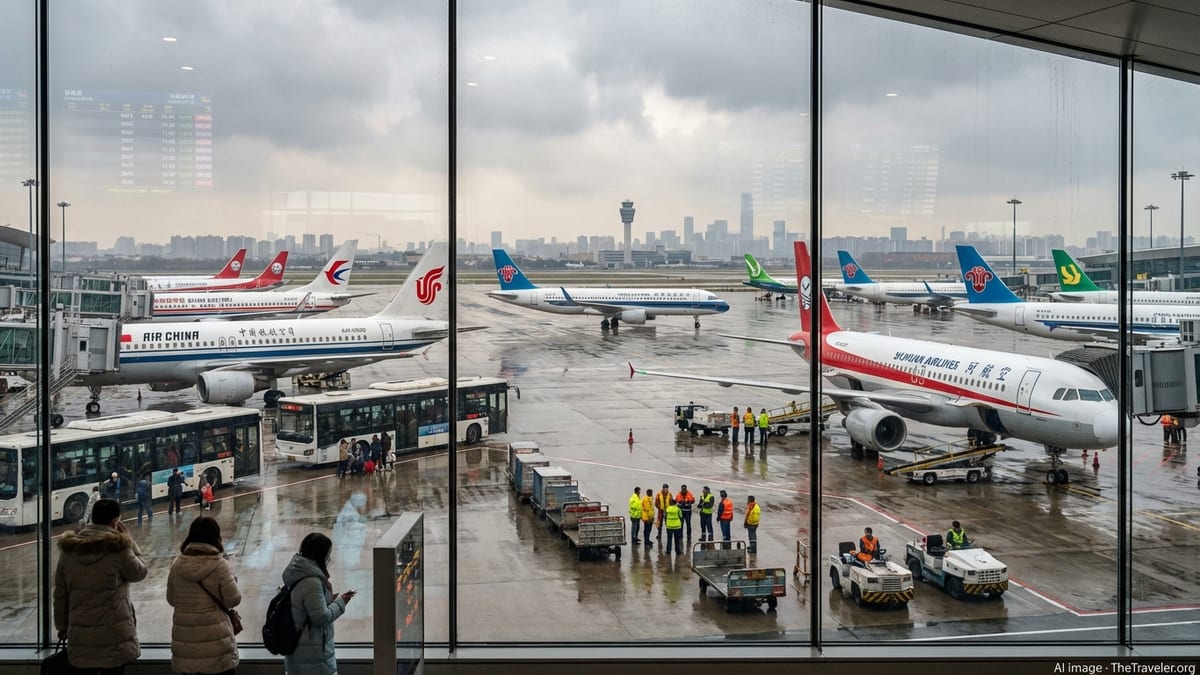
Fresh Wave of Cancellations Hits China’s Aviation Network
A new round of flight cancellations has rippled across China’s domestic network, with operational data showing in excess of 25 services scrubbed over recent days as airlines adjust schedules and respond to localised bottlenecks. While the scale is smaller than major shutdowns seen earlier in the winter, the impact is being felt disproportionately on popular city pairs and regional spokes that feed the country’s largest hubs.
China Southern, China Eastern and Shenzhen Airlines are among the carriers reducing frequencies or dropping individual rotations, alongside other domestic operators. The latest disruptions follow a pattern seen through January and February in which relatively modest cancellation numbers still translate into significant inconvenience when concentrated on peak-time departures and high-demand business routes.
Industry trackers continue to log elevated cancellation and delay ratios at several mainland airports, underlining how fragile recovery-era schedules remain. Although overall capacity across China is robust compared with pre-pandemic levels, the system is proving sensitive to even minor weather events, crew re-rostering issues and aircraft availability.
The result for travellers is a landscape where flights that appear reliable on paper can still be withdrawn at short notice, particularly on secondary legs into and out of tier-two cities that connect through Beijing, Shanghai, Guangzhou and Chengdu.
Major Hubs From Beijing to Shenzhen Bear the Brunt
Beijing and Shanghai continue to act as the primary shock absorbers when airlines trim or reshuffle their operations. Cancellations into these cities from regional airports force passengers to rebook through alternative hubs or travel at off-peak times, lengthening journey durations and complicating connections. Shanghai’s dual-airport system and Beijing’s role as a political and corporate centre mean that even a small cut in daily movements can snarl transfer flows.
Farther south, Guangzhou and Shenzhen are again seeing knock-on effects as southern China’s dense web of short-haul services is adjusted. Travellers connecting through these Pearl River Delta gateways report longer queues at rebooking desks and growing reliance on high-speed rail as a fallback when air options evaporate or sell out rapidly.
Hangzhou and Chengdu, both key pillars in the country’s domestic network, are also feeling the strain. As airlines concentrate capacity on trunk routes with the strongest yields, thinner services to and from these cities can be vulnerable to consolidation. Passengers flying between western and eastern China are particularly exposed when Chengdu-originating flights into Shanghai or Hangzhou are pulled from the schedule.
Even where airports remain operationally stable, the clustering of cancellations at major hubs magnifies disruption for travellers making onward connections to smaller cities, amplifying the effect of what, on paper, appears to be a limited number of scrubbed flights.
Airlines Balance Network Efficiency With Passenger Backlash
Behind the latest cancellations lies a complex balancing act for Chinese carriers. After aggressive capacity rebuilding over the past two years, airlines such as China Southern and China Eastern are fine-tuning networks to better match seasonal demand, fuel costs and fleet utilisation. Trimming underperforming or marginally loaded flights is one lever to protect yields and reduce operational stress.
However, frequent last-minute adjustments are testing passenger patience. Travellers have voiced frustration at short-notice notifications and difficulties securing like-for-like alternatives, especially when cancellations affect the first or last flight of the day on a given route. For business passengers targeting same-day returns, the loss of a single rotation can turn a quick trip into an overnight stay.
To mitigate this, airlines are leaning more heavily on flexible rebooking policies within the same travel day or to nearby airports, as well as encouraging use of digital tools for real-time updates. Yet uneven communication standards between carriers and across sales channels mean some customers still learn about cancellations only upon arriving at the airport.
Analysts note that while the current wave of disruptions is modest by historical standards, it underscores the challenge of running dense, high-frequency domestic networks amid changing demand patterns and intermittent operational constraints.
What Travellers Flying to and Within China Should Do Now
For passengers planning trips involving Beijing, Shanghai, Guangzhou, Chengdu, Shenzhen, Hangzhou or other major Chinese gateways in the coming days, the latest cancellations serve as a reminder to build resilience into itineraries. Travel agents and corporate travel managers are advising clients to allow longer connection windows, particularly when linking regional flights with tight same-day international departures.
Where possible, travellers are being urged to select earlier flights in the day, which historically have a better on-time performance and leave more room for rebooking if schedules change. Choosing routes with multiple daily frequencies and more than one operating carrier can also provide additional fallback options if an individual flight is cancelled.
At the airport, arriving earlier than usual remains prudent while disruptions continue. Extra time can be crucial for securing seats on alternative departures before they sell out, especially during busy evening bank periods at major hubs. Passengers are also encouraged to keep a close eye on airline apps and airport departure boards, as same-day schedule changes remain more common than before the pandemic.
For domestic segments where high-speed rail offers a viable alternative, some travellers are proactively booking flexible train tickets as a contingency, particularly on heavily trafficked corridors between Shanghai, Hangzhou, Nanjing and nearby cities, or on routes linking Chengdu with key western and central Chinese destinations.
Outlook: Elevated Disruption Risk as Peak Travel Approaches
With China’s aviation network moving toward spring and early summer peaks, the risk of further rolling disruptions is likely to remain elevated. Seasonal weather patterns, continuing fleet rotations and ongoing fine-tuning of domestic capacity suggest that sporadic cancellations on key routes will persist, even if headline numbers stay relatively modest.
Market observers expect airlines such as China Southern, China Eastern, Shenzhen Airlines and their peers to keep adjusting schedules week by week as they track booking curves and operational performance. This data-driven approach can support stronger long-term reliability but, in the short term, may translate into continued last-minute changes on select flights.
For now, the latest round of more than 25 cancellations serves as a timely signal for travellers not to assume that all published schedules are fixed. Building flexibility into plans, monitoring flights closely and understanding rebooking options will be essential strategies for anyone flying into or within China’s busy airspace in the days ahead.