


More news on this day
China’s high-speed rail network has entered a new phase of growth, crossing the 50,000-kilometer mark as fresh investment, new corridors and overseas projects consolidate the country’s position at the center of global rail development.
Get the latest news straight to your inbox!
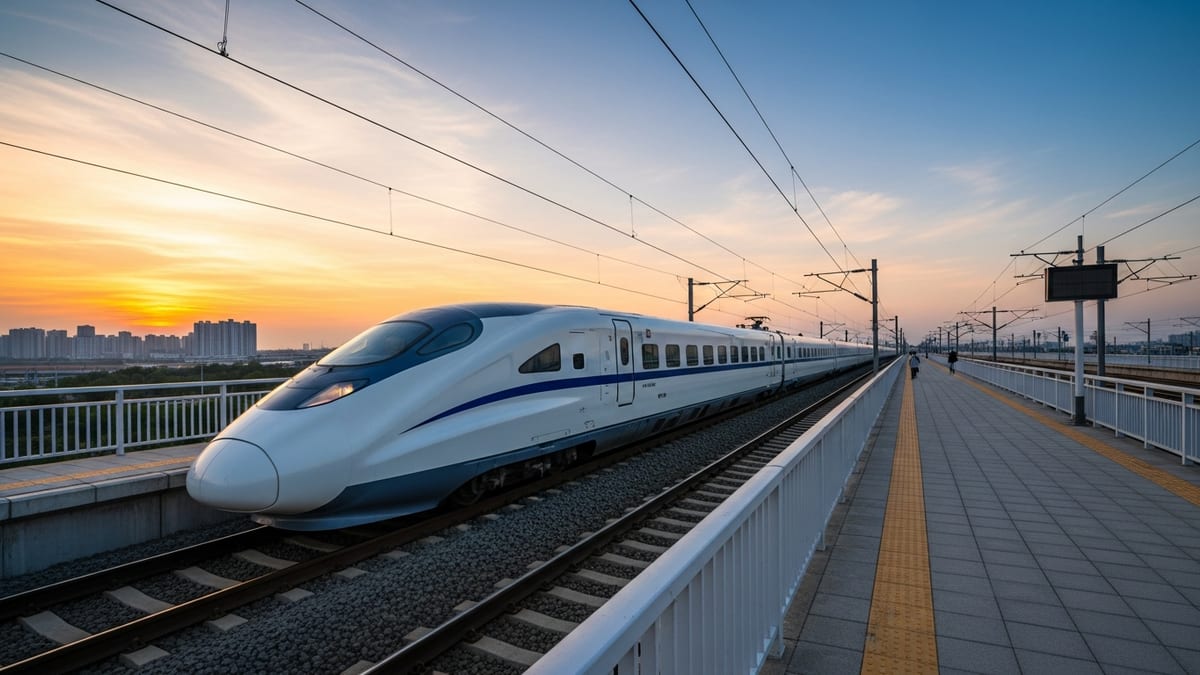
Network passes 50,000 kilometers as new lines open
Publicly available transport statistics indicate that China’s high-speed rail network now exceeds 50,000 kilometers in operation, accounting for the majority of the country’s newly built railway mileage in recent years. High-speed routes now touch 31 of 34 provincial-level regions, knitting together major coastal megacities, inland provincial capitals and emerging industrial hubs.
Data released in early 2026 on rail construction in 2025 show that China put more than 3,100 kilometers of new railway into service in a single year, with close to 2,900 kilometers built to high-speed standards. This pushed the national railway network to roughly 165,000 kilometers in total, of which high-speed lines represent nearly one third, underscoring the priority given to faster intercity travel.
China State Railway Group and transport authorities have signaled that expansion will continue through the current planning cycle. Official targets for 2030 envisage around 180,000 kilometers of total railway, including about 60,000 kilometers of high-speed track, meaning thousands of additional kilometers of high-speed corridors are due to open before the end of the decade.
Alongside new mileage, the network is being used more intensively. Winter and summer timetable adjustments for 2026 introduce more than 12,000 scheduled trains per day nationwide, with heavily trafficked high-speed sections in the Pearl River Delta reported to be among the busiest in the world by frequency.
New corridors shorten journeys across key regions
The newest wave of high-speed projects is focused on filling gaps in China’s interregional grid and strengthening links between major city clusters. Recent openings include high-speed routes between Shantou and Shanwei in Guangdong, Wuhan and Yichang in central Hubei, and Baotou and Yinchuan in the north, each cutting travel times by several hours compared with older conventional lines.
Transport planning documents highlight the role of such links in creating continuous high-speed corridors. The Wuhan–Yichang section, for example, forms part of the larger Shanghai–Chongqing–Chengdu axis, which will eventually connect the Yangtze River Delta on the east coast with major inland centers in Sichuan and Chongqing. In the north, new lines connect Hohhot more efficiently with Lanzhou and Yinchuan, improving access across the less densely populated northwest.
Regional integration initiatives are also pushing high-speed expansion. In the Yangtze River Delta, local governments have agreed on dozens of interprovincial transport projects for the 2026 to 2030 period, including further work on the Shanghai–Chongqing–Chengdu high-speed corridor and additional intercity lines around Shanghai, Suzhou and Jiaxing. Officials in the region describe rail connectivity as a backbone for deeper economic coordination across provincial borders.
Major trunk lines that opened more than a decade ago continue to set new usage records. The Beijing–Shanghai high-speed route, which marked its 15th anniversary in mid-2026, has carried more than 2.3 billion passenger trips since launch. As more feeder lines connect into such flagship corridors, their role as national spines of the network continues to grow.
Shift from rapid build-out to higher-quality operations
Industry commentary in Chinese media describes a gradual shift in priorities from sheer expansion speed toward higher-quality, more efficient operation of the existing network. While annual additions of new high-speed lines remain substantial, attention is increasingly turning to timetable optimization, maintenance, digital signaling upgrades and passenger experience.
Research published in recent years by academic and multilateral institutions highlights how the first generation of high-speed lines has altered regional economies by shrinking travel times, expanding labor markets and redirecting investment. Case studies of county-level economies along the network find measurable gains in manufacturing and services output in areas that gain high-speed stops, suggesting that the benefits of the network extend beyond headline ridership figures.
At the same time, analysts note that the financial and operational sustainability of such a vast system is an emerging challenge. With slower growth in some regions and tighter scrutiny of public borrowing, transport planners are under pressure to ensure that new high-speed routes align with long-term demographic and economic trends rather than replicating capacity where demand is uncertain.
In response, planning documents for the 2026 to 2030 period emphasize the completion of key national corridors, improved connectivity to existing conventional rail, and better integration with urban transit. The focus is on securing network effects and raising throughput on existing lines, rather than simply chasing headline mileage figures.
High-speed rail as a pillar of domestic tourism and travel
For travelers within China, the continued expansion of high-speed rail is reshaping how people move for work, leisure and family visits. Journey times of two to six hours between many major cities have positioned high-speed trains as a preferred alternative to short-haul flights, especially on routes such as Beijing–Shanghai, Guangzhou–Shenzhen and Shanghai–Hangzhou.
Tourism boards and local governments increasingly market destinations based on their high-speed accessibility, highlighting station-to-scenic-area connections, integrated ticketing and rail-inclusive tour packages. In regions like the Yangtze River Delta and the Pearl River Delta, dense webs of high-speed and intercity lines allow travelers to base themselves in one city and make rapid day trips to multiple others.
Published ridership data for the 2024 and 2025 peak holiday seasons show record passenger volumes, with trains frequently operating at or near capacity during the Lunar New Year and summer travel periods. High-speed rail has become particularly important for second-tier and inland cities that previously relied on slower overnight trains or long-distance buses, broadening the range of destinations that domestic and foreign tourists consider for short stays.
As more airports, metro systems and bus terminals connect directly to high-speed rail stations, transfer times are falling and multimodal journeys are becoming smoother. This integrated approach is central to the country’s long-term goal of building what planning documents describe as a comprehensive, three-dimensional national transport network covering road, rail, air and waterways.
Extending influence through overseas high-speed partnerships
China’s high-speed ambitions are not limited to its domestic network. Rail technology, engineering services and financing tools developed at home are being exported through joint projects abroad, particularly under the Belt and Road framework. The Jakarta–Bandung high-speed railway in Indonesia, which began commercial operation in 2023, is the most prominent example to date.
According to published coverage from Indonesian and Chinese outlets, the 142-kilometer Jakarta–Bandung line has carried more than 15 million passenger trips since opening, cutting journey times between the two cities from around three hours by road to under one hour by train. The service, marketed locally under the brand Whoosh, uses Chinese-designed rolling stock and signaling systems adapted to local conditions.
The project has drawn international attention both for its technical achievements and for its financial structure, which combines Chinese loans, Indonesian public funding and equity from a joint venture company. Debates in Indonesia over cost overruns and debt restructuring have made the line a test case for how large-scale rail infrastructure financed with foreign capital can be managed over the long term.
Despite those questions, railway cooperation remains a central element of China’s outward-facing infrastructure strategy. Additional feasibility studies and framework agreements for high-speed or higher-speed lines have been reported in parts of Southeast Asia, the Middle East and Eastern Europe, suggesting that the expertise accumulated through the domestic build-out will continue to shape rail development well beyond China’s borders.