


More news on this day
From Beijing to Shanghai and hundreds of city pairs in between, China’s expanding high-speed rail network is challenging domestic flights on speed, price and convenience, forcing travellers to rethink what a “fast” journey really means.
Get the latest news straight to your inbox!
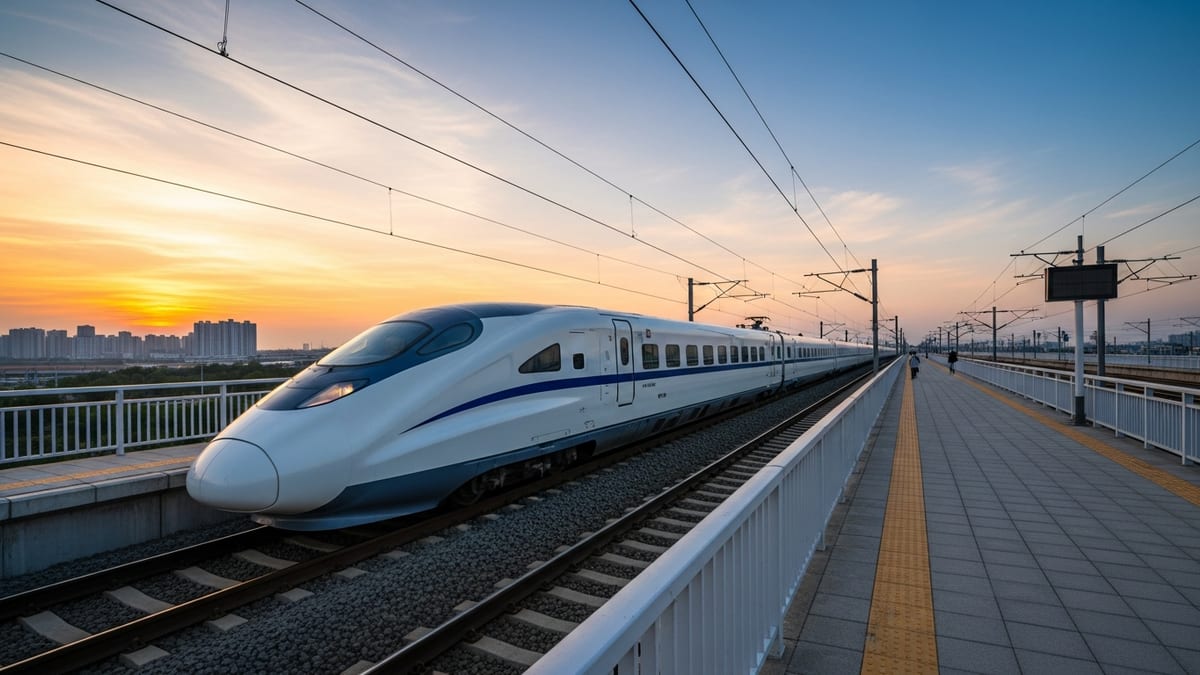
Door-to-door time: when trains beat planes on speed
Headline journey times suggest that flying is faster. A typical Beijing to Shanghai flight covers around 1,100 kilometres in about two hours in the air, while high-speed rail takes about four and a half to five and a half hours depending on the service. Yet door-to-door, the picture is more complicated.
China’s main high-speed stations are often located in or near city centres and are linked to metro systems, cutting surface travel times. By contrast, major airports such as Beijing Capital and Shanghai Pudong generally require longer transfers and buffer times for check in and security. Travel planning comparisons published in recent transport studies show that when these factors are included, total travel time between Beijing and Shanghai narrows to within about half an hour either way for many passengers, and rail can be quicker for those starting or ending close to the station.
On medium-distance corridors of 500 to 800 kilometres, such as Wuhan to Shanghai or Guangzhou to Changsha, publicly available timetables indicate that trains taking three to four hours are now directly competing with short flights that require similar or greater overall time once airport procedures are counted. According to industry analyses of domestic routes, this is the range where high-speed rail has captured the largest share of travellers from airlines.
Delays further complicate the comparison. Research using Chinese flight data has documented significant schedule risk due to congestion and weather, particularly on trunk routes. By contrast, high-speed services are generally reported to run with high punctuality, making rail travel times more predictable even when the scheduled journey is longer on paper.
Price, comfort and productivity reshape the idea of “fast”
For many travellers, the fastest trip is not simply the one with the shortest clock time. Ticket pricing, onboard comfort and the ability to work or rest are increasingly central to decisions between rail and air in China.
Government-backed investment and regulated fares have kept many high-speed rail tickets competitively priced. Studies of Beijing Shanghai and other flagship lines note that second class rail fares often undercut flexible economy air tickets, especially when airline discounts are limited during peak periods. Airlines have responded by cutting prices on some overlapping routes, but published market research suggests that rail continues to draw passengers who prioritise value and predictability over marginal time savings.
Surveys and consumer reports highlight that trains offer more generous legroom, wider seats and the freedom to move around, alongside the practical advantage of stable mobile and data connections for much of the journey. For business travellers, the ability to work uninterrupted for several hours can make a four hour train effective time use compared with a fragmented air journey involving boarding queues and switching devices on and off.
Overnight services on parts of the network add another dimension. While not all high-speed lines offer sleepers, where they exist they allow passengers to travel while sleeping and arrive early in the morning, effectively compressing the perceived travel time compared with an evening flight followed by a hotel stay.
Environmental performance and policy pressures
Beyond individual convenience, environmental considerations are influencing how the speed debate is framed. A growing body of Chinese and international research comparing modes from a life cycle perspective finds that electrified high-speed rail generally produces significantly lower carbon emissions per passenger kilometre than domestic jet aircraft on the same routes, particularly when powered increasingly by cleaner electricity mixes.
Recent academic work focusing on the Beijing Shanghai corridor concludes that shifting demand from air and road to rail strengthens the emission reduction advantage of the high-speed network. Other modelling studies of the wider system indicate that as more high-speed lines open and are electrified, average emissions per passenger trip can fall further, even after accounting for the substantial embedded carbon in construction.
Policy documents and sector plans make clear that China views rail as a key tool for meeting climate and air quality targets. Analyses of air transport policy over the last decade report that on routes newly served by high-speed lines, airlines have reduced frequencies, downgraded aircraft size or withdrawn altogether, effectively nudging travellers toward rail where there is a viable alternative.
For environmentally conscious travellers, published comparisons of mode-specific emission factors present a consistent message: per passenger, high-speed rail is usually the lower carbon choice on these domestic links. That does not make it universally faster, but it does change how many people weigh the trade off between minutes saved and emissions generated.
Network coverage, reliability and regional gaps
China’s high-speed rail system is now the largest in the world, stretching for tens of thousands of kilometres and linking most major cities. Official statistics and sector overviews describe a network built around national corridors that connect dense eastern and central provinces, with further expansion planned into western regions.
Even so, coverage is not uniform. Large parts of the northwest and southwest remain more dependent on air links, and on routes where terrain or distances exceed around 1,000 to 1,200 kilometres, flying maintains a firm advantage in time. Airlines have increasingly focused on these longer domestic and international services as high-speed rail has eroded demand on short and medium routes.
Reliability perceptions also influence mode choice. While aviation safety rates are very high, Chinese travellers regularly encounter disruptions from storms, airspace constraints and traffic congestion. Publicly available performance data and academic assessments often describe high-speed rail as more reliable in terms of departure and arrival times, though the rail system is not immune to weather events and occasional technical failures.
The result is a patchwork. On some dense corridors where stations sit in city centres and trains run every few minutes, high-speed rail has become the default mode, with flights reduced or cut. On others, particularly in less populated regions, aviation remains the only realistic fast option, and any future high-speed rail projects will need to reconcile high capital costs with uncertain demand.
How travellers can decide what “better” means
The question of whether a faster journey is always better has no single answer in China’s evolving transport landscape. Research into passenger welfare suggests that travellers respond to a bundle of attributes that includes total time, reliability, comfort, price and environmental impact, rather than speed alone.
For a business traveller making a same day return between two major cities on a busy corridor, high-speed rail may offer a more predictable, productive and less stressful experience, even if the clocked journey takes an hour longer than a flight. For a tourist connecting remote destinations or working within a tight schedule, a domestic flight can still be the only practical way to cover long distances.
Travel advisories and comparative studies of China’s transport modes recommend that passengers assess origin and destination access, expected delay risks, and their own priorities. When proximity to a central station, high train frequency and a modest distance align, rail can effectively be the faster and more efficient choice. Where airports are closer, distances are great or connections are tight, air travel remains hard to beat on pure speed.
As China continues to expand and refine both networks, the competition between train and plane is less about a single fastest option and more about offering differentiated choices. For travellers, the better journey increasingly depends on which combination of time, comfort, cost and climate impact matters most on a given day.