

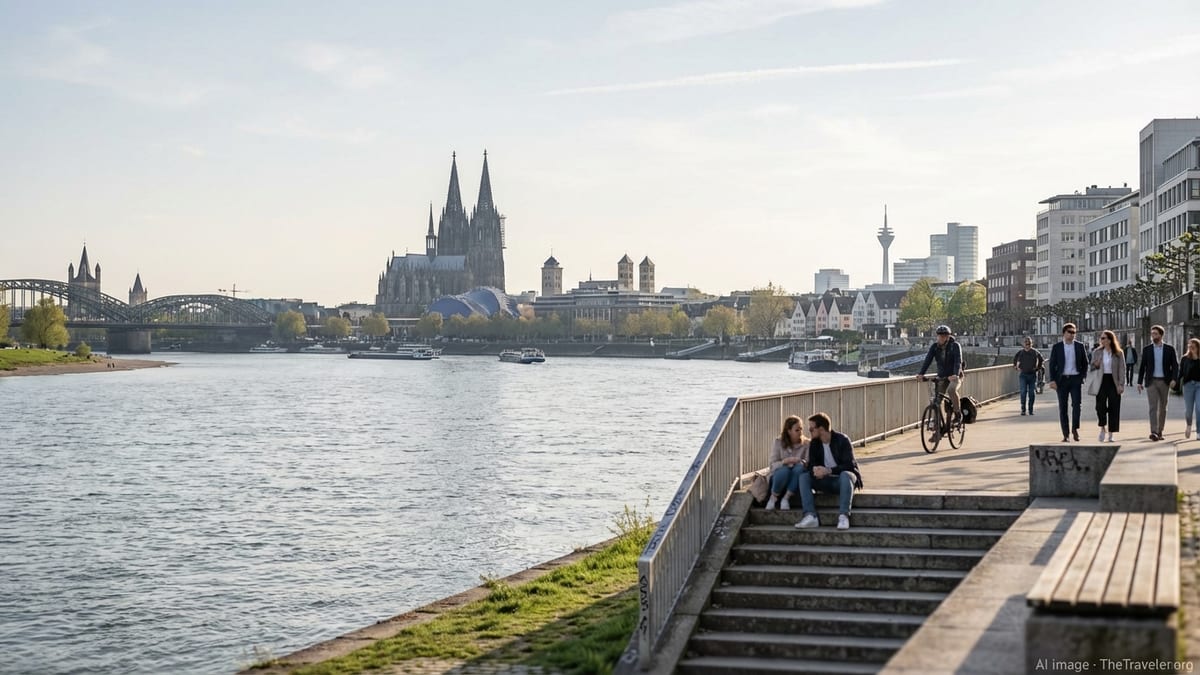
Separated by just 40 kilometers of Rhine River, Cologne and Düsseldorf have spent centuries eyeing each other across the water as friendly rivals. For travelers deciding where to spend a precious few days in western Germany, the choice can feel like picking sides in a quietly passionate local debate.
Cologne is larger, older and more overtly romantic, anchored by its soaring Gothic cathedral and a famously warm, bohemian spirit. Düsseldorf is sleeker and more compact, a capital of fashion and design with polished riverfront promenades and a cosmopolitan buzz. Both are rewarding; which one is “better” depends on what you want your Rhine city break to feel like. This comparison works best after understanding whether Cologne is worth visiting on its own.
First Impressions: Character, Scale and Atmosphere
Cologne is the extrovert of the pair. With nearly 1.1 million residents, it is the fourth largest city in Germany and the biggest in North Rhine-Westphalia. The historic core spreads along the left bank of the Rhine, threaded with medieval churches, crooked lanes and lively squares. The first glimpse of the twin spires of Cologne Cathedral from the train window sets the tone: this is a city that wears its history on a dramatic sleeve. The mood is relaxed and sociable rather than formal, and visitors often remark that Cologne feels more like a big village than a metropolis.
Düsseldorf, with around 620,000 residents, is smaller but often feels more urbane. As the state capital of North Rhine-Westphalia and a major business and fashion hub, it presents a carefully composed cityscape of 19th century boulevards, waterfront plazas and striking contemporary architecture. The compact center, largely on the east bank of the Rhine, is easy to grasp in a day or two. Where Cologne leans into its rough edges, Düsseldorf prefers clean lines and polished stone, from its luxury shopping avenue Königsallee to the revamped harbor district of MedienHafen.
In terms of atmosphere, Cologne is more relaxed and improvisational, with a strong student presence, plenty of street art and a tolerant, alternative streak that surfaces in everything from its nightlife to its Carnival traditions. Düsseldorf feels more curated and design conscious. You are more likely to pass showrooms and gallery spaces here, and the lunchtime crowds skew toward well-dressed professionals. For some travelers that reads as sophisticated; for others, Cologne’s looser, more informal charm wins out. Reviewing the main things to do in Cologne highlights how it differs from Düsseldorf.
Landmarks and Sights: Cathedral vs. Skyline
If your image of the Rhine is tied to dramatic church spires and medieval stonework, Cologne has an immediate advantage. Cologne Cathedral is one of Europe’s great Gothic churches, begun in the 13th century and completed in the 19th. It dominates the skyline beside the river and the main train station. Visitors can tour the cavernous interior, view medieval art treasures, and climb hundreds of steps to a viewing platform for a sweeping look over the city and the Rhine bridges. Around the cathedral, the Old Town fans out in cobbled streets lined with pastel gabled houses and traditional beer halls.
Beyond the cathedral, Cologne offers a dense cluster of Romanesque churches, archaeological sites and museums. The Romano-Germanic Museum preserves mosaics and artifacts from the city’s Roman past. The Museum Ludwig is a major draw for modern art lovers, with an important collection of Picasso and pop art. The Cologne Chocolate Museum and the riverside Rheinauhafen district, where old brick warehouses share space with futuristic “crane house” towers, add variety along the water’s edge.
Düsseldorf’s charms are less about a single blockbuster monument and more about composition and views. The city’s best known modern landmark is the Rheinturm, a 240 meter telecommunications tower whose observation deck gives a wide panorama of the river’s curve, the Old Town and the harbor. At its base, the MedienHafen area showcases striking contemporary buildings by architects such as Frank Gehry, their twisted facades mirrored in the water. This is Düsseldorf’s answer to Cologne’s cathedral: a symbol of ambition and design rather than ecclesiastical power.
In the historic Altstadt, Düsseldorf preserves its own ensemble of churches and townhouses, though on a smaller scale than Cologne. The charm lies in the intimate street grid, river access and the way the Old Town flows directly onto the Rheinuferpromenade, a broad pedestrian riverfront lined with outdoor cafés. Together with the tree lined Königsallee canal just a few minutes inland, these set pieces make Düsseldorf particularly photogenic in the golden hour, when the Rhine turns silver and the city’s parks and promenades fill with people.
Food, Beer and Nightlife: Kölsch vs. Altbier
In both cities, beer is not just a drink but a civic emblem. Cologne is synonymous with Kölsch, a pale, top fermented beer served in slender 200 milliliter glasses. Traditional breweries in the Old Town serve Kölsch almost continuously, with waiters circulating between the wooden tables carrying trays of fresh glasses that replace your empty one unless you signal to stop. This ritual, together with simple Rhineland dishes such as Himmel und Äd (mashed potatoes with apples and sausage) or hearty pork knuckles, gives a strong sense of place. Even if you are not a beer enthusiast, settling into a Kölsch hall is part of the Cologne experience.
Düsseldorf’s specialty is Altbier, a copper colored, malt forward beer also brewed with top fermentation but matured longer at cooler temperatures. It is poured in similarly small glasses in the Altstadt’s traditional brewpubs, particularly around streets like Ratinger Straße. Locals treat the compact Old Town as the “longest bar in the world,” with dozens of bars, pubs and late night spots shoulder to shoulder. Altbier culture feels marginally more restrained than the boisterous Kölsch halls, but on weekends the area can be just as lively.
When it comes to broader food culture, Cologne offers a wide spectrum from unpretentious street food and student-friendly eateries to a handful of fine dining restaurants. Turkish, Middle Eastern and Asian cuisines are well represented in neighborhoods such as Ehrenfeld and Nippes, reflecting long established migrant communities. The vibe is eclectic and approachable rather than trend conscious, which suits travelers looking to eat well without much planning.
Düsseldorf, by contrast, leans more toward the polished end of the spectrum. The city is renowned for its Japanese community, one of the largest in Europe, concentrated around Immermannstraße. This gives Düsseldorf an exceptional choice of ramen bars, sushi counters and izakaya style spots, a rare culinary highlight in Germany. Along Königsallee and in the harbor, upscale restaurants and cocktail bars cater to business travelers and fashion visitors. Prices can be a touch higher than in Cologne, but the standard of presentation and service tends to match.
Culture, Museums and Events
Both cities invest heavily in culture, but they express it differently. Cologne’s museum landscape is anchored by major institutions like Museum Ludwig and the Wallraf Richartz Museum, which covers European painting from the Middle Ages into the 19th century. Smaller venues highlight photography, applied arts, city history and Jewish heritage. The density of churches, including twelve large Romanesque churches in the old core, also turns the city itself into a kind of open air museum of sacred architecture.
Düsseldorf emphasizes contemporary art and design, building on the legacy of the Kunstakademie Düsseldorf, an arts academy associated with influential post war artists and photographers. The Kunstsammlung NRW operates several sites devoted to 20th century and contemporary art, while the Kunstpalast museum combines fine arts with design and glass collections. Galleries cluster in districts such as Flingern and around the old harbor, and visiting them can feel like a curated walk through the European art market.
On the events calendar, both cities are powerhouse hosts of trade fairs and festivals that shape the travel experience. Cologne’s huge Koelnmesse complex brings millions of visitors each year for everything from games and digital culture to food and hardware fairs. During major events hotel prices spike and the city teems with delegates. Düsseldorf’s Messe grounds on the north side of the city play a similar role, particularly in sectors like boating, medical technology and printing, frequently filling the city’s hotels with international business guests.
For most leisure travelers, though, the signature events are Carnival and Christmas markets. Cologne Carnival has a particularly strong identity, with elaborately scripted parades, local songs and costumes that fill the streets in the week leading up to Ash Wednesday. Düsseldorf has its own Carnival traditions and parades, colored by the longstanding rivalry between the two cities, but Cologne’s celebrations are generally larger and more famous. Around Advent, Cologne hosts multiple Christmas markets scattered across squares around the cathedral, the Old Town and neighborhoods such as the Stadtgarten, each with its own atmosphere. Düsseldorf mounts its own suite of themed markets near Königsallee and the Old Town, with stylish decor and a strong emphasis on skating rinks, light installations and design led stalls.
City Layout, Green Spaces and Getting Around
From a practical standpoint, Düsseldorf is easier to navigate on a short visit. Most major sights sit within a tight triangle bounded by the main station, the Old Town and the Königsallee. The Rhine promenade stitches them together, and the compactness means that many visitors explore almost entirely on foot. A reliable network of trams, buses and underground lines covers outlying neighborhoods, with the Rhine bridges giving quick access to riverside parks and residential districts on the west bank.
Cologne, by comparison, is more spread out and a little rougher around the edges. The main landmarks such as the cathedral, Museum Ludwig and the Old Town cluster near the station, but interesting districts like Ehrenfeld, Belgian Quarter and Deutz sit further out and reward a bit of tram or bike travel. The city’s patchwork reconstruction after the Second World War left some busy traffic arteries cutting through the center, which can make the pedestrian experience feel less cohesive than in Düsseldorf. Yet this sprawl comes with unexpected pockets of charm, from quiet courtyards to repurposed industrial sites along the Rhine.
Both cities offer broad riverfront paths that invite walking, running and cycling. Düsseldorf’s Rhine embankment is especially elegant, with terraced steps down to the water and uninterrupted views upriver and downriver. Cologne’s banks feature longer stretches that mix promenade sections with more utilitarian areas, but they offer striking perspectives on the cathedral and the arched Hohenzollern Bridge lined with trains. Green spaces are plentiful in both, though Düsseldorf’s parks, such as the Hofgarten near Königsallee and the larger urban forest areas, feel more integrated into the city center.
Public transport connections link the two cities in as little as 20 to 30 minutes by regional train, making it entirely feasible to stay in one and day trip to the other. For travelers flying in, Düsseldorf Airport is one of Germany’s busiest and sits just north of the city with strong rail links to both Düsseldorf and Cologne. Cologne Bonn Airport, southeast of Cologne, also serves a wide mix of European routes. Your decision may come down to which airport has the most convenient or affordable flights for your itinerary.
Costs, Crowds and Best For Whom
In terms of everyday costs, Cologne and Düsseldorf are broadly comparable. Both sit on the higher side for Germany but below the prices of Munich or central Berlin. Accommodation prices in each city fluctuate sharply around major trade fairs and Carnival; at these times, Düsseldorf can feel particularly expensive due to its role as a business hub. Accommodation options also influence the choice, especially when comparing the best hotels in Cologne.
Outside peak dates, midrange hotels and comfortable guesthouses in both cities are accessible to many travelers, and public transport tickets, museum entry and casual dining are still reasonably priced by western European standards.
Crowding is another consideration. Cologne’s central station, cathedral and riverfront can feel very busy at almost any time of year, amplified during weekends, Carnival and Advent. The same popularity that makes Cologne feel lively can also mean lines for major sights and a sometimes jostling atmosphere in the Old Town. Düsseldorf’s center is lively around the shopping streets and Altstadt, but the more ordered street grid and roomier river embankment often make it feel less congested. During big trade fairs, however, hotel lobbies and central restaurants brim with exhibitors and attendees, shifting the city’s focus more toward business than leisure.
For first time visitors to Germany, Cologne often serves as a gentle introduction to Rhineland warmth, with recognizable icons like the cathedral, easy day trips along the Rhine and a strong sense of local culture. Its slightly scruffy edges and visibly lived in streets appeal to travelers who like cities with layers and contradictions. Düsseldorf is an excellent fit for visitors drawn to contemporary architecture, design, fashion and a more curated urban experience. Art collectors, business travelers tacking on a weekend and food lovers curious about Japanese and high end dining will find much to enjoy in its polished core.
If you are planning a multi day stay focused mainly on museums, churches and historic ambiance, Cologne may have the edge. If you prefer to combine riverfront strolling, boutique shopping and gallery hopping in a compact, stylish package, Düsseldorf is likely to suit you better. Thanks to the quick rail link between them, it is entirely reasonable to split your time or base yourself in one and sample the other for a day before you decide where your allegiance lies.
The Takeaway
Calling one Rhine city “better” than the other misses the point of the Cologne versus Düsseldorf rivalry. Each has built its reputation by leaning into a different side of Rhineland identity. Cologne is the story rich cathedral city, shaped by two thousand years of history, with Carnival confetti in its hair and a glass of Kölsch in its hand. Düsseldorf is the sharp suited state capital, where riverfront promenades and angular glass towers reflect a forward looking confidence, and where an evening can move seamlessly from Altbier pub to minimalist cocktail bar.
Travelers who value historic gravitas, neighborhood diversity and a distinctly bohemian, open atmosphere will likely feel more at home in Cologne. Those who prefer urban polish, a strong contemporary art and fashion scene and more orderly public spaces may gravitate toward Düsseldorf. The good news is that you do not need to choose forever. With fast trains, shared festivals and parallel stretches of Rhine, it is easy to sample both and decide which one speaks more clearly to your travel style.
In the end, the better city is the one whose rhythm matches your own. Whether you find it in the echoing nave of Cologne Cathedral at dusk or on a sunlit bench along Düsseldorf’s Rhine embankment watching ships slide past, the stretch of river between the two offers one of Germany’s most engaging urban contrasts.
FAQ
Q1. Which city is better for a first time visitor, Cologne or Düsseldorf?
For a first visit, Cologne is often the easier choice because of its iconic cathedral, dense cluster of museums and clearly defined Old Town along the Rhine. You get an immediate sense of history and local character. Düsseldorf is just as rewarding but feels more contemporary and businesslike, which some travelers may appreciate more on a second or third trip.
Q2. Is it realistic to visit both Cologne and Düsseldorf in one trip?
Yes, the two cities are connected by frequent regional and intercity trains, with journey times typically around 20 to 30 minutes. Many travelers base themselves in one city and take a day trip to the other, allowing a direct comparison without changing hotels.
Q3. Which city has better nightlife?
Both cities have strong nightlife, but the flavor differs. Cologne’s nightlife is more scattered, with student bars, music venues and beer halls spread across several districts and a particularly exuberant energy during Carnival. Düsseldorf concentrates nightlife in its Altstadt and MedienHafen, where bars, clubs and cocktail lounges sit closer together. If you like a compact party zone, Düsseldorf may suit you; if you prefer a more informal, neighborhood based scene, Cologne has the edge.
Q4. Where will I find better shopping, Cologne or Düsseldorf?
Düsseldorf generally wins for fashion and high end shopping, centered on Königsallee and the surrounding streets, which host many international luxury brands and stylish boutiques. Cologne offers extensive shopping as well, especially along Schildergasse and Hohe Straße, but the focus is more on mainstream retail than on luxury labels.
Q5. Which city is more family friendly?
Families can enjoy both cities, but Cologne’s major sights, such as the cathedral, Chocolate Museum and river cruises, tend to appeal broadly across age groups. The city also has plenty of parks and family friendly museums. Düsseldorf’s riverfront, parks and compact center are easy to navigate with children, and the city’s calmer overall feel outside the Altstadt on weekend nights can be an advantage.
Q6. Is one city cheaper than the other?
On everyday expenses such as local transport, casual meals and most attractions, prices are similar. Düsseldorf can become more expensive during major trade fairs when demand for beds and dining spikes. Cologne’s hotel rates climb around big events and Carnival. Checking event calendars before you book can help you avoid the highest price periods in either city.
Q7. Which city is better in winter, especially for Christmas markets?
Both cities run attractive Christmas markets, but Cologne’s are more numerous and varied, spread across squares near the cathedral, the Old Town and several neighborhoods. The cathedral market in particular creates a striking festive scene. Düsseldorf’s markets cluster near the Old Town and Königsallee, with an emphasis on design focused stalls, skating rinks and decorative lighting. If Christmas markets are your main reason for visiting, Cologne usually feels more immersive.
Q8. How do the local beers differ and which city is better for beer lovers?
Cologne specializes in Kölsch, a light, crisp beer served in small cylindrical glasses, while Düsseldorf is known for Altbier, a darker, maltier style. Both cities have historic brewpubs where beer culture is central to the experience. Beer enthusiasts will enjoy comparing the two styles; if you prefer lighter beers, Cologne may appeal more, whereas fans of richer, amber ales often favor Düsseldorf’s Altbier.
Q9. Which city has stronger art and museum offerings?
Cologne stands out for its combination of major churches, Roman heritage and diverse museum collection, including one of Germany’s most important modern art museums. Düsseldorf focuses more narrowly but intensely on modern and contemporary art and design, with several significant collections and a dense gallery scene linked to its art academy. Travelers most interested in broad historical coverage might favor Cologne, while those drawn to current art and design trends may prefer Düsseldorf.
Q10. If I only have one full day, which city should I choose?
If your priority is to see a world class cathedral, walk an atmospheric Old Town and get a quick feel for historic Rhineland culture, spend your day in Cologne. If you would rather stroll along a refined riverfront, sample Japanese food, window shop along a luxury boulevard and enjoy a sunset from a modern observation tower, choose Düsseldorf. With more time, combining both gives the most complete picture of this stretch of the Rhine.