

More news on this day
New Zealand’s vital Cook Strait link has entered a period many commentators describe as a perfect storm, as repeated ferry breakdowns, ageing vessels and a stalled replacement programme collide to disrupt passenger travel and choke a key freight corridor between the North and South islands.
Get the latest news straight to your inbox!
Aging Fleets and High-Profile Breakdowns
Cook Strait ferries have long been marketed as a scenic gateway between Wellington and Picton, but recent years have instead produced a steady stream of mechanical failures and service cancellations. Timelines compiled by national media show a pattern of breakdowns affecting both Interislander and StraitNZ Bluebridge vessels, with incidents ranging from engine faults to power losses and groundings that have stranded passengers and disrupted sailings.
Among the most widely reported events was the grounding of Interislander’s Aratere near Picton in June 2024, after a newly integrated autopilot system remained in control during a critical manoeuvre. Subsequent coverage highlighted that the vessel had previously undergone significant modifications and already carried a reputation for reliability issues, turning the grounding into a symbol of the fleet’s vulnerability rather than an isolated mishap.
Bluebridge has faced its own setbacks. A Connemara sailing that lost power in Cook Strait and another incident where the ship struck a Wellington wharf were documented in news timelines as part of a broader series of reliability problems. Regulators later issued a formal warning to the company over how it communicated passenger rights during disrupted sailings, underscoring how repeated technical issues were spilling over into consumer and regulatory concern.
While operators emphasise that most crossings are completed safely, the cumulative effect of visible, high-impact breakdowns has eroded public confidence. Travellers planning holidays or essential journeys increasingly weigh the risk of last-minute cancellations, while freight operators confront the prospect of delayed deliveries and extra costs whenever another vessel is taken out of service.
From Mega Ferries to Policy Reversal
The breakdowns unfolded against a contentious political backdrop. Under the previous government, KiwiRail and its Interislander arm advanced the Inter-Island Resilient Connection (iRex) project, a plan to introduce two large, rail-capable hybrid ferries and associated terminal upgrades. Initial cost estimates around the $1 billion mark rose sharply, and by late 2023 Treasury briefings and public reporting indicated projected costs in the vicinity of $3 billion once wharf and landside works were included.
In December 2023, newly installed ministers declined KiwiRail’s request for additional funding, effectively halting the iRex programme. Subsequent reporting revealed that hundreds of millions of dollars had already been spent on design work, early manufacturing and enabling infrastructure before the contract was unwound. Industry commentary described the cancellation as a major reversal that left New Zealand with ageing ships, no immediate replacements and substantial sunk costs.
Published coverage also shows that terminating the shipbuilding contract and related works carried its own price tag. KiwiRail and the government later disclosed large compensation and break-fee payments to the overseas shipyard, while Treasury documents and union statements pointed to a total cancellation burden that could reach into the hundreds of millions of dollars. As those figures emerged, debate intensified over whether abandoning the original project had actually saved money or simply converted a cost overrun into a prolonged capacity crunch.
By 2025, a new entity, Ferry Holdings, had been established to procure replacement Cook Strait ferries under a redesigned programme with a lower stated budget but a longer delivery horizon. Publicly available information released in late 2025 indicated a target cost of under $2 billion for new ships and infrastructure, yet also confirmed that the new vessels would not arrive until close to the end of the decade, entrenching New Zealand’s reliance on its ageing fleet in the meantime.
Travel Disruption and Freight Bottlenecks
The ferry troubles have direct consequences for people and goods moving between islands. Cook Strait links the capital’s port with Marlborough and wider South Island destinations, making it a critical route for tourism, coastal communities and national supply chains. KiwiRail data released after the Aratere grounding indicated that Interislander alone typically carries more than 620,000 passengers, 230,000 cars and over 70,000 commercial vehicles each year, highlighting the scale of demand that must be met even as capacity fluctuates.
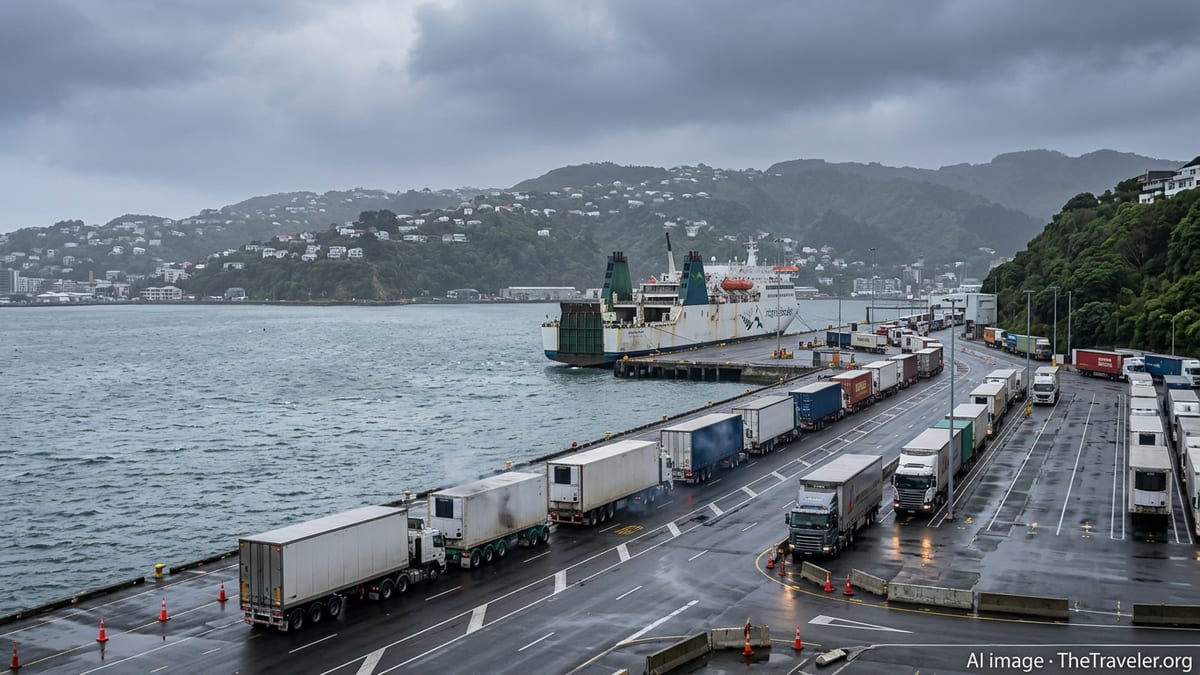
When a vessel is unexpectedly withdrawn, operators can sometimes rework schedules to maintain basic connectivity, but peak travel periods quickly expose the system’s limits. Reports describe long queues of trucks waiting for available sailings, freight-forwarders scrambling to rebook loads, and regional exporters facing uncertainty over whether perishable goods will reach markets on time. For passenger traffic, particularly during school holidays and long weekends, cancelled crossings can derail travel plans and funnel more people onto already busy domestic air routes.
Analysts note that the Cook Strait corridor does not exist in isolation. Delays on the water ripple through road and rail networks, from Auckland and Hamilton in the north to Christchurch and Dunedin in the south. Missed connections can force trucking companies to add layovers or reposition vehicles at short notice, raising operating costs that may eventually be passed on through higher prices for food, fuel and consumer goods.
Some logistics specialists quoted in trade and transport publications argue that the current situation reduces resilience just as New Zealand faces broader shocks from extreme weather events and global supply chain volatility. With limited redundancy in ships and terminal infrastructure, any single breakdown or prolonged outage can leave the country’s inter-island lifeline operating on a knife edge.
Safety Scrutiny and Regulatory Pressure
Each high-profile incident on Cook Strait has prompted closer examination of safety practices, maintenance regimes and regulatory oversight. Maritime investigations have been opened into loss-of-power events, groundings and wharf collisions, with preliminary reporting emphasising a mix of technical faults, human factors and the challenges of operating older vessels in some of the country’s roughest waters.
Regulators have also focused on how companies treat passengers during disruption. In May 2024, the Commerce Commission publicly warned StraitNZ Bluebridge that some of its representations around compensation and cancellations in 2023 sailings risked misleading consumers. The warning, while not a financial penalty, served as a signal that consumer law obligations were under active scrutiny at the same time as mechanical reliability was being questioned.
For KiwiRail and Interislander, the Aratere grounding triggered an internal review of systems integration, contractor oversight and bridge procedures. The operator has since outlined a package of operational improvements and reported periods of significantly improved reliability and on-time performance. These efforts are presented in official statements as evidence that short-term risks can be reduced, even if structural renewal of the fleet remains years away.
Maritime unions and transport researchers, however, continue to warn that incremental fixes cannot fully compensate for ageing hulls and outdated terminal assets. Academic and industry analyses describe the current ferry and port infrastructure as life-expired or close to it, arguing that without substantial new investment, regulators will be forced to balance pressure for uninterrupted service against a growing need to de-rate or retire ships on safety and fatigue grounds.
Uncertain Timeline for a Long-Term Fix
With the original mega-ferry plan cancelled and a re-scoped replacement programme still at the contract and design stage, the outlook for Cook Strait remains uncertain. Official material released by Treasury, the Ministry of Transport and Ferry Holdings outlines a path toward new vessels by around 2029, but also acknowledges substantial risks around cost escalation, global shipyard capacity and the complexity of upgrading port infrastructure in Wellington and Picton while services continue to operate.
Industry commentary increasingly frames the situation as a race against time. Each year of delay pushes the existing ships closer to the end of their economic and technical lives, increasing maintenance downtime and the likelihood of further breakdowns. At the same time, inter-island freight volumes have been trending upward, and coastal communities are relying on the ferries to support both tourism growth and essential supply flows.
Some observers have likened the current moment to a case study in infrastructure planning under fiscal and political pressure. Early ambition to modernise the Cook Strait link with rail-enabled, low-emissions vessels has given way to a more constrained plan shaped by cost ceilings and risk aversion. The result, they argue, is a decade in which New Zealand must manage a fragile lifeline with limited room for error, even as climate impacts and trade demands make resilience more important than ever.
For travellers and freight customers, the practical advice from transport providers remains simple but sobering: build in extra time, maintain flexible plans and expect occasional disruption. Until new ships are in the water and upgraded terminals are in place, Cook Strait is likely to remain a barometer of how well New Zealand can navigate the intersection of critical infrastructure, public finance and transport reliability.