


More news on this day
The Czech Republic is pushing ahead with a patchwork of transport, energy and digital upgrades that, taken together, are reshaping the country’s infrastructure more through steady accumulation than sweeping overhaul.
Get the latest news straight to your inbox!
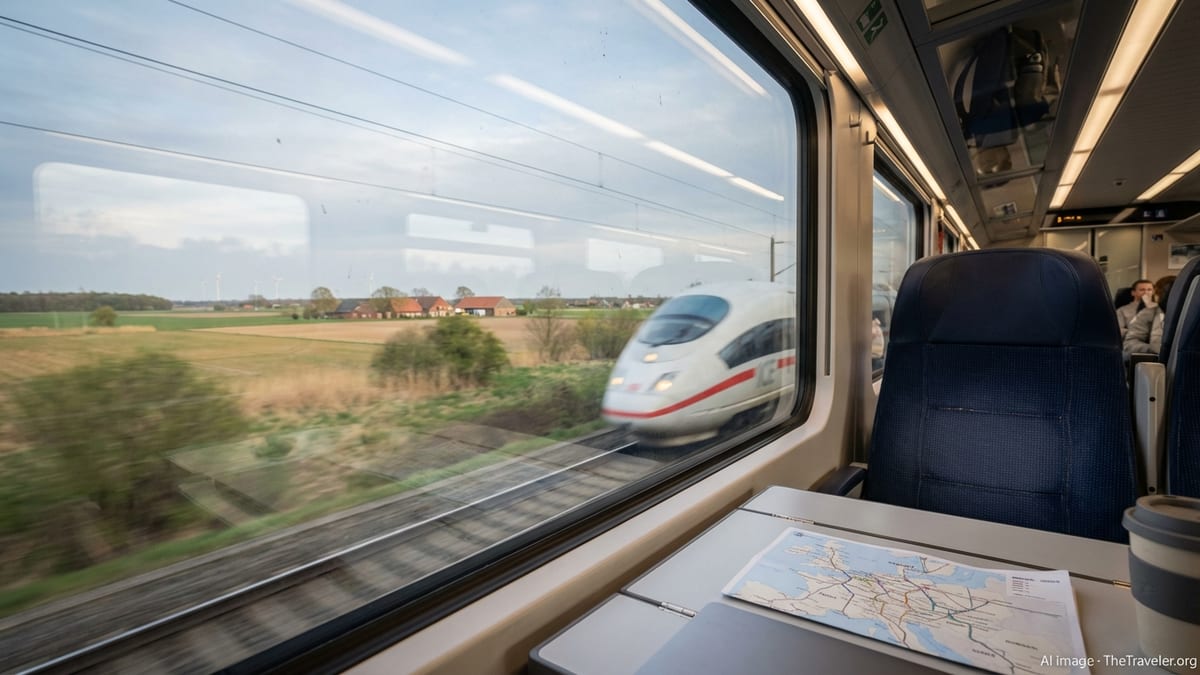
Rail network upgrades move from plans to construction
After years of preparation, the most visible strand of Czech modernisation is unfolding on the railways. Publicly available information from the national infrastructure manager shows record investment flowing into track renewals, station refurbishments and digital signalling, much of it supported by European Union funding instruments. Recent funding rounds under the Connecting Europe Facility have channelled billions of Czech crowns toward modernisation works, including deployment of the European Train Control System and early design work for future high speed alignments.
Work on key conventional corridors is serving as a bridge to that higher speed era. The strategic Brno–Přerov route is undergoing staged upgrading to increase capacity and line speeds, forming part of the planned fast connection between Prague, Brno and Ostrava. Construction schedules indicate that the modernised section will tie into new high speed infrastructure at both ends, cutting journey times across the country while also strengthening east west freight flows.
Parallel investment is going into passenger rolling stock. New long distance ComfortJet trainsets ordered by national operator České dráhy are being introduced on domestic InterCity and international EuroCity services. Designed for top speeds above current Czech line limits, they highlight how rolling stock procurement is being aligned with infrastructure upgrades so that improvements can be exploited as soon as higher speed segments become available.
Despite this momentum, the emerging network remains a mosaic of upgraded stretches rather than a continuous high speed grid. Policy documents describe a vision in which, by the 2030s and 2040s, new lines and modernised corridors will form a coherent system integrated into the wider European network, but for now the focus remains on unlocking benefits route by route.
Highways extended while ageing routes are rebuilt
On the roads, the Czech Republic is pursuing a similar stepwise strategy, combining construction of new motorway sections with reconstruction of heavily used legacy routes. The transport ministry’s annual yearbook for 2024 highlights progress on several long planned projects, including new stretches of the D3, D6 and D7 motorways and multiple bypasses intended to divert heavy traffic away from town centres.
The D35 motorway, which will eventually form a parallel east west axis to the busy D1, has become a flagship example of this incremental approach. Recent updates show additional sections entering construction or early site preparation, building on earlier phases opened to traffic. While the full corridor will take years to complete, each new link is already altering travel patterns by shortening regional journeys and offering alternatives to congestion on existing roads.
At the same time, reconstruction of older motorways is intended to raise safety standards and extend asset life rather than add capacity outright. The long running modernisation of the D1 corridor illustrates how complex these works can be, involving phased closures, bridge replacements and new interchanges on a route that remains the backbone of national road transport. Government communications emphasise that such reconstructions are necessary precursors for any future capacity increases.
This piecemeal road strategy reflects both budgetary constraints and environmental considerations. By sequencing smaller packages of work and prioritising bottlenecks, the authorities seek to spread disruption over time while progressively lifting the overall standard of the network.
Energy system strengthened for the green transition
Beyond transport, the country’s energy infrastructure is undergoing gradual reinforcement to accommodate the transition away from coal and to improve security of supply. A major recent development is a substantial loan from the European Investment Bank to utility group ČEZ, earmarked for upgrading and expanding the electricity distribution grid. Public information about the transaction indicates that the funding will support grid reinforcement, digitalisation and the integration of more renewable sources.
These measures tie into broader European efforts to increase resilience and reduce dependence on imported fossil fuels. In parallel, national and EU backed schemes such as the Modernisation Fund are providing targeted subsidies for modernising power and industrial installations covered by emissions trading, encouraging more efficient technologies and lower carbon fuels. Investment decisions published by the fund show multiple Czech projects in areas such as combined heat and power and industrial process upgrades.
The gas and oil supply system has also seen incremental adjustments, including pipeline capacity expansions that diversify import routes. While such works are often less visible than new rail lines or motorways, they are central to the long term goal of ensuring that electricity and heat supplies remain reliable as older coal plants are retired and more variable renewable output comes online.
Analysts note that this energy modernisation is not proceeding uniformly across all regions. Industrial areas with access to European transition funding tend to move faster, while smaller municipal networks face more complex financing and permitting challenges, reinforcing the pattern of uneven but cumulative progress.
Digital connectivity advances, but gaps remain
Digital infrastructure has emerged as another pillar of the Czech modernisation drive, although official assessments portray a mixed picture. Strategic documents linked to the updated National Recovery Plan describe the country as lagging behind European frontrunners on fixed high speed broadband coverage, even as it performs relatively well on 5G deployment.
Under the recovery plan, a substantial share of funding in the digital chapter is devoted to high capacity networks and the extension of 5G along key transport corridors. Regulatory filings and public consultations from the Czech Telecommunication Office outline projects aimed at closing mobile signal gaps on railway routes and rural sections of the motorway network, with obligations placed on major operators to extend coverage as part of spectrum or licence arrangements.
Additional calls for projects launched by the Ministry of Industry and Trade target both backhaul and last mile connectivity, including support for fibre rollout in underserved areas. These measures are designed to complement private investment rather than replace it, reflecting a policy preference for public funds to focus on commercially marginal locations where market forces alone are unlikely to deliver timely upgrades.
The result is a landscape in which urban centres and major corridors are seeing rapid gains in speed and reliability, while more remote regions progress at a slower pace. Officials acknowledge in policy papers that bridging this urban rural divide is essential if digitalisation is to support balanced economic development.
Coordinating many small steps into a long term vision
Viewed together, the Czech Republic’s transport, energy and digital initiatives reveal a modernisation strategy built around many discrete projects rather than a single transformative scheme. Rail junction upgrades, new motorway links, grid reinforcements and corridor specific 5G deployments are each modest in isolation, but collectively they are altering how people and goods move, how energy is delivered and how information flows.
Government strategies and investment plans set out ambitious timelines stretching into the 2030s and 2040s, particularly for the high speed rail network and for achieving climate and digital targets. Yet these long term goals depend heavily on the consistent delivery of near term construction phases, tenders and regulatory adjustments. Recent yearbooks, investment announcements and planning documents suggest that, despite administrative hurdles and local opposition in some areas, the overall trajectory remains one of gradual, steady advance.
For travellers and businesses, the impact of this piecemeal modernisation is already visible in shorter regional rail journeys, smoother motorway sections, more reliable mobile coverage on key routes and early signs of a cleaner, more robust energy system. The challenge for policymakers will be to maintain funding and public support so that these individual improvements continue to add up to a more integrated and competitive Czech Republic within the European landscape.