


More news on this day
Delta Air Lines is sharpening a strategy built around premium cabins, loyalty partnerships and a disciplined route network, creating what analysts describe as a growing margin moat in an often commoditized global airline industry.
Get the latest news straight to your inbox!
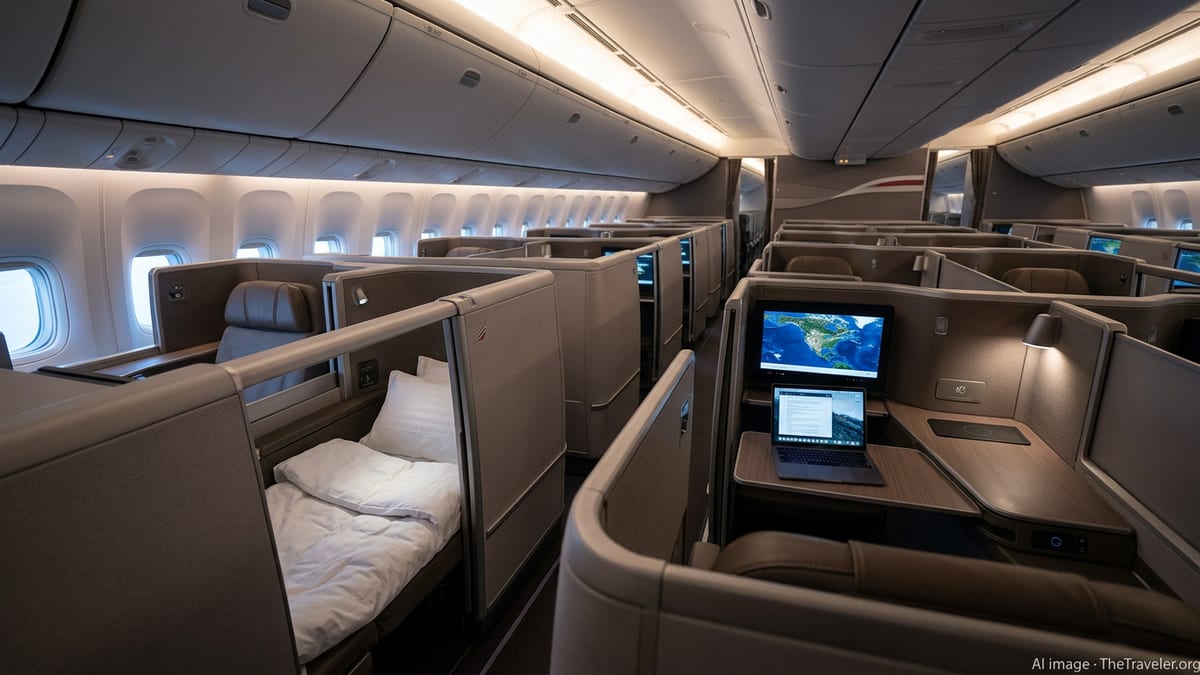
Premium Products Anchor Revenue Outperformance
Recent financial disclosures show that Delta is leaning heavily on higher-yield cabins and services to keep its profitability ahead of most rivals. In 2025 the carrier reported record annual revenue of more than 58 billion dollars and highlighted that it sustained a sizable unit revenue premium versus the broader industry, even as capacity grew and economic conditions shifted. Publicly available information indicates that Delta’s premium products, loyalty income and other non-main-cabin streams now account for the majority of its sales mix, a structural shift that gives the airline more resilience when basic fares come under pressure.
Investor presentations outline how paid demand for domestic first class and other premium seats has steadily increased over the past decade, contributing to a margin gap between premium cabins and the main cabin. Historical slides shared with investors point to a double‑digit percentage point margin differential for premium products compared with standard economy, reinforcing management’s focus on growing the share of higher-value seats on each aircraft. This approach has been credited with helping the carrier move away from the purely volume-driven competition that defines many domestic routes.
By increasing the share of first class, premium economy and extra-legroom seating, Delta has shifted a larger portion of its revenue base toward customers who are less price sensitive, including frequent business travelers and high-spend leisure passengers. That mix helps protect yields when low-cost competitors discount economy tickets. It also allows Delta to prioritize operational reliability and service investments targeted at customers willing to pay more, further differentiating its brand and reinforcing the cycle that underpins the margin moat.
Premium revenue has also shown more stability through the travel recovery cycle. Even as some leisure demand has fluctuated and geopolitical events have affected certain long-haul markets, demand indicators for premium cabins have generally remained robust. Corporate and high-end leisure travelers have continued to seek lie-flat seats on long-haul routes and more spacious options on key domestic business corridors, giving Delta a relatively steady stream of higher-margin revenue.
Loyalty and Co‑Brand Cards Deepen the Moat
Alongside premium seating, loyalty and financial partnerships have become central pillars of Delta’s margin story. Company filings for 2025 indicate that diversified, high-margin revenue streams, including loyalty and co‑brand credit card remuneration, grew faster than overall revenue and represented about 60 percent of total sales. Remuneration from a long-standing banking partner exceeded 8 billion dollars in 2025, supported by double-digit growth in card spending and consistent new cardholder acquisition.
Unlike ticket revenue, which fluctuates with seasonality and macro shocks, loyalty revenue is relatively predictable and carries attractive margins. Customers earn miles on everyday purchases, while the bank partner pays Delta for those miles and associated benefits. That arrangement creates a sizable pool of cash flow that is less exposed to swings in jet fuel prices or last-minute discounting. For investors, this loyalty engine is often cited as a key component of Delta’s margin moat, buffering the airline against volatility in base fares.
The growing integration between SkyMiles membership, credit card benefits and the onboard experience also helps lock in high-value customers. Elite status tiers, lounge access and priority services are closely tied to spending on the co‑brand card, prompting frequent travelers to consolidate both their flying and their everyday purchases within the Delta ecosystem. Public commentary from industry analysts suggests that this level of engagement makes it harder for competitors to lure away lucrative customers with one-off fare sales.
Over time, as more of Delta’s most profitable customers become deeply embedded in the loyalty program, the airline’s pricing power on routes they favor can strengthen. While competitors can match fares, they cannot easily replicate years of accumulated status, upgrade priority and card-linked benefits that influence booking decisions. That dynamic, in combination with strong co‑brand economics, contributes to the durability of Delta’s margin profile compared with more transaction-focused carriers.
Network Discipline and Corporate Travel Strength
Another element of Delta’s margin moat is its approach to capacity and network planning. The carrier operates a hub-and-spoke model built around major U.S. cities, with an emphasis on coastal gateways and strong international partners. Recent quarters have seen the airline trim main cabin capacity on certain routes while increasing the share of premium seats, especially on long-haul and high-frequency business markets. Disclosures for the March 2026 quarter noted that domestic unit revenue grew faster than capacity, with particular strength in premium cabins and on transatlantic flying.
Corporate travel has been a crucial part of this story. Company updates for late 2025 and early 2026 reported record or near-record corporate sales, with broad-based growth across sectors such as banking, aerospace, technology and consumer services. Surveys cited in Delta’s public materials indicate that a large majority of corporate clients expect their travel volumes to remain stable or increase, supporting ongoing demand for higher-yield seats. This base of contracted corporate business gives Delta more visibility into future revenue and allows for more disciplined pricing on key routes.
At the same time, Delta has maintained a relatively cautious stance on adding capacity. Where some competitors have pursued aggressive growth in domestic markets, Delta’s guidance suggests low-single-digit capacity increases, focused on routes and aircraft types that support premium and international connectivity. Industry observers note that this discipline can help avoid fare wars, preserve pricing power and support margin expansion, particularly when combined with the airline’s emphasis on operational reliability.
Partnerships with foreign carriers also bolster the network component of the moat. Joint ventures across the Atlantic and Pacific, along with extended codeshare relationships in regions such as Africa, enable Delta to offer wider global coverage to corporate and premium customers without bearing all of the capacity and capital risk alone. That network breadth, layered on top of strong hubs and premium-focused aircraft, makes the airline an attractive choice for multinational companies seeking consistent service across continents.
Cost Control, Fleet Renewal and Financial Foundation
While much of the attention focuses on revenue quality, Delta has also emphasized cost discipline and balance sheet improvement as foundations for its margin advantage. Management commentary around the 2025 full-year results highlighted non-fuel unit cost growth of roughly 2 percent, aligning with a long-term goal of low-single-digit annual increases. Keeping cost growth below revenue growth is a core driver of operating margin expansion, especially as fuel prices and labor expenses remain volatile.
Fleet renewal plays a prominent role in this equation. Delta has been adding more fuel-efficient aircraft with higher premium seating density, while retiring older, less efficient jets. New-generation narrowbodies and widebodies generally burn less fuel per seat and carry more high-yield capacity in business and premium economy, improving both cost per available seat mile and revenue per seat. Public filings indicate that the airline is continuing to refresh cabins to harmonize interiors, further increasing the share of premium inventory across the fleet.
On the financial side, Delta has prioritized debt reduction and aims to maintain investment grade credit ratings from major agencies. A stronger balance sheet reduces interest costs and provides flexibility to keep investing through cycles, whether in lounges, digital tools, or additional premium seating. Investor materials describe this combination of manageable leverage, solid free cash flow and disciplined capital allocation as central to the company’s long-term margin ambitions.
The airline’s refinery operations, which can provide a partial hedge against fuel price spikes, also factor into its margin profile. Guidance for the June 2026 quarter references an expected benefit from the refinery in the hundreds of millions of dollars, helping offset elevated jet fuel costs. While not unique in the industry, this vertical integration is relatively unusual and adds another layer to Delta’s efforts to control one of its most volatile expense lines.
Risks to the Moat in a Shifting Travel Landscape
Despite the strength of its current position, Delta’s margin moat faces potential challenges. Premium-focused strategies can be vulnerable in severe economic downturns if high-yield customers cut travel or trade down to cheaper cabins. Discussion among industry watchers has occasionally questioned whether the airline’s emphasis on premium pricing could backfire if competitors undercut fares on business-heavy routes or if corporate travel policies tighten meaningfully.
Consumer sentiment is another variable. Online discussions among frequent flyers have highlighted tensions between Delta’s premium branding and customer perceptions of value when business-class fares significantly exceed those of rivals on comparable routes. Some travelers have reported shifting bookings to other carriers on transatlantic routes when fare differences reached several thousand dollars, suggesting that there are limits to how far pricing power can stretch, even among affluent or corporate-funded passengers.
Regulatory and environmental pressures may also shape the future of high-margin air travel. Academic work and policy debates are increasingly scrutinizing the climate impact of premium cabins, which use more space per passenger and therefore more emissions per seat. Any future carbon pricing schemes or regulatory measures that disproportionately affect premium or long-haul flying could challenge part of the model that underpins Delta’s margin advantage.
For now, however, the combination of premium revenue growth, loyalty economics, disciplined capacity planning and an improving balance sheet continues to support Delta’s margin moat. As global travel demand remains robust and corporate flying stabilizes at higher levels, the airline’s strategy positions it as one of the most financially resilient carriers in the U.S. market, and a key player to watch for travelers and investors tracking the future of premium air travel.