


More news on this day
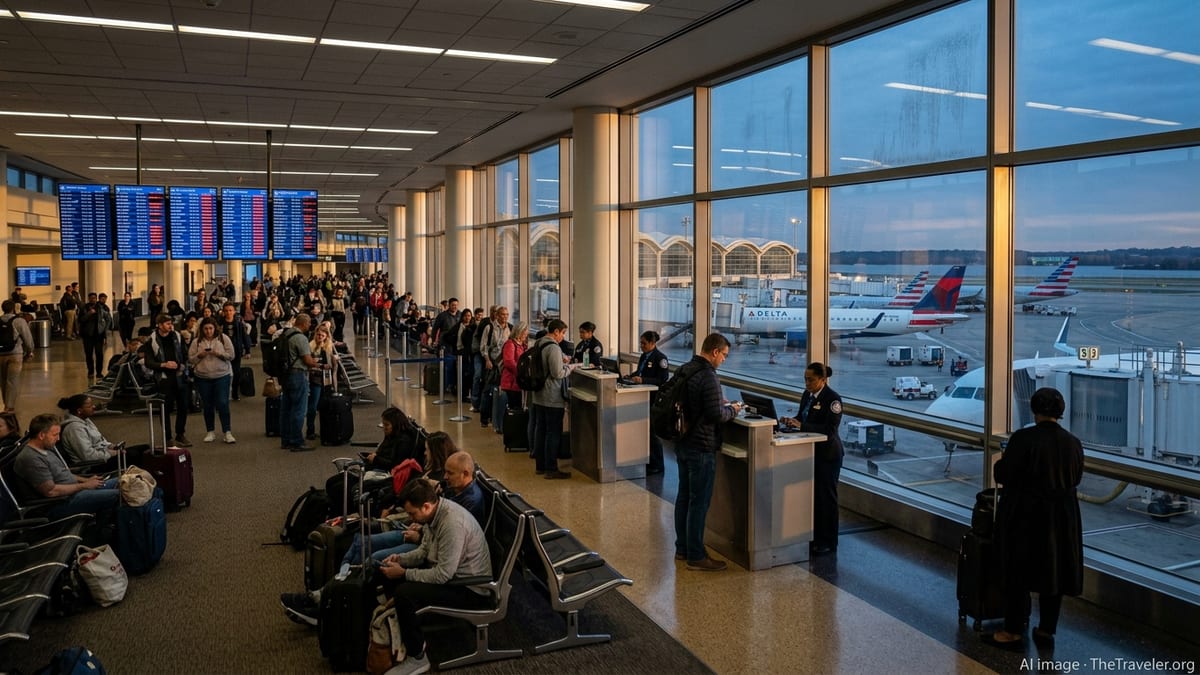
Delta Air Lines has issued a security-related travel advisory for flights involving Riyadh, casting fresh uncertainty over its planned Atlanta to Riyadh route and reigniting debate over whether the carrier’s high-profile new service will ever fully take off.
Get the latest news straight to your inbox!
A New Route Overshadowed by Security Concerns
Publicly available information on Delta’s advisory pages shows that travel to, from or through Riyadh is subject to special conditions after a security situation in the Saudi capital. The advisory names Riyadh’s King Khalid International Airport and specifies that journeys involving the city between 23 October 2026 and 26 March 2027 may be affected by operational changes or disruptions.
The policy offers customers booked on affected Riyadh itineraries options to change their flights without additional charges within a defined window, or to cancel and receive either a refund or an electronic credit. The flexibility applies to tickets issued on or before 12 October 2026, which is shortly before the originally publicized launch window for Delta’s new Atlanta to Riyadh service.
While the airline’s official language frames the move as a travel waiver and advisory, online commentary has characterized it in starker terms, with some commentators describing it as a de facto “do not travel” warning for the fledgling long-haul route. That perception has added to skepticism over whether the planned nonstop link between Atlanta and Riyadh, once promoted as part of Delta’s network expansion, remains viable in the near term.
The Riyadh notice appears alongside a broader set of advisories connected to unrest and security developments in the Middle East, underscoring the geopolitical backdrop that has complicated new air links into Saudi Arabia’s capital.
Waivers, Refunds and What Affected Travelers Can Do
The Riyadh advisory sets out relatively generous rebooking conditions compared with standard fare rules. Travelers whose itineraries touch Riyadh during the affected period are permitted to change their flights once without incurring change fees, provided they rebook in the same cabin and travel by 31 May 2027. In that scenario, the fare difference is waived, which can significantly reduce unexpected costs for travelers needing to alter long-planned trips.
For those who do not wish to proceed with travel that includes Riyadh, the advisory explains that tickets may be canceled for either a refund to the original form of payment or an eCredit toward future travel. This option is particularly relevant for passengers who booked the Atlanta to Riyadh route when it was first added to schedules and who now prefer to avoid the uncertainty surrounding operations into the Saudi capital.
Outside the flexible rebooking window, standard fare rules reassert themselves and any increase in fare is collected at the time of reissue. The advisory notes that changing the origin or destination airport may also trigger a fare difference, an important detail for travelers considering entirely rerouting their trip to different Gulf or Middle Eastern destinations.
Passengers are directed through Delta’s usual self-service channels to manage their bookings, including the airline’s mobile app and the “My Trips” section of its website. Industry observers point to these tools as increasingly central to how major carriers implement rapid schedule and policy changes in volatile regions without relying solely on call centers.
Unpopular Before Takeoff: Weak Demand and Network Questions
Separate from the security dimension, the Atlanta to Riyadh link has attracted attention for its reportedly soft demand even before launch. Aviation-focused publications and enthusiast forums have highlighted limited visible bookings and questioned the underlying business case, noting that the route sits outside Delta’s more traditional transatlantic and transpacific strongholds.
Commentary circulating in frequent-flyer communities suggests that the route struggled to gain traction with leisure travelers and corporate accounts alike, despite Saudi Arabia’s wider push to attract tourism and investment. With other carriers already serving Riyadh from major European and Gulf hubs, some analysts have questioned whether nonstop service from Atlanta could sustain year-round loads without substantial connecting traffic and commercial support.
The advisory’s timing, coinciding with the planned start of operations, has further fueled speculation that the route could be postponed or scaled back before becoming fully established. Previous reporting on Delta’s network decisions has shown that the airline is prepared to delay or cancel routes close to launch when economic or operational conditions change sharply, especially on long-haul sectors that require significant aircraft and crew commitments.
For travelers and travel planners, these uncertainties make the Atlanta to Riyadh option harder to rely on for conferences, major events or complex itineraries that hinge on a single nonstop segment. Some corporate travel managers are reportedly steering bookings toward alternative routings via European or Middle Eastern hubs until the situation stabilizes.
Part of a Wider Pattern of Middle East Caution
The Riyadh advisory arrives against a wider backdrop of cautious moves by Delta and other carriers regarding Middle Eastern routes. In recent years, Delta has paused and adjusted its Tel Aviv operations several times in response to evolving security conditions and demand shifts, extending suspensions or delaying resumptions when on-the-ground realities changed.
Industry coverage has emphasized that airlines regularly weigh government travel guidance, insurance requirements and internal risk assessments when deciding to open or maintain services into sensitive markets. Even a route that appears commercially promising can face hurdles if security assessments or airspace constraints increase operational risk or complexity.
In this context, the Atlanta to Riyadh flight represents more than a single new line on Delta’s route map. It illustrates how strategic ambitions to tap into emerging tourism and business corridors can collide with fast-moving geopolitical events. For airlines, that often translates into a preference for reversible steps such as schedule placeholders and flexible waivers rather than firm long-term commitments when conditions remain fluid.
For Saudi authorities and airport operators, the advisory and the questions surrounding the route highlight the challenge of convincing major U.S. carriers that year-round service can be both safe and commercially sustainable. The balance between aspirations for connectivity and the realities of regional security remains a central factor in shaping new long-haul links.
What the Advisory Means for Future Bookings
For travelers considering booking future trips that might rely on the Atlanta to Riyadh route, the current advisory serves as a signal to plan with flexibility. Travel agencies and corporate travel departments tracking the situation are giving greater weight to itineraries that can be easily re-routed through alternative hubs if the nonstop service is altered, delayed or removed from schedules.
Publicly available guidance suggests that customers who value certainty may wish to prioritize tickets with straightforward rebooking and refund options, or to use loyalty currency such as airline miles that can sometimes be redeposited when flights are canceled by the carrier. Travel insurance policies that cover schedule disruptions related to security advisories are also being scrutinized more carefully.
For now, the advisory does not permanently close the door on the Atlanta to Riyadh concept, but it does underscore that the route is in a fragile state before fully launching. The combination of security-related caution and questions over passenger demand has turned what was once marketed as an expansion into a case study in how quickly a new long-haul route can become a liability on an airline’s network plan.
Until there is clearer evidence that both the security environment and customer appetite support sustained operations, many travelers may treat the route warily, if they consider it at all. That hesitancy, in turn, could make it harder for Delta to prove the service can succeed, especially while a prominent advisory is still in place for Riyadh-bound journeys.