


More news on this day
The Dominican Republic is rapidly emerging as a Caribbean test case for low‑carbon aviation, with a cluster of airports rolling out large-scale solar facilities, certified carbon management programs, and climate-aligned policies that are beginning to recast one of the region’s busiest air networks as a laboratory for greener skyways.
Get the latest news straight to your inbox!
Solar Megawatts Turn Terminals Into Power Producers
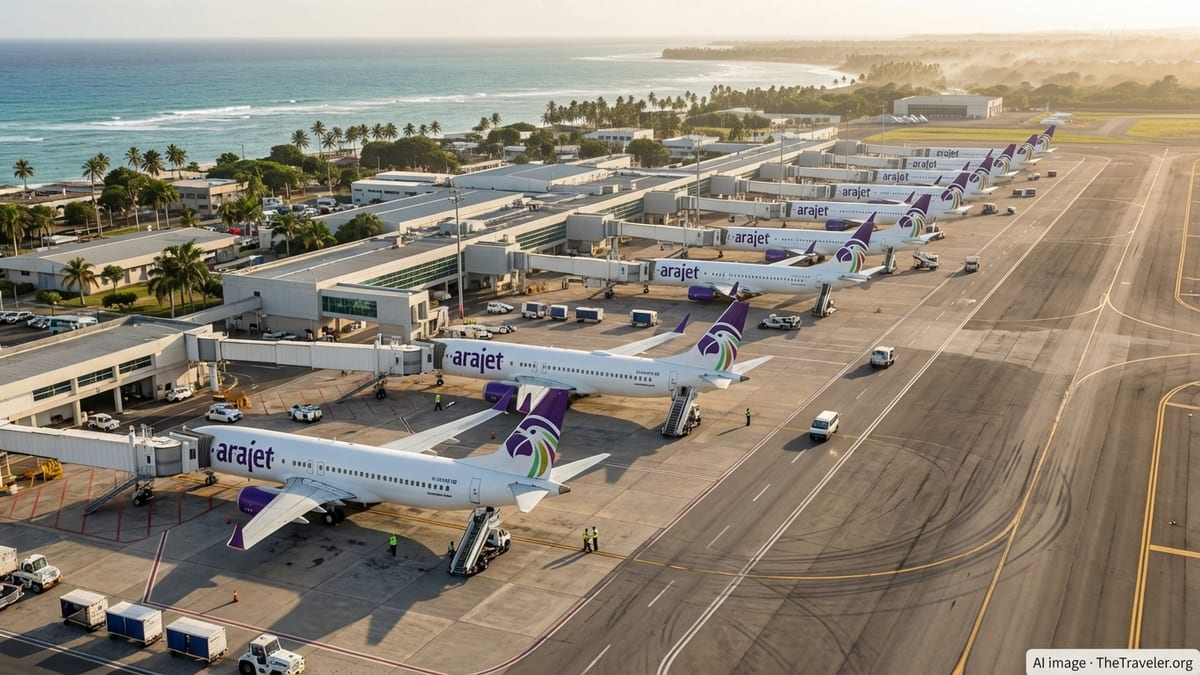
Publicly available information shows that the Dominican Republic’s state-concession airports have become unlikely leaders in airport solar power. Aeropuertos Dominicanos Siglo XXI (AERODOM), operated by VINCI Airports, manages six state-owned gateways including Santo Domingo’s Las Américas International and has spent much of the past decade installing photovoltaic fields across its network.
A VINCI group announcement indicates that successive expansion phases have made AERODOM the country’s largest private-sector producer of solar electricity, with solar capacity at its airports reaching roughly 6.8 to 7.5 megawatts at the beginning of this decade. These arrays feed terminal operations and, when generation exceeds on-site demand, inject power back into the national grid, effectively turning airport land into distributed generation hubs rather than pure energy consumers.
Earlier VINCI activity reports describe how photovoltaic systems at secondary airports such as La Isabela, Puerto Plata and Barahona can already cover a substantial share of their electricity needs, in some cases supplying more than three-quarters of daytime demand. That level of penetration, while still evolving, places the Dominican Republic among the more aggressive adopters of on-site solar in Latin American and Caribbean aviation.
The strategy aligns with VINCI Airports’ global environmental roadmap, which targets net zero emissions across its network by 2050, and positions the Dominican Republic concessions as a prominent showcase for the group’s decarbonization tools in a tourism-dependent economy.
Carbon Accreditation and Climate Frameworks Reshape Operations
Alongside hardware investments in solar fields, Dominican airport operators have increasingly tied their efforts to international climate frameworks. According to coverage of VINCI Airports’ programs, AERODOM was the first airport operator in the Caribbean to certify all of its terminals under the Airport Carbon Accreditation (ACA) scheme, initially at Level 1 for mapping emissions.
More recent information on AERODOM’s environmental management notes that the company now holds ACA Level 3 certification, reflecting not only detailed carbon accounting but also active emissions reduction and stakeholder engagement. The process pushes airports to optimize energy use in terminals, ground support equipment, and auxiliary services, complementing the shift to solar generation with demand-side efficiencies.
At policy level, the Dominican Republic has aligned its aviation sector with the Carbon Offsetting and Reduction Scheme for International Aviation, known as CORSIA, developed by the International Civil Aviation Organization as a global market-based mechanism to curb emissions from international flights. Government documents and ICAO reporting show that the country joined early cooperative efforts on CORSIA implementation and continues to develop monitoring, reporting and verification systems that bind domestic carriers and international operators into a shared climate framework.
The combination of ACA accreditation at the airport level and CORSIA participation at the national level creates a layered architecture for decarbonization, where local infrastructure projects feed into broader international targets on aviation climate impact.
Tourism Growth Tests Resilience of Green Commitments
The Dominican Republic’s efforts to modernize airport infrastructure are occurring against the backdrop of fast-rising passenger volumes, particularly at tourist gateways such as Punta Cana, Santo Domingo and Puerto Plata. Activity updates from VINCI Airports show continued investments in terminal upgrades and new cargo facilities at Las Américas, designed to handle increasing traffic while improving operational efficiency.
Balancing that growth with decarbonization objectives is a central test for the country’s green skyways narrative. As solar capacity expands, airports can reduce their reliance on fossil-fuel-based electricity even as airside and landside energy demand climbs. Energy-efficiency measures in lighting, ventilation, and cooling systems, coupled with electrification of ground vehicles where feasible, further limit the emissions intensity per passenger.
However, international climate accounting frameworks distinguish between airport operations and the much larger emissions footprint of aircraft themselves. While solar-powered terminals sharply cut Scope 1 and 2 emissions for operators, the majority of aviation-related emissions remain tied to jet fuel burned in flight. This reality underscores why policies such as CORSIA and long-term global aspirational goals for aviation are seen as critical complements to local infrastructure upgrades.
For the Dominican Republic, a tourism economy that depends heavily on long-haul and regional air access, the challenge is not whether to grow air connectivity but how to make that growth compatible with its emerging climate commitments and the expectations of increasingly sustainability-minded travelers.
Regional Signal for Caribbean Aviation Transitions
Observers of climate policy in aviation note that examples from small and medium-sized states can carry outsized influence, especially in regions where many countries share similar challenges but have limited capacity to experiment with new models. The Dominican Republic’s mix of large-scale airport solar deployment, international carbon accreditation, and early engagement with CORSIA positions it as a practical reference point for neighboring Caribbean and Latin American markets.
ICAO’s wider environmental agenda, including its long-term emissions reduction objectives for international aviation, places emphasis on ensuring that no country is left behind in the transition. In that context, the operational track record of Dominican airports in integrating renewable power and structured carbon management provides a concrete illustration of how concession frameworks and private investment can accelerate decarbonization in developing economies.
Future developments are likely to focus on deepening these initiatives rather than radically changing direction. VINCI group publications highlight plans to scale solar capacity across its global airport network and to embed climate resilience into infrastructure design. For the Dominican Republic, further capacity additions at existing airport solar parks, exploration of energy storage, and gradual electrification of more ground systems would build on a trajectory already visible in current projects.
As other Caribbean hubs consider their own pathways to lower-carbon operations, the Dominican experience suggests that a combination of regulatory alignment, concession-based investment, and transparent climate reporting can move airports from incremental efficiency measures to more transformational roles in their national energy and climate strategies.