


Landing at Jeddah’s King Abdulaziz International Airport is the real beginning of most modern Umrah journeys. After a long flight, your first major decision is how to get from the terminal to your hotel in Makkah or Madinah quickly, safely and without confusion. This detailed guide walks you through real-world options for private cars, group vans and hotel drop-offs, with practical examples on prices, timing, luggage and what works best for families and solo women pilgrims.
Get the latest updates straight to your inbox!
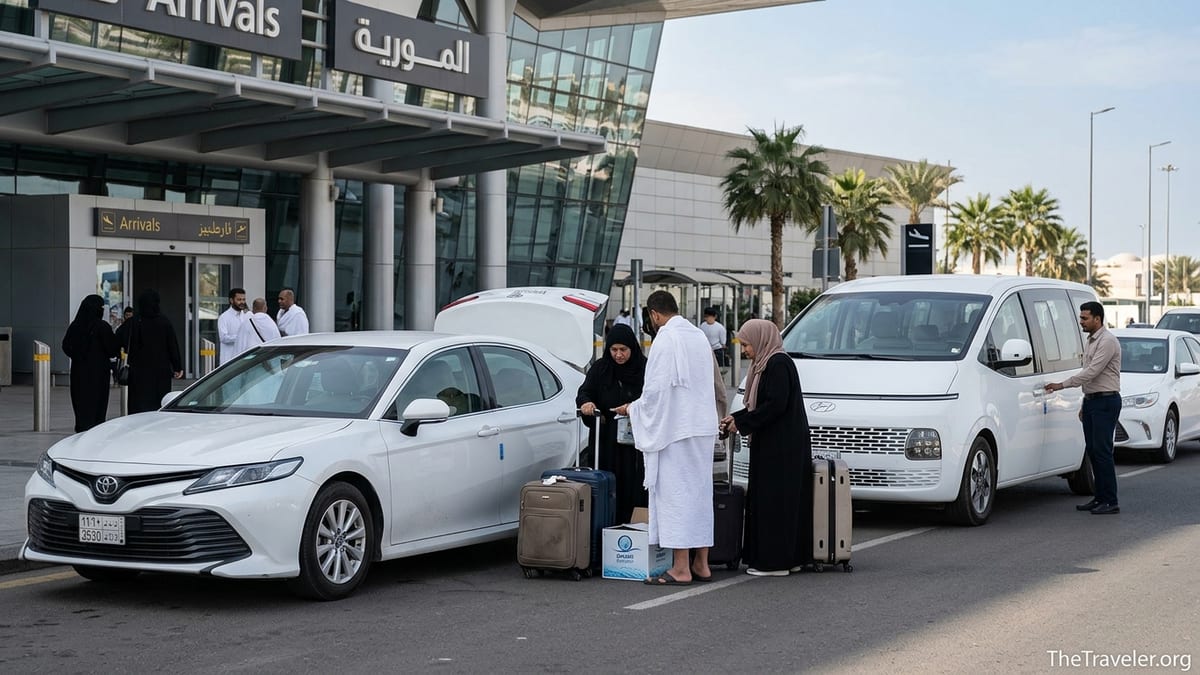
Understanding Your Route from Jeddah Airport
Most Umrah pilgrims arrive at King Abdulaziz International Airport (JED) in Jeddah, using either the new Terminal 1 or the dedicated Hajj and Umrah terminal in peak seasons. From here, the two main destinations are Makkah, roughly 80 to 100 kilometers away depending on your hotel’s location, and Madinah, around 400 kilometers to the north. Journey times can vary significantly with traffic, time of day and whether you use highways or detour via the Haramain High-Speed Railway.
In typical conditions, a private car from Jeddah Airport to central Makkah hotels near the Haram can take around 1.5 to 2 hours. Several Umrah transport companies quote similar timings in their transfer descriptions and package documents, which align with recent experiences shared by independent pilgrims who report door-to-door trips of roughly 90 minutes in off-peak hours. For Madinah, most reputable chauffeured car services and online transfer platforms quote about 4 to 4.5 hours of driving from Jeddah to central Madinah hotels, again depending on traffic.
Understanding these basic distances and timings helps set expectations when comparing transfer options. If a provider promises to get you from Jeddah to Madinah in “under three hours” by road, for example, it is reasonable to treat that claim with caution, as more mainstream operators, including well-known international car services, are consistent in quoting 4 hours or more for this route. For Makkah, large variations in stated journey times usually have more to do with traffic patterns and pickup delays than with the distance itself.
Another important factor is which terminal you arrive at. Many private transfer companies explicitly mention they serve all Jeddah terminals 24/7, including Hajj and Umrah terminals, and will meet you at arrivals with a name board. If you prefer to use ride-hailing apps or airport taxis instead, factor in the extra time needed to exit customs, reach the car pick-up area and possibly negotiate fares or wait for the driver to navigate the crowded airport roads.
Private Umrah Transfers: Comfort, Privacy and Typical Prices
Private transfers are the preferred option for many Umrah pilgrims who prioritize convenience and privacy, especially after long-haul flights or when traveling with elderly relatives and children. Licensed Umrah transfer operators commonly offer a range of vehicles: economy sedans such as Toyota Camry or Hyundai Sonata, larger SUVs like Toyota Fortuner, and 7 to 10-seater vans or Hyundai Staria-type minivans for family groups. These services are usually booked in advance and priced per vehicle, not per person.
For the 2024 to 2025 Umrah season, several Saudi-based transport companies publish sample rates for private transfers between Jeddah and Makkah that give a realistic price range. One frequently cited benchmark in current price sheets is around 250 to 300 Saudi riyals for an economy sedan from Jeddah Airport to a central Makkah hotel, with larger vans for 6 to 10 passengers often quoted between roughly 375 and 530 riyals one way, depending on model and capacity. Some operators that target international groups list higher “package” prices, around 430 riyals or more for small cars, which may include additional services such as on-the-ground coordination or flexible waiting time.
For Jeddah to Madinah, private car rates naturally increase due to the longer distance. Fixed-price transfer pages from specialist Umrah taxi providers and general chauffeured-car platforms often show sedan prices around 400 to 500 riyals for Jeddah Airport to Madinah city hotels in 2025 and 2026, with premium vehicles and larger vans costing more. An example is a sedan taxi advertised at about 450 riyals for the Jeddah to Madinah route, while some corporate transport rate sheets list 750 riyals or more for larger vehicles servicing the same journey. These figures represent typical ranges rather than universal standards, and final quotes can vary by season and demand.
Beyond price, the main practical advantages of a private transfer are predictability and door-to-door service. The driver waits for you in arrivals, helps with luggage when possible, and drives directly to your hotel in Makkah or Madinah without additional stops. For families with children or older pilgrims who tire easily, this means less stress compared with navigating train stations, shuttle buses or negotiating with multiple taxi drivers. Many operators also emphasize that they track flight delays and adjust pickup times automatically, which can be critical when arriving on late-night or early-morning flights.
Group Vans, Shared Shuttles and When They Make Sense
Group vans and shared shuttles are common for larger pilgrim parties and cost-conscious travelers. In practice, two different models exist. The first is a private group van, where your family or tour group books the entire vehicle, typically a 7 to 14-seater like a Hyundai Staria or Toyota Hiace, at a flat rate. The second is a seat-in-coach or shared shuttle, where individuals or small families pay per seat and travel with other unrelated passengers going to similar hotels or districts in Makkah or Madinah.
Many Umrah transport price lists show that private vans can offer excellent value once you reach 5 or more passengers. For example, where a sedan from Jeddah to Makkah might cost around 260 to 300 riyals, an 8 to 10-seater van may be quoted in the region of 375 to 450 riyals. If eight people share that van, the per-person cost can drop to roughly 50 to 60 riyals, which is significantly lower than buying individual seats on multiple smaller transfers. For the longer Jeddah to Madinah route, families on recent pilgrim forums report paying around 700 riyals for a private van after negotiating with several operators, which worked out cheaper than two separate smaller vehicles.
Shared shuttles, often arranged through Umrah agencies or hotels, can be even cheaper per person, but they come with trade-offs. Because the shuttle waits for multiple passengers arriving on different flights or heading to different hotels, departure times may be less predictable and the overall journey can take longer. It is not unusual for a theoretical 90-minute Jeddah to Makkah transfer to stretch to 3 or more hours in a shared shuttle once you account for waiting time at the airport, loading and unloading luggage, and multiple hotel drop-offs. For pilgrims who are tired, traveling with young children or aiming to perform Umrah quickly after arrival, this lack of control may outweigh the savings.
Shuttles make the most sense for budget-conscious solo travelers or couples who do not mind extra waiting, especially outside peak seasons when vehicles and drivers are under less pressure. Some recently created online communities and informal “DIY Umrah” groups also encourage pilgrims arriving in the same timeframe to coordinate and book a private van together, essentially creating their own small group transfer and dividing the cost. This hybrid approach can offer the comfort of a direct journey at a price closer to a shared shuttle seat.
Hotel Drop-Offs in Makkah and Madinah: What to Expect
Whether you choose a private car, group van or app-based ride, understanding how hotel drop-offs work in the Haram areas of Makkah and Madinah will help prevent surprise delays. In Makkah, traffic and road closures around the Masjid al Haram, particularly near Jabal Omar hotels, the Ajyad area and tunnel entrances, can change with crowd conditions and major prayer times. Many transport operators therefore describe drop-off points in terms of zones, sometimes listing Jabal Omar, Ajyad or Misfalah separately in their rate cards to reflect small differences in access and time.
For example, a private transfer company may charge one price for “Jeddah Airport to Makkah central hotels (Jabal Omar / Ajyad)” and a slightly different rate for hotels further out in districts such as Aziziyah. In practice, the driver might not be able to reach the exact front door of your hotel during busy hours and may instead drop you at an official vehicle access point or side street from which bell staff or porters collect luggage. This is common during peak Umrah periods and should not necessarily be interpreted as poor service, but it is worth asking your provider in advance what drop-off arrangements they normally achieve for your chosen hotel.
In Madinah, hotel drop-offs are usually smoother, as roads around Al Masjid an Nabawi are generally more accessible to vehicles, with clear north and south hotel clusters. Many private car descriptions for Jeddah to Madinah transfers specifically mention “hotel-to-hotel” or “airport-to-hotel” service, highlighting that the driver will take you directly to the entrance of your booked property. Approximate transfer times provided by licensed Hajj operators for internal movements, such as Madinah hotel to Madinah Airport in around 30 minutes, give further context to how compact the city’s central area is compared with Makkah.
When booking any transfer, it is useful to share your full hotel name, district and approximate check-in time with the provider. Some Umrah package itineraries list a combined route like “Jeddah Airport – Makkah – Madinah – Jeddah Airport including Ziyarah,” and providers use this information to plan efficient sequences of hotel drop-offs. If you are arranging transport independently, clarifying that you need a direct airport-to-hotel drop, rather than being left at a general area near the Haram, can make a noticeable difference in your arrival experience, especially when carrying several suitcases or traveling with limited mobility.
Women, Families and Safety Considerations
For women and families, safety and comfort during transfers are just as important as cost and timing. Saudi Arabia has made significant regulatory changes in recent years, including easing male guardianship restrictions and officially allowing women to travel for Umrah without a mahram in many cases. At the same time, individual religious opinions and family preferences still differ, and many women choose to travel with relatives or in organized groups. From a practical standpoint, major travel advisories highlight that ride-hailing apps such as Uber and regional service Careem are widely used in Saudi cities and are generally preferred over street taxis for better traceability and safety features.
Real-world accounts from recent female pilgrims and travel advisors indicate that solo women now routinely use ride-hailing apps from Jeddah Airport to Makkah or to the high-speed train station, particularly when they can speak some Arabic or are familiar with app-based rides elsewhere. Nonetheless, several Hajj and Umrah safety booklets and experienced group leaders still recommend that women avoid taking unmarked or informal taxis alone, especially late at night. A conservative but common practice is for solo women to stay in public, well-lit areas of the terminal while waiting and to share trip details with relatives using app tracking features whenever possible.
Families with young children and elderly relatives may find private pre-booked transfers or agency-arranged buses more reassuring than arranging transport on arrival. Many licensed Umrah transport companies advertise that their drivers are vetted and accustomed to assisting pilgrims, and some even offer options to request drivers who are used to working with family groups. While female drivers remain relatively rare in Saudi Arabia compared with male drivers, they are gradually becoming more visible in ride-hailing apps, particularly in major cities like Jeddah. Some solo female travelers actively try to match with female drivers where available, though this cannot always be guaranteed.
Ultimately, the safest option is usually one that is pre-arranged with a trustworthy provider, clearly documented by email or booking confirmation, and aligned with your personal or religious comfort level. For example, a solo woman arriving late at night for an 11-hour layover might choose a reputable private transfer company recommended by her Umrah agency, rather than a cheaper but less predictable on-the-spot taxi. A multi-generational family group staying several days could coordinate a private van for airport to hotel, plus additional local trips for Ziyarah, minimizing the number of times they need to negotiate separate rides.
Luggage, Mobility and Practical Arrival Tips
Luggage capacity is an often-overlooked detail that can affect your choice of transfer. A standard sedan used by many Umrah taxi services can comfortably accommodate around two large checked suitcases and a couple of cabin bags in the trunk and rear seat footwells. If your group has four adults, each with a large suitcase, a sedan may not be practical even if it is technically allowed; you are likely to be more comfortable in a minivan or SUV. Many transport rate sheets explicitly state maximum passenger and bag counts for each vehicle type, such as 3 passengers and 3 large bags for sedans, or 7 passengers and 7 to 8 large bags for bigger vans.
Pilgrims bringing wheelchairs, strollers, Zamzam containers on the return leg, or bulky items such as folding chairs should confirm in advance that their chosen vehicle can accommodate these. Some private operators offer dedicated luggage trailers or extra-large vans for large family groups on peak days, particularly at the end of Umrah when passengers may carry multiple boxes and water containers. A common real-world example is a group of six relatives leaving Makkah after Umrah with two Zamzam boxes each, who find that upgrading from a sedan to a 10-seater van for a modest extra fee saves them from having to hire a second vehicle just for luggage.
Mobility needs also matter. If someone in your group uses a wheelchair or has difficulty walking long distances, a direct hotel drop-off becomes especially important. In Makkah, where some hotels are located on hills or connected to the Haram via series of escalators and bridges, a transfer that stops a short walk away can add unnecessary strain. Inform your transfer provider at booking if you require minimal walking, step-free access or extra help loading mobility aids. Many operators can advise on more accessible drop-off points near specific hotels.
Finally, be realistic about arrival fatigue. Long immigration queues, baggage delays and the emotional weight of beginning Umrah can leave you drained. Arranging a straightforward transfer where you know the approximate cost, vehicle type and meeting point in advance reduces stress at the very moment you most want to focus on your intention and prayers. A simple, practical approach could be to pre-book a private car for the airport-to-hotel leg and then rely on ride-hailing or hotel-arranged taxis for shorter local journeys once you have rested and become familiar with the surroundings.
Pre-Booking vs On-the-Spot: How and When to Reserve
Pre-booking your Umrah transfer from Jeddah Airport has clear advantages, especially during busy months such as Ramadan or the school holidays of major Muslim countries. Many licensed Umrah tour operators include airport transfers in their packages, often using a mix of private cars and group buses. If you are arranging Umrah independently, you can still book transfers directly with local transport companies through their websites or via global booking platforms that list “airport to city hotel” services in Jeddah, Makkah and Madinah.
When comparing options, look beyond the headline price. Check whether the quote is per car or per person, whether there are night surcharges, and how much free waiting time is included after your scheduled landing. Reputable operators commonly offer 60 to 90 minutes of free waiting from the moment your plane lands, which is important if immigration queues are long. Some will ask you to share your flight number so they can monitor delays and adjust pickup times at no extra cost. Others may start charging hourly waiting fees after a fixed grace period.
On-the-spot options include official airport taxis, private drivers who approach passengers in the arrivals hall, and ride-hailing apps. Pilgrim discussions from recent years show a wide range of taxi prices being quoted at Jeddah Airport for the ride to Makkah, sometimes as low as 170 to 200 riyals after bargaining hard, but also as high as 400 riyals or more in peak periods or late-night arrivals. Several travelers report using Uber or Careem from central Jeddah to Makkah for around 120 to 200 riyals, while fares from the airport itself can be higher due to added time and demand. In all cases, prices can change quickly with fuel costs, regulations and seasonal demand, so these examples should be treated as approximate guidance rather than fixed rates.
An effective compromise is to pre-book at least your arrival transfer from Jeddah to Makkah or Madinah, then decide on return and intercity options once you are on the ground and have a feel for current local prices. For instance, you might lock in a 260 to 300 riyal private sedan from Jeddah Airport to a Makkah hotel, then later negotiate a van for your family’s Makkah to Madinah leg after speaking with several providers recommended by your hotel or fellow pilgrims. Always confirm the final agreed price, inclusions and payment method in writing, such as by WhatsApp message or email, to avoid misunderstandings when it is time to pay.
The Takeaway
Choosing the right transfer from Jeddah Airport to Makkah or Madinah can shape the tone of your entire Umrah trip. Private cars offer comfort, privacy and predictable door-to-door service at prices that, while higher than shared shuttles, are still moderate when split between family members. Group vans provide an excellent balance of cost and convenience for larger parties, while shared shuttles and app-based rides can suit budget-conscious or experienced travelers who are comfortable with some uncertainty.
For women and families, pre-booked transfers with reputable operators and clear documentation typically provide the greatest peace of mind. Luggage capacity, hotel access, mobility needs and realistic journey times should all play a role in your decision, rather than price alone. By understanding the real-world ranges for costs, the typical travel times and the practical constraints around hotel drop-offs, you can select a transfer option that lets you arrive focused, calm and ready to begin your worship.
FAQ
Q1. How long does it usually take to get from Jeddah Airport to Makkah by car?
In normal traffic, most private transfers and taxis take around 1.5 to 2 hours from King Abdulaziz International Airport to central Makkah hotels near the Haram, though peak-season congestion can add extra time.
Q2. What is a typical price for a private car from Jeddah Airport to Makkah?
Recent rate sheets from Umrah transport companies commonly show economy sedans priced roughly between 250 and 300 Saudi riyals one way, with some premium or package services charging higher, especially in peak months.
Q3. How much should I expect to pay for a private transfer from Jeddah to Madinah?
For the longer Jeddah to Madinah route, many private transfer services quote around 400 to 500 riyals for a standard sedan, with larger vans and premium vehicles costing more due to higher capacity and fuel costs.
Q4. Is it better to pre-book my Umrah transfer or arrange it on arrival?
Pre-booking is generally safer and less stressful, especially during busy periods, because you lock in an approximate price, know your meeting point and avoid negotiating with multiple drivers after a long flight.
Q5. Are private group vans good value for families and larger groups?
Yes, private vans often become very cost-effective once you have five or more passengers, as a single 8 to 10-seater vehicle can be only slightly more expensive than a sedan while carrying far more people and luggage.
Q6. Is it safe for a woman to take a taxi or ride-hailing car alone from Jeddah Airport?
Many women now use ride-hailing apps and pre-booked private transfers alone, but safety advice typically recommends using reputable, traceable services, avoiding unmarked taxis and sharing trip details with family where possible.
Q7. How do hotel drop-offs work near the Haram in Makkah?
Due to traffic controls, drivers sometimes cannot reach the exact front door of hotels close to the Haram and may drop passengers at nearby access points, from which porters or hotel staff assist with luggage and final access.
Q8. What should I tell the transfer company about my luggage?
Inform them how many large suitcases, cabin bags, strollers, wheelchairs or Zamzam boxes you have so they can recommend a suitable vehicle and avoid last-minute issues with space at the airport.
Q9. Are shared shuttles from Jeddah Airport to Makkah a good idea?
Shared shuttles can be cheaper per person but often involve waiting for other passengers and multiple hotel stops, which can significantly increase total travel time compared with a direct private transfer.
Q10. Can I use Uber or Careem from Jeddah Airport to reach Makkah?
Ride-hailing apps such as Uber and Careem are widely used in Saudi Arabia, and many pilgrims report using them between Jeddah and Makkah, though prices fluctuate with demand and may differ from pre-booked private transfer rates.