


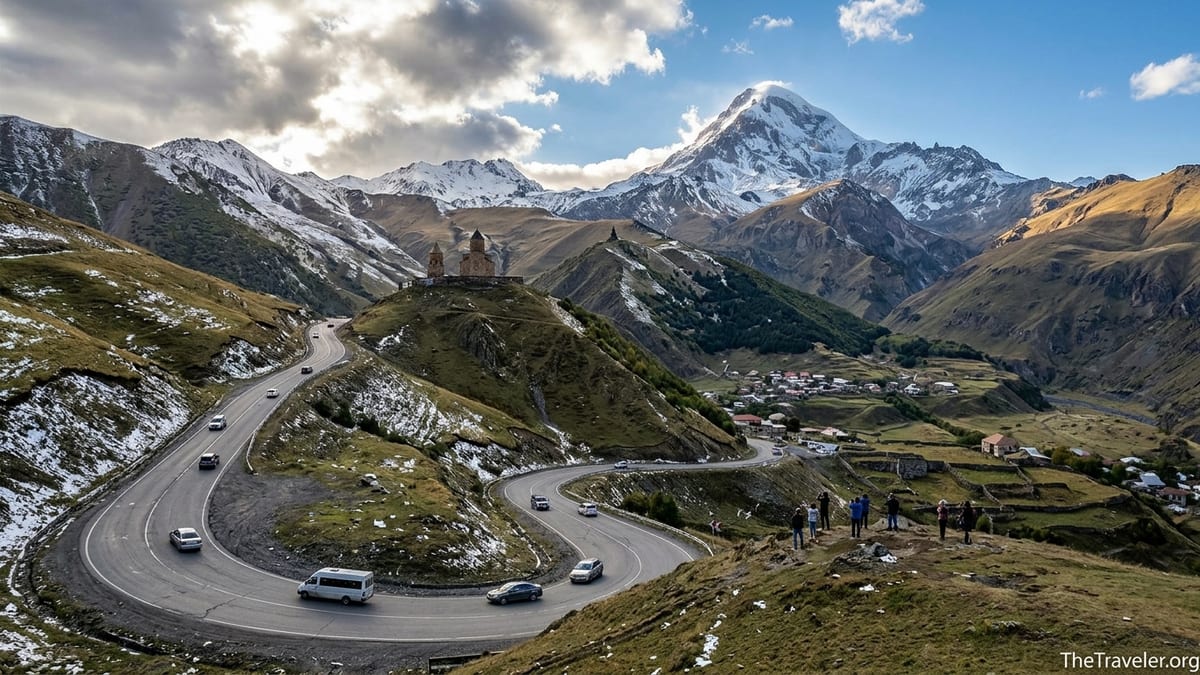
The roughly 150-kilometre journey from Tbilisi to Stepantsminda (Kazbegi) along the Georgian Military Highway usually takes around three to four hours each way in good conditions. A same-day return is absolutely possible, and thousands of visitors do it every year, but once you factor in photo stops, lunch and the detour to Gergeti Trinity Church, it becomes a long and often rushed day. Whether you should drive independently or join an organized tour depends on how much flexibility, comfort and mountain-weather resilience you want to build into the trip.
Get the latest updates straight to your inbox!
The Georgian Military Highway: Beauty, Distance and Time Reality
The route from Tbilisi to Stepantsminda follows the S3 highway, commonly called the Georgian Military Highway, from the ancient town of Mtskheta over Jvari Pass to the Kazbegi valley. The official S3 section from Mtskheta to the Russian border is about 139 kilometres, while door-to-door from central Tbilisi to Stepantsminda is closer to 150 to 160 kilometres depending on your starting point. In steady traffic with no extended stops, most drivers report a driving time of around 3 to 3.5 hours in each direction.
In practice, almost no leisure traveller drives it non-stop. Popular viewpoints at Zhinvali Reservoir, Ananuri Fortress and around Gudauri invite at least short photo breaks, while many people also stop for coffee or lunch in Pasanauri, Gudauri or Stepantsminda. Once you add 15 to 30 minutes at several stops, plus time to transfer to a 4x4 at Stepantsminda for Gergeti Trinity Church, a realistic day trip from Tbilisi often turns into a 10 to 12 hour operation even in summer, with only 2.5 to 4 hours actually spent in the mountains at the top end of the route.
Conditions on the Georgian Military Highway change quickly with altitude. From the lowlands around Tbilisi and Mtskheta you climb to over 2,300 metres at Jvari Pass before descending to Stepantsminda at roughly 1,700 metres. This means heavy trucks grinding slowly uphill, sharp hairpins and frequent fog or localized downpours around the pass, even when Tbilisi enjoys blue skies. In winter and spring, snow and black ice significantly slow the journey, and road restrictions between Gudauri and Kobi can add unplanned hours or even force an overnight stay.
For visitors weighing a same-day dash against a slower overnight trip, the key is not the distance but how much time you want on foot in the Kazbegi valley, and how comfortable you feel driving high mountain roads as the light and weather change. Those who see driving as part of the experience often embrace the long day; others find that an overnight stay in Stepantsminda or nearby villages transforms the journey from stressful endurance test into relaxed mountain escape.
Transport Options: Rental Car, Marshrutka, Private Driver or Tour
Travellers heading from Tbilisi to Kazbegi in 2026 typically choose between four main options: self-drive rental, shared marshrutka minibus, a private driver or an organized tour. Each comes with distinct departure points, costs and levels of flexibility. Rental cars can be picked up in central Tbilisi or at the airport through international brands and local firms; compact sedans with basic insurance often start around 120 to 170 lari per day outside peak summer, with higher rates for SUVs and 4x4 models. Fuel for a round trip to Kazbegi and local driving usually adds roughly 120 to 200 lari depending on consumption.
For budget travellers, the marshrutka from Didube bus station remains the cheapest way to reach Stepantsminda. Current reports from Tbilisi-focused guides put a one-way seat in 2026 in the range of about 15 to 25 lari, with several departures in the morning and early afternoon. These minibuses generally run point to point, stopping briefly in larger settlements, but they do not pause at viewpoints like Ananuri or the Russia–Georgia Friendship Monument, and they can feel crowded in summer. They are, however, a realistic same-day option if you are content with a quick visit to Stepantsminda and a 4x4 shuttle to Gergeti before returning on an afternoon van.
Private drivers and app-based intercity rides through services such as Bolt or Yandex Go have become a comfortable middle ground. Local agencies and platforms currently quote one-way Tbilisi to Stepantsminda transfers starting around 120 to 150 lari for a basic car, with more spacious or English-speaking-driver options going higher. A full-day return with waiting time and stopovers at Ananuri, Gudauri viewpoints and the Friendship Monument often comes out in the range of 250 to 400 lari for the vehicle, depending on negotiation, season and inclusions.
Organized day tours bundle transport, an itinerary of stops and an English-speaking guide. Small-group Kazbegi tours from Tbilisi in 2026 are widely advertised online for around 80 to 200 lari per person, usually on a 15 to 20 seat minibus, with pick-ups from Freedom Square or Rustaveli. Private guided day tours with a dedicated car and driver-guide are typically priced from roughly 500 to 800 lari for 1 to 3 travellers, sometimes excluding lunch and the Gergeti 4x4. These tours remove logistics and weather-checking from your hands but trade away spontaneity and tend to keep tight time limits at each stop.
Key Stops on the Georgian Military Highway: What Is Worth Your Time
Almost every itinerary up the Georgian Military Highway focuses on the same core sights. The first classic stop is Zhinvali Reservoir, a vivid blue artificial lake framed by forested hills about 60 kilometres from Tbilisi. There are a couple of roadside viewpoints here where cars and tours pull over for wide panoramas. While you can appreciate Zhinvali in a 10-minute photo stop, drivers with their own car might choose to linger, especially in autumn when the forests turn gold and red.
Just beyond Zhinvali stands Ananuri Fortress, a 16th-century complex of defensive walls and churches perched above the reservoir. Most commercial tours schedule around 30 to 40 minutes here, just enough to walk through the gate, climb one of the towers and step inside the main church to see its frescoes. Independent travellers often wish for at least an hour to explore the ramparts, photograph the setting and visit the small chapel near the waterline. If you travel by marshrutka you may only see the fortress from the road, as the public vans generally do not pull into the car park.
Higher up near the ski resort of Gudauri, the highway breaks out above the treeline into broad alpine views. One of the most popular roadside stops is the Russia–Georgia Friendship Monument, a circular concrete lookout built in the Soviet era on a clifftop above the Aragvi valley. Shared tours tend to allow about 20 to 30 minutes here for photos and a quick walk onto the viewing platform. Self-drivers can easily stretch this to an hour, exploring informal paths along the ridge and, in summer, browsing the stalls where local vendors sell churchkhela and honey.
Beyond Gudauri, the road reaches Jvari Pass, the highest point of the journey at more than 2,300 metres. Commercial tours rarely linger at the pass itself; more often they stop a little below at one of the Gudauri or Kobi viewing points, or at the vivid orange mineral springs that stain the cliffs near Kobi. These mineral springs are striking but close to the highway, so a short stop of 10 to 15 minutes is usually sufficient. If you drive independently, you can choose to skip a repetitive viewpoint in poor weather and instead arrive earlier in Stepantsminda to walk the riverside or explore the village lanes before the day-tour crowds arrive.
Mountain Weather, Road Closures and Safety on the Gudauri–Kobi Section
The most critical stretch of the Georgian Military Highway is the Gudauri to Kobi section around Jvari Pass. The Roads Department of Georgia publishes official restrictions and updates for this corridor, often specifying kilometre markers between Gudauri (Posta) and Kobi. Recent notices in November 2026, for example, banned vehicles with trailers and semi-trailers on the Gudauri–Kobi section during snowfall and sub-zero temperatures while allowing cars and minibuses to pass with or sometimes without chains. Such targeted restrictions are common in winter and do not necessarily mean that the road is completely closed to all traffic.
Full closures do occur, usually due to avalanches, avalanche risk or heavy snow combined with poor visibility. Over the past few winters, there have been episodes when the pass area was shut for hours or days, including a spring avalanche event that kept the route closed to all traffic until early May. Avalanche research from Georgian scientists has highlighted the Gudauri–Kobi area as one of the country’s most active avalanche zones, with numerous recorded events over recent decades. When closures happen, trucks can queue for kilometres and tourists may find themselves stranded on either side of the pass, sometimes unexpectedly spending the night in Gudauri or Stepantsminda.
Because conditions change rapidly, especially from late November to April, anyone planning to drive should check same-day restrictions before departure using official Georgian road-status channels or updated summaries published by local travel information services that translate the Roads Department bulletins into English. Distinguish carefully between notices that apply only to heavy vehicles or trailers and announcements that suspend all traffic. Also note that restrictions may tighten or lift mid-day. Leaving Tbilisi early improves your chances of crossing the pass while daylight and snow-clearing operations are at their best.
For visitors without winter driving experience, it is prudent to avoid self-driving this route in active snow or when ice is forecast. Local drivers are used to overtaking slow trucks on blind bends, and a mix of aggressive overtakes and frozen surfaces can feel intimidating. In these periods, a private driver or organized tour that can react to restrictions, re-time departures or even reroute your day can be safer than handling the logistics yourself. In good summer weather, by contrast, confident drivers usually find the road manageable, though still demanding full concentration.
Driving, Insurance, Winter Tires and the Gergeti Trinity Church Access Road
Most major and local rental agencies in Georgia allow their vehicles on the S3 highway to Kazbegi, but the small print matters. Contracts often exclude cover for off-road driving, certain unpaved tracks and river crossings, and may restrict use of smaller city cars on rough mountain roads. In winter, agencies are increasingly equipping cars with winter or all-season tires and may specify that chains are available or required for certain routes. Before committing to a self-drive Kazbegi trip, confirm in writing that your rental insurance remains valid on the Tbilisi–Stepantsminda route during your dates, and ask explicitly about winter equipment if travelling between November and March.
The main Georgian Military Highway between Tbilisi and Stepantsminda is paved, though you can expect sections of patched asphalt, construction zones and occasional potholes, especially near the pass where weather is harsh. A high-clearance vehicle or 4x4 is not strictly necessary in dry summer conditions for the main road. However, four-wheel drive or at least good clearance becomes very useful, and sometimes essential, on side roads and in snow or heavy rain. Nowhere is this more relevant than on the short but steep access road from Stepantsminda up to the car park near Gergeti Trinity Church.
Gergeti Trinity Church sits at around 2,170 metres on a shoulder above Stepantsminda, with Mount Kazbek rising above it. The modern access road from the village to the church car park is officially paved but narrow, steep and in places deeply rutted, with tight hairpins and loose gravel on the edges. Local authorities and guides strongly recommend using a local 4x4 rather than attempting the drive in a standard rental sedan. Shared 4x4 taxis based around the main square and bus stop in Stepantsminda typically charge in the region of 20 to 30 lari per person for a return trip when the vehicle is shared, or 50 to 80 lari for a private jeep depending on demand, time of day and season.
Without your own suitable vehicle, visiting Gergeti on a day trip can be logistically tight. Organized tours either include the 4x4 shuttle in the price or collect cash on the day and negotiate with local drivers. Independent travellers arriving by marshrutka need to factor in the time to secure a jeep, ascend to the church, explore the site and return to catch a late-afternoon van back to Tbilisi. This is feasible in good weather but leaves little margin for delays. An overnight stay in Stepantsminda removes much of this time pressure and increases your chances of seeing the church in clear conditions at either sunrise or sunset.
Staying Overnight in Stepantsminda: Views, Villages and Accommodation
Stepantsminda, still widely called Kazbegi by travellers, has grown into a compact mountain resort village with guesthouses, small hotels and a handful of larger properties. Rooms with direct Mount Kazbek and Gergeti Trinity Church views are concentrated on the eastern side of the valley and on gentle slopes above the main road. Well-known view-focused hotels sit slightly outside the village centre, while many family-run guesthouses with balconies and garden terraces are scattered through residential lanes within a 10 to 15 minute walk of the bus stop.
Accommodation prices fluctuate by season, but recent listings for 2026 show basic guesthouse rooms with private bathrooms and breakfast starting from roughly 120 to 200 lari per night for two people in shoulder seasons, rising during busy summer weekends and major holidays. Mid-range hotels with guaranteed mountain views and on-site dining often fall in the 250 to 450 lari per night bracket for a standard double. Higher-end properties with spa facilities and premium panoramic rooms can be significantly more expensive. Booking ahead is advisable for July and August or when a road closure strands additional travellers in town.
From a practical transport perspective, staying overnight in or near the village centre keeps you within easy walking distance of marshrutkas, 4x4 stands and grocery stores. Guests who choose more secluded lodges or hillside hotels with spectacular views may rely on their own vehicle, taxis or hotel shuttles to move between property, village and trailheads. Before confirming a reservation, clarify how you will reach the hotel if you arrive by public transport, and whether taxis are easily available early in the morning or later in the evening when you may wish to photograph sunset or dine in town.
Crucially, an overnight stay buys you flexibility around mountain weather. Many travellers who attempt Kazbegi as a day trip find Gergeti shrouded in cloud by the time they reach the church in the early afternoon, particularly in summer. With a full day and one or two nights in the area, you can time your visit for early morning or late evening windows when the light is softer and the probability of clear views is higher. You also gain the opportunity for an unhurried village walk, a second short hike or simply time to sit on a balcony and watch the mountains change colour with the sun.
Two to Three Day Road-Trip Itinerary with Hikes and Weather Awareness
A realistic two-day Tbilisi–Kazbegi road trip balances scenic driving, key stops and time on foot without pushing the limits of fatigue or weather. On day one, aim to depart Tbilisi around 08:00, allowing 40 to 60 minutes to reach Mtskheta if you choose a brief detour there, then continue to Zhinvali Reservoir for a short viewpoint stop. Allocate at least 45 minutes to an hour for Ananuri Fortress so you can climb a tower, walk the walls and photograph the reservoir. Continue up the valley, pausing for lunch in Pasanauri or Gudauri, then drive beyond the resort to the Friendship Monument for a substantial stop and, if conditions allow, a relaxed stroll along the clifftop path.
From the monument, cross Jvari Pass and descend to Stepantsminda, aiming to arrive in mid to late afternoon. Check into your guesthouse or hotel and, if the weather cooperates, take a gentle walk along the Tergi River or through the lanes of the village to orient yourself. In good visibility, some travellers arrange a late-afternoon or early-evening 4x4 up to Gergeti Trinity Church for sunset, though this is best reserved for stable forecasts as cloud often builds later in the day. Dinner in Stepantsminda rounds out the evening, with an early night advisable for those planning a hike the following morning.
On day two, an early-morning Gergeti visit can be the centrepiece. Arrange a 4x4 for shortly after sunrise to maximise your chances of clear skies and softer light on Mount Kazbek. From the church car park, a manageable option for active travellers is to walk along the ridge and explore alternative viewpoints rather than simply returning by jeep immediately. Back in the village by late morning, choose a short, lower-elevation hike that matches the weather and your fitness, such as a walk towards the Sno Valley or up one of the side tracks that lead to minor church sites and viewpoints above Stepantsminda.
If you have the flexibility to add a third day and conditions are favourable, Juta Valley becomes a rewarding extension. Juta, perched at over 2,000 metres and reached by a partially paved mountain road from Sno, offers access to hikes towards the Chaukhi massif. Trails out of Juta involve significant elevation gain, rocky sections and stream crossings, and sit at higher altitude than Stepantsminda. They are best attempted in stable summer weather with proper footwear and layers, and are unsuitable when snow, heavy rain or storms are forecast. Should forecasts worsen, reallocating your third day to additional low-level walks around Stepantsminda or even returning slowly to Tbilisi with extended stops at Ananuri and Mtskheta is a safer alternative.
High-altitude hikes across the region demand respect for rapid weather changes. Clear blue skies over Tbilisi in the morning do not guarantee benign conditions at 2,000 metres and above by midday. Thunderstorms can build quickly on warm afternoons, bringing heavy rain, sudden temperature drops and poor visibility. When cloud lowers, navigation becomes more complex and views vanish, undercutting the point of strenuous climbs. For those without alpine experience, local guides, conservative route choices and strict turnaround times are recommended, and if in doubt, staying low or entirely within the village area is the wiser decision.
Costs, Budgets and Who Each Option Suits
Putting real numbers to the options helps clarify what kind of trip suits which traveller. A guided small-group Kazbegi day tour from Tbilisi in 2026 often advertises prices from approximately 175 lari per person with a local operator for an itinerary that includes Ananuri, Gudauri and Stepantsminda, but may or may not bundle the 4x4 up to Gergeti or lunch. Some budget-focused tours appear in the 80 to 150 lari per person range from Tbilisi-based agencies, again usually excluding meals and sometimes the Gergeti shuttle. For a solo traveller, these seat prices are often cheaper than commissioning a private car.
A private driver with car for a long full-day Tbilisi–Kazbegi–Tbilisi round trip, with agreed sightseeing stops and waiting time at Stepantsminda, commonly comes in at around 250 to 400 lari for the vehicle, split between passengers. Add 20 to 80 lari for the Gergeti 4x4 depending on how many share the jeep, plus personal spending on food and drinks, and a couple could reasonably expect a total transport cost in the region of 350 to 500 lari for a tailored but still single-day excursion. Going independently by marshrutka, two people might pay around 60 to 100 lari combined for return seats, plus 50 to 80 lari for a shared 4x4 to Gergeti and modest spending on meals.
A self-drive overnight trip layers rental and accommodation costs on top. For example, two days’ rental of a compact car at around 150 lari per day, plus fuel, might total roughly 450 to 550 lari. Add one or two nights in a mid-range guesthouse at 200 to 300 lari per night, plus the Gergeti 4x4 and meals, and a couple’s overall budget can easily land between 900 and 1,500 lari for a relaxed two- or three-day escape, depending on hotel choice and restaurant habits. Travellers already renting a car for a longer Georgian itinerary effectively spread that base cost across more days, making Kazbegi a cost-efficient detour.
When planning, build in contingency for unexpected stays due to road closures, particularly in winter. Keeping an extra 300 to 500 lari accessible can cover last-minute accommodation in Gudauri or Stepantsminda and additional food costs if the pass shuts temporarily. Also factor in travel insurance that covers delays and, ideally, offers some support for medical evacuation in the unlikely event of a serious incident in a region with limited hospital facilities. Awareness of where the nearest clinics and fuel stations are located, and carrying warm layers, water, snacks and a charged phone, are basic but valuable safeguards.
Accessibility, Emergencies and Final Recommendations
Accessibility along the Georgian Military Highway is improving but still limited in places. Ananuri Fortress features uneven stone steps and gravel surfaces that can be challenging for those with reduced mobility. Viewpoints such as Zhinvali and the Friendship Monument involve short walks over rough ground and, in winter, compacted snow or ice. In Stepantsminda, pavements are often narrow or absent, and the steep path around Gergeti Trinity Church is largely unpaved. Visitors with mobility concerns may prefer to stay in accommodations close to the village centre and rely on private cars or 4x4s for as much of the sightseeing as possible, accepting that some viewpoints or sections of the fortress may not be practical.
From an emergency-planning perspective, the key is redundancy. Carry paper copies or offline maps of the route, along with essential phone numbers for your accommodation, rental company or tour operator. In winter, leave your itinerary with someone in Tbilisi and agree to check in at specific times. If you are self-driving and the pass closes while you are on the wrong side of it, resist the temptation to attempt unofficial tracks or pressure local drivers to take risks; instead, secure a room in the nearest settlement and wait for official reopening announcements. Local guesthouses are accustomed to stranded travellers and can often provide basic meals even at short notice.
For budget travellers who value cost above all, the marshrutka plus local 4x4 combination remains the least expensive way to see Kazbegi, but requires strict time management and a willingness to compress the experience into a single day. Confident drivers who enjoy mountain roads and want control over their schedule often find that renting a car for an overnight trip delivers the best balance between cost, freedom and depth of experience, especially outside the peak of winter. Photographers and landscape enthusiasts in particular benefit from an overnight stay, which opens up sunrise and sunset light at Gergeti and more patient exploration of side valleys like Sno or Juta when conditions are right.
Visitors with limited time, limited driving confidence or trips in the shoulder and winter seasons are usually best served by organized tours or private drivers. A well-run small-group or private tour lets you experience the Georgian Military Highway and Gergeti Trinity Church while someone else manages road conditions, live restriction checks and safe pacing on the mountain curves. For those who can spare at least one night, however, the value of staying in Stepantsminda is hard to overstate. Trading a rushed day tour for a slower two- or three-day road trip transforms Kazbegi from a tick-box excursion into a memorable encounter with one of the Caucasus’s most dramatic landscapes.