


Christmas airfares in the United States are on track to be among the priciest tickets of 2026, but that does not mean you are doomed to overpay. Using recent Google Flights analyses, airline fare data and current Christmas pricing trends from fare trackers such as Hopper, you can time your purchase and use smart tools to keep costs under control, even if you are booking late.
Get the latest updates straight to your inbox!
What recent data says about Christmas airfare in 2026
Several holiday forecasts released in late 2026 point to expensive but still manageable prices for Christmas travel. A 2026 holiday travel index from Hopper reports that domestic round trip Christmas tickets from U.S. airports are averaging about 450 dollars, more than 20 percent higher than last year, and well above typical fall fares. At some airports, such as Portland International in Oregon, local reporting based on federal transportation data shows average domestic fares rising by double digits year over year, illustrating how holiday trips now sit on top of already elevated base prices.
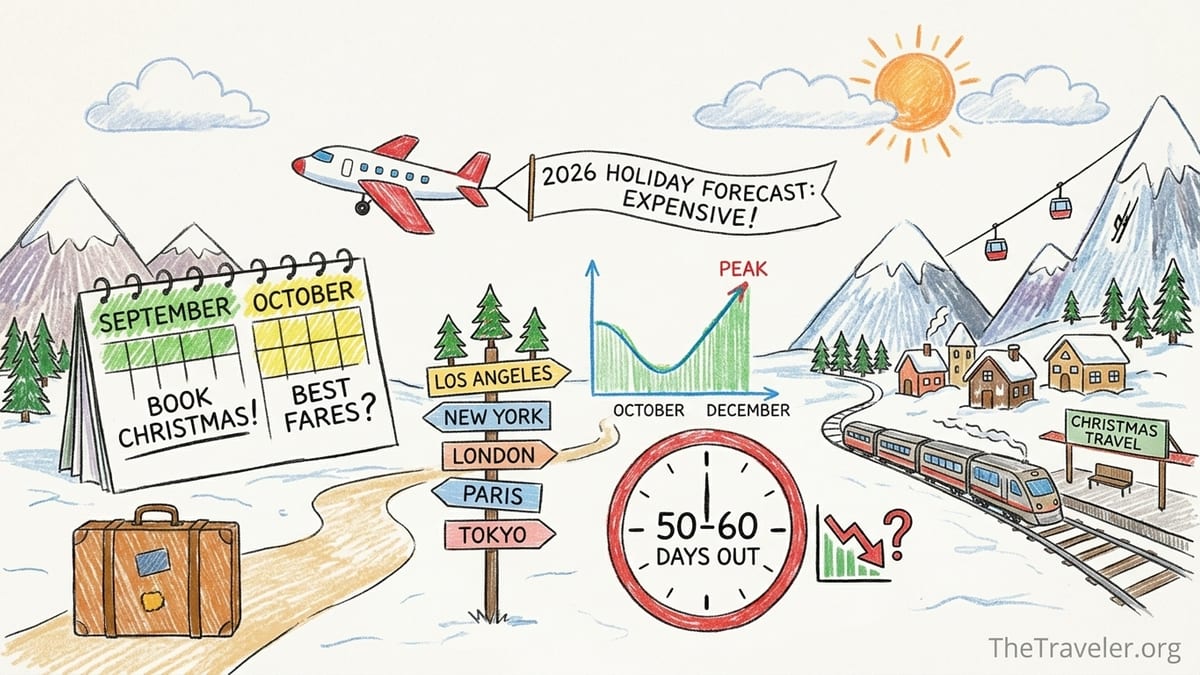
At the same time, Google Flights has continued to publish booking guidance based on several years of historical price data. The latest round of analysis, summarized in late 2024 and updated again in 2026 media coverage, finds that the cheapest average Christmas fares for domestic trips now appear roughly 50 to 60 days before departure, slightly earlier than in past years when the low point was often three to four weeks out. In practical terms, for a December 23 departure in 2026, Google’s historical patterns suggest that the best odds of low fares fall in late October rather than in early December.
Industry data also shows how much higher Christmas flights can be compared with the U.S. average fare. Federal Bureau of Transportation Statistics figures, along with commercial analyses from firms such as Savings.com, put the typical domestic itinerary around 390 to 400 dollars in recent years. When Christmas averages are in the mid 400s, that means many peak itineraries are running 20 to 30 percent above a normal trip on the same route. This gap is what travelers are trying to shrink or avoid through timing and smart use of search tools.
The big picture is clear: prices are high, and they are unlikely to collapse close to Christmas, but there is a repeatable pattern to when the best deals tend to appear. Understanding that pattern is the first step toward deciding when to commit to a ticket for 2026.
Ideal booking windows for Christmas 2026
Google Flights’ current guidance, based on several years of ticket data, indicates that the lowest average prices for domestic Christmas trips have usually appeared between about 20 and 80 days before departure, with the most consistent low point around 50 to 60 days out. Independent coverage from outlets such as CBS News and AFAR, summarizing Google’s findings, now advises U.S. travelers to have Christmas itineraries locked in by around Halloween, rather than gambling on a last minute bargain in November or early December.
Applied to Christmas 2026, this means that if you are flying out on Friday, December 18, a historically favorable booking window runs from late September through the end of October, with a particular focus on the first half of October. For travelers leaving a bit closer to the holiday, say on Wednesday, December 23, the cheapest window based on prior patterns moves roughly into the second half of October. Buying significantly earlier than that can work if you see an unusually low fare, but on average the data shows little reward for booking domestic Christmas trips more than three to five months out.
Christmas 2026 falls on a Friday, which concentrates both outbound and return demand into a narrow band of days. That timing increases the risk of very high prices on certain peak dates, especially Friday, December 18; Saturday, December 19; and Wednesday, December 23 on the outbound side, along with Sunday, December 27 and Sunday, January 3 on the return. If you must travel on one of these peak days, it becomes more important to book on the early side of the recommended window. For example, a nonstop New York to Denver round trip leaving Friday, December 18 and returning Sunday, December 27 may be already well above 600 dollars by early November.
For international Christmas trips, especially to popular leisure destinations such as London, Paris, Cancún or Tokyo, analysts and frequent flyer communities often recommend an even earlier window. Because international Christmas seats sell quickly, buying four to eight months in advance often makes sense. Travelers eyeing a December 20 flight from Los Angeles to London in 2026 might start watching prices as early as April and strongly consider buying by late summer if they see a fare near or below the usual off peak price for that route.
Real world price patterns on key U.S. routes
Recent holiday reports and live Google Flights searches illustrate how these patterns play out on specific city pairs. On busy domestic routes such as Los Angeles to New York, holiday tracking by Hopper shows Christmas round trips commonly sitting in the 550 to 700 dollar range for standard economy when departure falls just before December 24. In years when the broader U.S. average fare hovers around 400 dollars, that level gives a sense of just how much the Christmas premium can be on high demand routes between coastal hubs.
Smaller but still popular markets show similar behavior. A traveler flying from Chicago to Orlando for a family gathering might see October fares in the low 300s for a round trip leaving December 19 and returning December 27. By mid November, if the flight is filling up, those same dates can edge toward 400 dollars or more, a trend that aligns with Hopper’s observation that last minute Christmas tickets, particularly in the first week of December, tend to run about 8 to 10 percent higher than prices available in late October.
Regional differences matter too. Airports that already have higher than average domestic fares during the year, such as Salt Lake City, Denver or certain Alaska gateways, often see steeper absolute Christmas prices. A Denver to Honolulu itinerary over Christmas, for instance, may spend most of the fall priced in the 850 to 1,000 dollar range in standard economy, rarely dipping near 600 dollars even on less popular departure days. By contrast, a shorter route like Dallas to Phoenix may fluctuate between roughly 250 and 350 dollars depending on the exact dates and timing.
These examples are snapshots, not guarantees, but they show that when you spot an October fare that is only slightly higher than what you might pay in a non holiday month on the same route, that is often a sign to buy. Waiting in hopes of a major drop typically exposes you to a higher risk of sharp increases as remaining seats become scarce.
How to use Google Flights tools effectively
Google Flights has become central to how many travelers time their Christmas bookings, not just because it aggregates prices from dozens of airlines and online travel agencies, but also because of tools that analyze historical data. When you search a specific Christmas itinerary, such as Seattle to Atlanta departing December 20 and returning December 27, Google often displays a colored bar and a short note indicating whether the current fare is low, typical or high compared with prices seen in recent months for similar dates. That quick benchmark helps you decide whether to wait a bit longer or lock in the ticket.
Price tracking is another powerful feature for Christmas 2026 planning. After choosing your dates and route, you can toggle on a setting to track prices, which sends email alerts when fares move significantly. Many travelers describe receiving notifications every week or two when there are notable changes, and some recount being able to jump on brief dips before airlines updated their own sites. For a Boston to Los Angeles Christmas trip, you might set tracking in late August, watch as prices drift between 420 and 500 dollars through September, and then pounce in mid October when a price alert shows a sudden drop to 380 dollars.
Google Flights also allows you to track broader searches rather than a single fixed itinerary, which can help if your dates or even destinations are flexible. For instance, you can search New York to “Europe” with December filters and then use price tracking to monitor overall patterns. While some Reddit users have noted that broad “any date” tracking for general destinations sometimes works differently than before, the current interface still lets you track flexible date ranges if you scroll below the list of daily results and toggle tracking for that broader search.
One important limitation is that Google Flights does not sell tickets directly and does not always see every private or members only fare that might appear on an airline’s own site or via a specific credit card portal. When you receive an alert about a good fare, it is wise to double check the airline’s website directly before purchasing. In a few real world cases, travelers have reported that airline sites briefly honored a lower price even after Google sent an alert about an increase, giving a short window to secure the cheaper ticket.
Strategies if you are booking late in 2026
Not everyone can commit to Christmas travel in October. If you find yourself searching for flights in late November or even early December 2026, the data shows that you are less likely to find rock bottom prices, but you still have options to control the damage. The first step is to be brutally realistic about peak days. If you are currently priced out of a December 23 outbound and January 3 return, consider shifting to a slightly earlier departure on Tuesday, December 22 or a later return on Monday, January 4, which Hopper’s modeling suggests can shave as much as 200 to 250 dollars off a domestic round trip compared with the peak Sunday return.
Another late booking tactic is to accept a less convenient itinerary. Google’s own guidance highlights that taking a connection rather than a nonstop can meaningfully reduce price. For example, a last minute nonstop from San Francisco to Chicago on December 21 might price at 650 dollars in economy, while a one stop option via Denver or Dallas sold by the same airline could still be under 500 dollars. The trade off is extra travel time and a greater risk of weather disruptions, but for some travelers the savings are worth it.
Red eye flights and very early departures, such as a 5 a.m. departure on Christmas Eve itself, also tend to hold lower fares longer into the booking cycle. A family trying to reach Phoenix from Seattle might pay 450 dollars per person for a comfortable midday flight booked in early December, but could still find seats closer to 300 dollars on an overnight or dawn departure. Combining an off peak time with a less popular return date, like Tuesday, December 29 instead of Sunday, December 27, can produce cumulative savings even when you are planning late.
Finally, late bookers should keep an eye on alternate airports. Around major metropolitan areas, shifting from a main hub to a secondary field can occasionally unlock lower fares at the last minute. In the New York area, that might mean checking both Newark and New York Kennedy in addition to LaGuardia. In southern California, it can be worth comparing Los Angeles with Long Beach, Burbank or Ontario for Christmas week departures.
Booking windows and tactics for international Christmas trips
For overseas Christmas travel, the timeline and tactics shift. Google Flights’ general guidance for international bookings suggests that the best prices often appear several months earlier than for domestic trips. Frequent flyer communities and travel hacking forums commonly report that for high season routes, such as United States to Europe or Asia over Christmas and New Year, good economy fares can appear eight to ten months before departure and then slowly climb as the holidays approach.
Take the example of a traveler planning a December 20 to January 3 trip from New York to Paris in 2026. By March or April 2026, Google Flights searches might show economy fares around 900 to 1,000 dollars on major carriers. If you wait until September or October, that same itinerary could be closer to 1,200 dollars or more, with less flexibility on departure times. By November, many nonstops may have broken the 1,400 dollar mark, leaving only connecting itineraries at or below 1,000 dollars.
To manage this, start tracking your preferred international route as soon as schedules open, which for many airlines is roughly 11 to 12 months ahead of departure. If you see a fare that is comparable to or only moderately higher than what that route costs at non holiday times, consider booking even if it feels early. In the New York to Paris example, if typical spring fares are 650 to 750 dollars, grabbing a Christmas ticket at 900 dollars in April could be a good value relative to historic Christmas pricing.
International travelers should also pay close attention to connection choices. A Christmas flight from Chicago to Bangkok via a major European hub may be hundreds of dollars cheaper than a one stop routing through a North Asian gateway, especially when fuel prices and regional demand shift. Google Flights makes it easy to compare these combinations visually, allowing you to trade off connection length and total journey time against price.
Setting alerts, tracking trends and knowing when to buy
Whether you are traveling within the United States or abroad, the strongest tool you have for Christmas 2026 is information. Setting up Google Flights price alerts by late summer or early fall lets you watch the curve of fares on your route instead of guessing. If you track a Dallas to New York itinerary from August, for example, you may see it sit around 320 dollars through September, jump to 380 dollars in early October, briefly drop back to 340 dollars later that month, and then steadily climb from mid November onward. That pattern tells you that the October dip is the time to move.
If your schedule is flexible, you can also track multiple date combinations to see where the sweet spot lies. Try setting alerts for both a December 19 and a December 22 departure, plus two or three different return dates. Over time you may notice that Saturday departures spike more than Tuesday or Wednesday, or that returning on a Monday consistently shaves 50 to 100 dollars off the price. Those concrete differences make it easier to adjust your plans in ways that have real financial impact.
Travel experts frequently stress that the best time to buy is when you see a price you can live with, especially during holidays. While data from Google Flights, Hopper and the Department of Transportation can show general trends, no one can predict with certainty how a specific flight will behave as Christmas approaches. If a fare fits your budget and is close to or slightly below the “typical” range that Google shows for that route and cabin, it is usually safer to book then rather than risking a later surge.
Keep in mind as well that airlines may introduce schedule changes as Christmas nears, which can occasionally open the door to voluntary changes without fees if your flight time shifts significantly. Booking directly with the airline rather than through a third party can simplify how you handle these changes, even if you initially discovered the fare through Google Flights.
Putting it all together for Christmas 2026
For most U.S. travelers, the emerging consensus for Christmas 2026 is clear. Start monitoring prices with Google Flights by late summer, especially if you know you will have to travel on peak Fridays or Sundays. Aim to book domestic round trips in the roughly 50 to 60 day window before departure, which for many people will mean committing in October, and lean earlier within that window if you have specific times, seats or nonstops in mind.
If you are flying abroad for the holidays, push that window several months earlier. Use price tracking as soon as schedules open, and make a plan to book once you see a fare that aligns with what you know the route costs in non holiday periods, even if that means buying six to eight months ahead. When you are forced to book late, be prepared to adjust your departure times, return dates and even your choice of airport to capture whatever value remains.
Christmas air travel is never going to be truly cheap. Yet real world data from Google Flights, fare trackers and federal statistics shows that informed travelers can still find relative bargains. By combining realistic booking windows with targeted use of alerts, flexible dates and smart routing choices, you can keep your Christmas 2026 airfare closer to the national average and spend more of your holiday budget on what actually matters once you arrive.