


More news on this day
Travelers across multiple continents faced renewed disruption this week as a new wave of delays and cancellations at Dubai International Airport rippled through some of the world’s busiest long haul corridors, affecting routes to Saudi Arabia, India, the United Kingdom, Bangladesh, the United States, Singapore and several other destinations.
Get the latest news straight to your inbox!
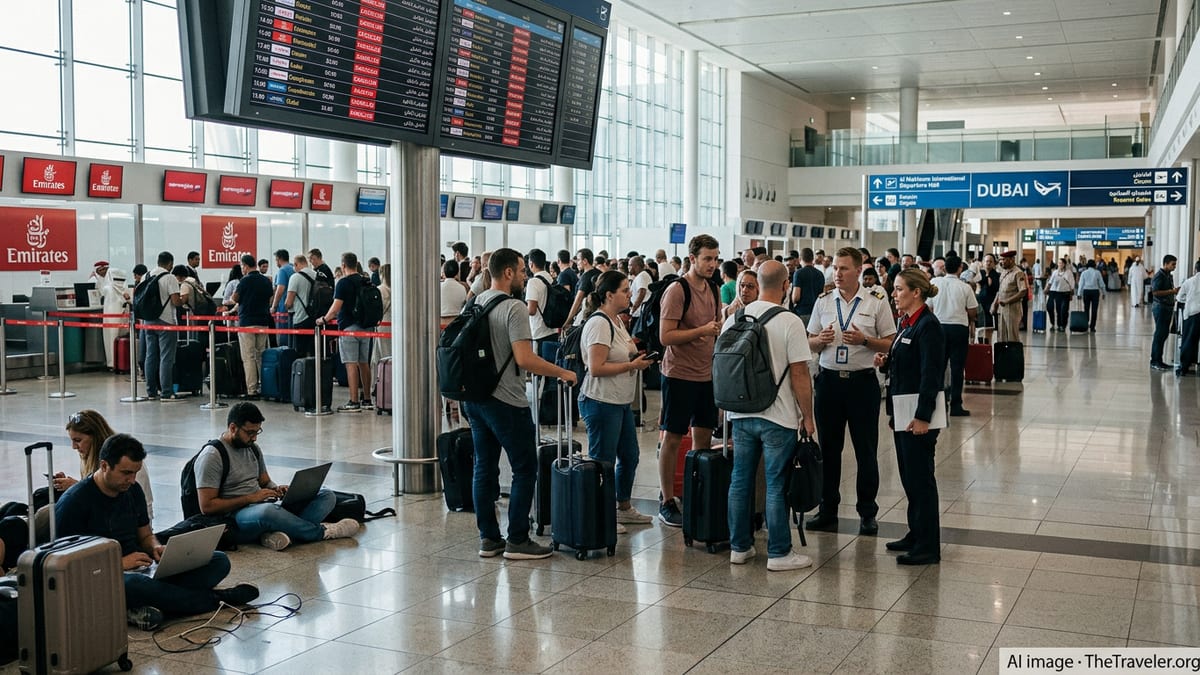
Fresh Operational Strain at a Key Global Hub
Publicly available flight data and travel advisories indicate that Dubai International Airport has recorded around 257 delayed services and at least 21 cancellations over a short period, underscoring how sensitive the regional network remains to any operational shock. The disruption comes even as airport operators have been highlighting a gradual return to more stable traffic patterns following months of regional airspace constraints.
Dubai International has been operating near or above pre disruption passenger volumes, which leaves limited slack in the system when flights are rescheduled or rerouted. Aviation bulletins and airport flight boards show that delays are spread across all three terminals, affecting both flagship carrier Emirates and a mix of regional and international airlines using Dubai as a transfer point.
Recent briefings from Dubai Airports describe a strategy of scaling up movements in line with available airspace and routing, while working with airlines to smooth schedules. However, analysts note that even modest timetable changes can quickly cascade into missed connections and crew displacement when an airport is handling tens of millions of passengers per quarter.
Major Carriers and Key Routes Affected
The latest disruption has hit a wide spectrum of airlines and markets. Long haul operators from Europe, Asia and North America had already been rebuilding their Dubai schedules in stages, often at reduced frequencies compared with pre crisis patterns. Observers tracking airline notices report that a number of carriers continue to trim or consolidate flights in response to airspace congestion, fuel constraints and broader security considerations across the region.
Flagship Gulf and Asian airlines are prominently visible in the latest wave of disruptions. Services touching Dubai from hubs such as Riyadh, Mumbai and Singapore appear frequently in delay and cancellation tallies, reflecting how central these city pairs are to the wider network. Travel forums and airline updates suggest that certain carriers have extended earlier suspensions or are operating fewer weekly frequencies on Dubai to Singapore and Dubai to select Saudi gateways.
North American and European services are also feeling the knock on effects. Route rationalisation by some transatlantic and Europe to India operators, combined with continuing adjustments to routings over the Gulf, has meant that Dubai based connections to and from US and UK cities remain vulnerable when schedules tighten. Passengers on multi sector itineraries linking North America or Europe with South Asia through Dubai have been reporting missed connections and involuntary rebooking as a result.
Riyadh, Mumbai, Singapore and South Asia See Knock On Delays
The disruption has been particularly visible on flows between Dubai and nearby Gulf capitals. Flight tracking data and regional commentary indicate repeated cancellations or last minute changes on some Saudi Arabia links, including Riyadh. Travelers in Riyadh and Jeddah have reported difficulty securing reliable departures to the United Arab Emirates in recent days, with some flights operating on irregular timings or being merged.
On the India corridor, Mumbai remains one of Dubai’s busiest city pairs and is again experiencing strain. Heavy monsoon weather recently disrupted operations at Mumbai’s main airport, creating a backlog of delays and diversions that then fed into outbound schedules to the Gulf. Carriers operating between Dubai and Mumbai have advised passengers to expect rolling schedule changes as both airports absorb weather related and regional airspace constraints.
Further east, Singapore is another focal point. Earlier schedule updates from one major Southeast Asian carrier showed Dubai Singapore services being suspended or reduced during parts of the summer season, with capacity reallocated to alternative long haul routes. The latest count of delays and cancellations at Dubai has raised concern among travelers booked on connecting itineraries that rely on a tight Dubai Singapore transfer window.
Beyond these high profile hubs, the ripple effects extend across South Asia. Routes linking Dubai with Dhaka and other Bangladeshi cities, as well as wider India and Pakistan markets, are seeing a mix of minor and extended delays as airlines juggle aircraft and crew rotations. Given the high proportion of migrant and visiting family traffic on these sectors, schedule shifts can have significant personal and economic consequences.
Passengers Face Missed Connections and Changing Waiver Policies
For individual travelers, the most immediate impacts are missed connections, longer layovers and, in some cases, overnight stays while waiting for the next available departure. Social media posts, traveler forums and airline advisories are filled with accounts of passengers rebooked via alternative hubs in Doha, Abu Dhabi, Kuwait or European gateway cities when Dubai connections no longer line up.
Airlines serving Dubai have periodically updated their waiver and rebooking policies, typically allowing date changes or rerouting at reduced penalties when disruptions are directly tied to airspace or operational constraints. Recent industry guidance encourages travelers to monitor these policies closely, as eligibility windows and conditions can change quickly in response to the evolving situation across Middle East air corridors.
Travel management companies and corporate travel departments are increasingly steering time sensitive itineraries away from tight Dubai connections where possible. Instead, some are favouring slightly longer connection times or alternative routings that skirt the most congested airspace, even when that adds extra flight time, in an effort to improve reliability for business critical trips.
Outlook for Summer Travel Through Dubai
Looking ahead to the peak northern hemisphere summer period, the outlook for Dubai remains mixed. On one hand, official traffic statistics and recent communications from airport operators point to sustained demand, strong passenger volumes and a concerted push to restore full network connectivity. On the other, regional airspace remains crowded, and specialist advisories warn that any renewed security flare up or infrastructure incident could quickly translate into another spike in delays and cancellations.
Analysts note that Dubai’s role as a super connector for traffic between Europe, Africa, Asia and Oceania means that it will remain central to global travel planning even during periods of heightened volatility. Airlines are likely to continue fine tuning schedules, adjusting aircraft types and exploring additional frequencies on proven high demand legs such as Dubai Mumbai, Dubai Riyadh and Dubai London as conditions permit.
For now, industry guidance for passengers transiting Dubai is consistent: check flight status repeatedly in the 24 hours before departure, build extra time into connections, and remain prepared for last minute gate or routing changes. With more than 250 recent delays and over 20 cancellations tied to the latest operational strain, travelers using the hub in the coming days may need patience and flexibility as the regional network rebalances once again.