


More news on this day
Hundreds of travelers across Australia and New Zealand faced hours of disruption as severe winter weather combined with tight airline schedules to cancel 31 flights and delay more than 640 services across Melbourne, Sydney, Brisbane, Auckland, Wellington and Christchurch, affecting operations at Jetstar, Qantas, Virgin Australia, QantasLink and Air New Zealand.
Get the latest news straight to your inbox!
Major Hubs Across Two Countries Grind to a Crawl
Airports on both sides of the Tasman Sea experienced widespread disruption as storms, low cloud and strong winds swept across key air corridors linking Australia and New Zealand. Published coverage indicates that the worst effects were concentrated on the busy domestic and trans-Tasman networks serving Melbourne, Sydney and Brisbane in Australia, and Auckland, Wellington and Christchurch in New Zealand.
Preliminary tallies from airline and airport data show that 31 flights were cancelled outright while about 644 services were delayed, creating rolling queues at check in, security and boarding gates. The pattern of disruption suggests that once early services fell behind schedule, knock on effects rippled through the day’s tightly timed rosters and aircraft rotations.
Travelers reported extended waits on the ground, missed connections and last minute changes to routings as carriers attempted to rethread aircraft and crew around weather related bottlenecks. While some flights departed with shorter delays once conditions briefly improved, others were held at gates or on taxiways as air traffic control limited movements during the most intense periods of low visibility and crosswinds.
By evening, departure and arrival boards in several terminals showed clusters of services pushed back by more than an hour, alongside strings of cancellations that underscored how vulnerable current schedules can be when winter weather combines with high demand and limited spare capacity.
Jetstar, Qantas, Virgin and Air New Zealand Among Hardest Hit
The disruption stretched across most of the region’s major carriers. Publicly available flight status information shows that Jetstar, Qantas, Virgin Australia, QantasLink and Air New Zealand all recorded cancellations and significant delays as the weather system moved through key hubs.
Domestic trunk routes such as Sydney to Melbourne, Brisbane to Melbourne and Auckland to Wellington appeared particularly exposed, with frequent shuttle style services leaving little room to absorb cascading delays. Short haul international services between Australia and New Zealand, especially those routed through Melbourne, Sydney, Auckland and Christchurch, also experienced schedule changes as aircraft and crews were repositioned.
Operational data released in recent months already pointed to tight margins in on time performance for several of these carriers, reflecting strong demand alongside constrained fleets and staffing. The latest wave of weather related disruption further illustrates how quickly reliability can be shaken when multiple airlines are operating near capacity with few standby aircraft available.
For travelers, brand distinctions were often blurred, as passengers booked on one airline were in some cases reprotected on partner services or placed on later departures when their original flights were removed from the schedule at short notice.
Weather, Staffing and Network Design Drive Vulnerability
Meteorological reports describe the system that affected the region as a combination of strong frontal activity, embedded thunderstorms and persistent low cloud, particularly over coastal corridors used by aircraft arriving and departing from Sydney, Brisbane and Auckland. These conditions typically trigger stricter air traffic control spacing, reducing the number of takeoffs and landings that can be safely handled each hour.
Industry analysis has also highlighted how lean scheduling practices can magnify the impact of bad weather. Tight turnarounds, high aircraft utilization and limited crew reserves leave airlines with fewer options when early flights are disrupted. Once aircraft miss their departure slots, the time needed for deicing, refueling, catering and crew changes compounds delays across the day.
In New Zealand, published guidance from consumer agencies notes that weather and air traffic control restrictions are generally considered outside an airline’s direct control, which tends to limit formal obligations around compensation. Similar frameworks apply in Australia, where passenger entitlements often depend on whether the disruption stems from controllable operational issues or external factors such as storms.
As a result, many travelers affected by the latest disruption were left to rely on goodwill policies, travel insurance and flexible tickets to recover costs for missed hotel nights, tours or connecting flights that fell outside the original booking.
Passengers Face Long Queues and Patchwork Support
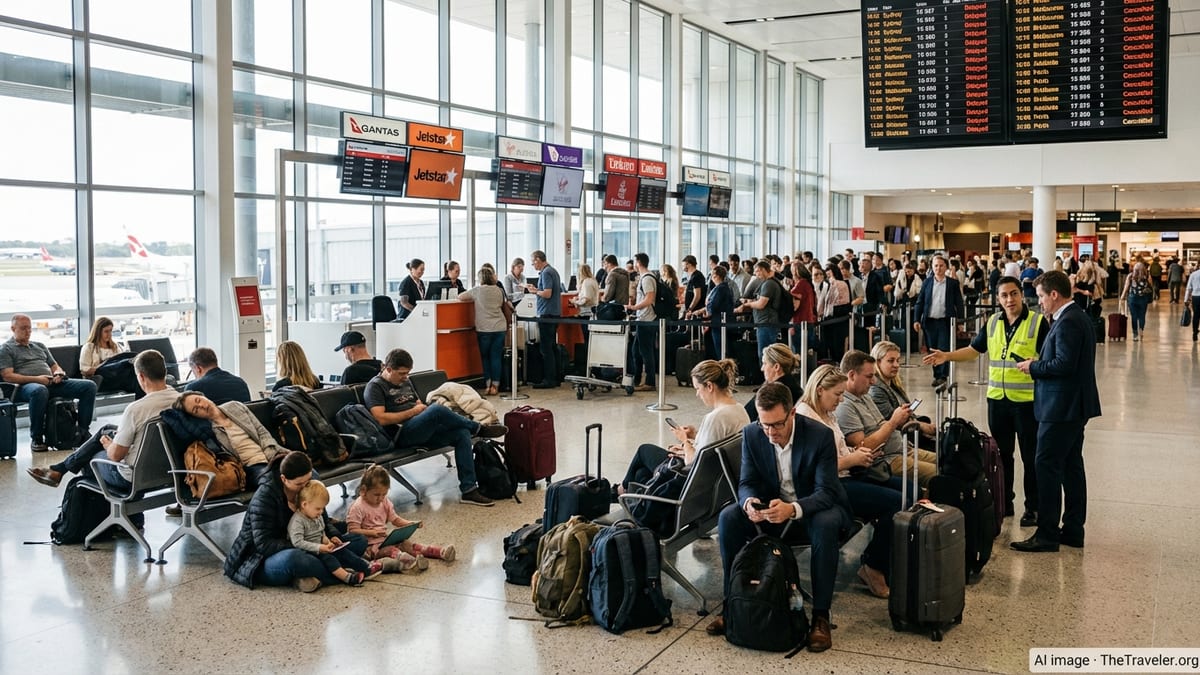
Across major terminals, the visible impact on travelers was immediate. Images and first hand accounts shared via social media and local media outlets described crowded check in halls, long lines at customer service desks and departure boards scrolling through multiple status changes for the same flight over the course of several hours.
Some passengers reported receiving text and app notifications advising them of delays or cancellations only after arriving at the airport, while others learned of changes at the gate when boarding was repeatedly pushed back. In several cases, travelers attempting to salvage connections to long haul services through Asian and North American hubs faced difficult choices between waiting for replacement flights or purchasing entirely new itineraries.
Consumer advocates in both countries regularly encourage passengers to document expenses linked to significant disruption, including meals, ground transport and emergency accommodation, as well as to keep records of boarding passes and updated itineraries. These materials can support later claims through airline customer care channels, travel insurers or, in some circumstances, consumer dispute resolution bodies.
However, the fragmented regulatory landscape between Australia, New Zealand and international destinations often leaves travelers navigating a complex mix of airline policies and national rules, particularly when an itinerary involves multiple carriers or ticketing intermediaries.
Renewed Scrutiny on Reliability of Trans-Tasman Travel
The latest day of disruption is likely to sharpen scrutiny of operational resilience across key Australian and New Zealand carriers. Regulators and transport agencies in both countries already publish regular on time performance and cancellation statistics, providing a baseline for tracking trends in reliability over time.
Recent reports have suggested gradual improvement in punctuality compared with the early post pandemic period, yet ongoing incidents of mass delays and cancellations continue to erode traveler confidence. Aviation analysts note that the combination of seasonal weather risks, volatile fuel costs and ongoing staffing challenges makes it difficult for airlines to maintain strong resilience while keeping fares competitive.
Calls for clearer minimum standards of care during major disruptions have become more frequent, with some passenger rights groups pointing to more prescriptive compensation frameworks in parts of Europe and North America. In Australia and New Zealand, by contrast, many protections still rely on general consumer law and individual airline commitments rather than a dedicated aviation specific regime.
For now, the hundreds of travelers caught up in the latest wave of cancellations and delays are working through rebookings and claims, while airlines continue efforts to stabilize operations ahead of upcoming school holiday peaks and the next pulse of winter weather across the Tasman region.