


More news on this day
Dubai International Airport is navigating a turbulent July 2026 as regional tensions, airspace restrictions and adjusted airline schedules continue to trigger pockets of flight delays, cancellations and reroutings at one of the world’s busiest hubs.
Get the latest news straight to your inbox!
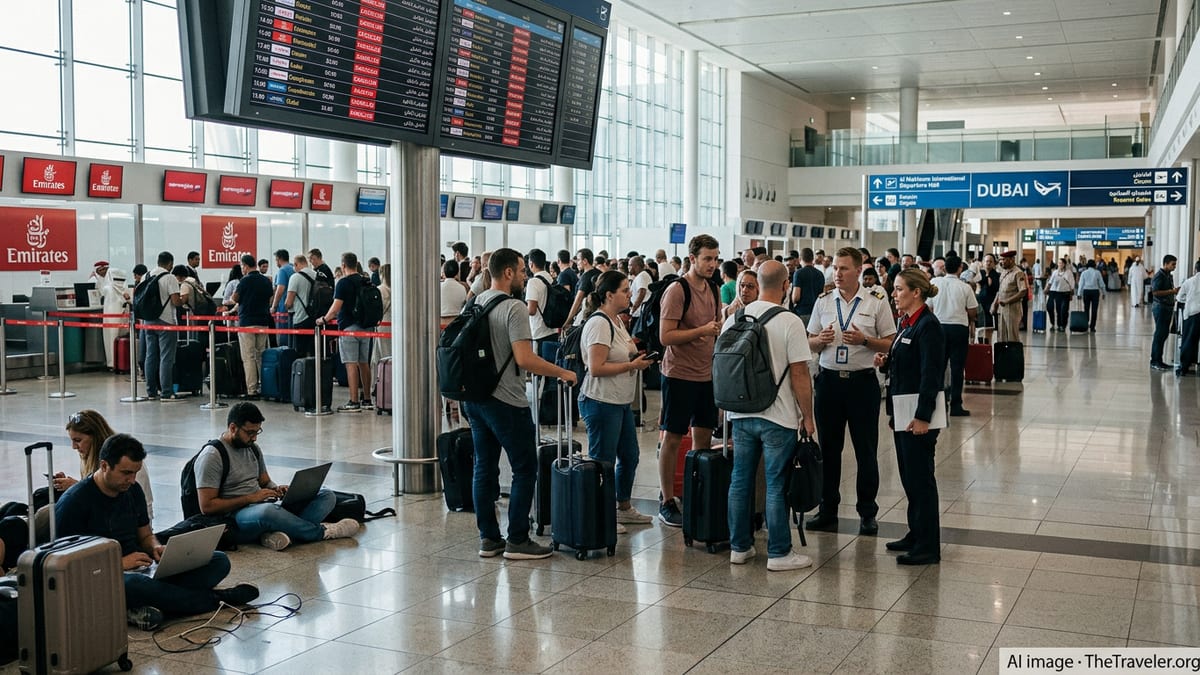
Regional crisis keeps pressure on Dubai’s flight schedules
The aviation picture across the Gulf remains fragile in mid July 2026, months after Iranian strikes on the United Arab Emirates temporarily closed Dubai International Airport and caused extensive regional airspace shutdowns. Publicly available timelines show that the heaviest disruption occurred in March, when airspace closures led to thousands of cancellations across the Middle East and a temporary suspension of operations at Dubai and other key hubs.
Since early May, sector analyses indicate that the UAE has reopened its airspace and restored broad connectivity, but at reduced throughput compared with pre-crisis norms, with estimates suggesting Dubai International Airport has been operating below full capacity into the summer peak. This constrained environment has left airlines with less operational flexibility when further pressures arise, such as congestion, weather or new security developments.
Advisories compiled by travel risk firms and aviation monitors in late June and early July point to continued rerouting around Iranian airspace and selective schedule cuts across the region. While Dubai itself remains operational, the cumulative impact of longer routings, crew duty-time limits and shifting demand patterns has translated into short-notice timetable changes and occasional delays for flights using the hub.
Airline suspensions and schedule cuts reshape July travel options
Even as Emirates and flydubai maintain extensive networks through Dubai, a number of foreign carriers have thinned or suspended services into the city for parts of summer 2026, narrowing choices for travelers. Coverage in regional business media in June highlighted that British Airways, for example, postponed its planned restart of Dubai flights until October, citing the wider Middle East disruption and the need for sustained stability before redeploying aircraft.
Industry digests tracking airline schedules also list multiple European and Asian carriers that have kept Dubai routes either suspended or operating at reduced frequency into July, after large-scale cancellations earlier in the year. Community travel forums summarizing this information for passengers describe a patchwork of service resumptions, with some airlines restoring Dubai flights while others continue to divert capacity elsewhere.
Schedule data reviewed by network-planning analysts shows that Emirates itself has been fine-tuning its July operations, including equipment changes on long haul routes to balance capacity and resilience. These adjustments are framed as part of a broader plan to manage demand at a time when the airline reports that it has restored most of its global network, but continues to factor in regional risk and airspace constraints.
Operational plans and airspace measures aim to contain new disruptions
Regulators in the United Arab Emirates have set out new frameworks intended to manage any renewed disruption more systematically. A notice published by the General Civil Aviation Authority in late April details procedures for managing arrival capacity during periods of disruption, including the option for regional air traffic control to temporarily halt departures from specified origin airports when a UAE hub is under strain.
Separate updates issued in Abu Dhabi on July 9 describe the activation of broader operational plans to contain the impact of ongoing regional developments, with an emphasis on keeping passenger flows through UAE airports orderly and mitigating knock on effects when flight schedules must be adjusted at short notice. Public information on these measures highlights the use of coordinated slot management, rerouting and terminal flow controls rather than large scale airport closures.
Travel alerts from international airlines echo this cautious posture. At least one major European carrier has notified customers that flights to and from Dubai are suspended until mid July 2026, presenting rebooking and refund options to affected passengers. Other airlines advise travelers to expect possible last minute changes on itineraries crossing affected flight corridors and to monitor notifications closely through carrier apps.
On the ground at Dubai: busy terminals, localized delays
First hand accounts from passengers transiting Dubai in June and July describe terminals that are busy, particularly around holiday peaks, but generally functioning smoothly. Travelers posting on public forums in early July report that operations inside the airport largely resemble pre-crisis conditions, with typical queues at immigration and security but no widespread disruption on the days they traveled.
At the same time, individual reports mention isolated delays and rolling knock on effects when inbound aircraft arrive late due to earlier hold ups on congested routes. One traveler describing a July connection through Dubai noted a modest departure delay linked to a late arriving aircraft, but indicated that flight connections and airport services operated normally once in the terminal.
Operational data for specific flights supports this mixed picture. Flight tracking information for services operated by Dubai based carriers on July 13 and 14 shows many flights arriving and departing broadly on time, alongside a subset of services experiencing delays or minor schedule adjustments. For most passengers, the main visible impact appears to be a higher incidence of rescheduling and longer journey times on routes that must avoid restricted airspace.
What July 2026 passengers should do before flying via Dubai
For travelers planning to pass through Dubai in the second half of July 2026, industry guidance emphasizes preparation and flexibility rather than expectation of severe disruption. Airlines advise passengers to check their flight status repeatedly in the 24 hours before departure, ensure contact details are up to date in booking profiles and use mobile apps for real time notifications of any schedule changes.
Passengers whose flights are part of long haul connections through Dubai are encouraged by travel advisors to build in slightly longer connection windows where possible, given the risk of upstream delays on earlier legs. Those affected by cancellations or significant timing shifts are generally being offered rebooking, vouchers or refunds under existing disruption policies, although the exact options vary by carrier and ticket type.
Travel risk consultancies continue to monitor the security backdrop in the Gulf and caution that renewed regional escalations could again affect airspace availability with limited warning. For now, publicly available information suggests that Dubai International Airport is open and handling large volumes of passengers, but with an elevated likelihood of timetable changes and route alterations compared with a typical summer season.