


I went up to Jayuya with one rule for myself: no snacks from gas stations, no anonymous chains. If it did not roast coffee, bake bread, fry fritters or stir a pot of rice right there in the mountains, it did not count. Over one long day, I ate my way from a neighborhood bakery in the pueblo to a specialty coffee shop, then on to a criollo restaurant and finally a rural coffee hacienda, noting what things actually cost, how long I waited, and which places truly poured Jayuya-grown coffee into the cup.
Get the latest updates straight to your inbox!
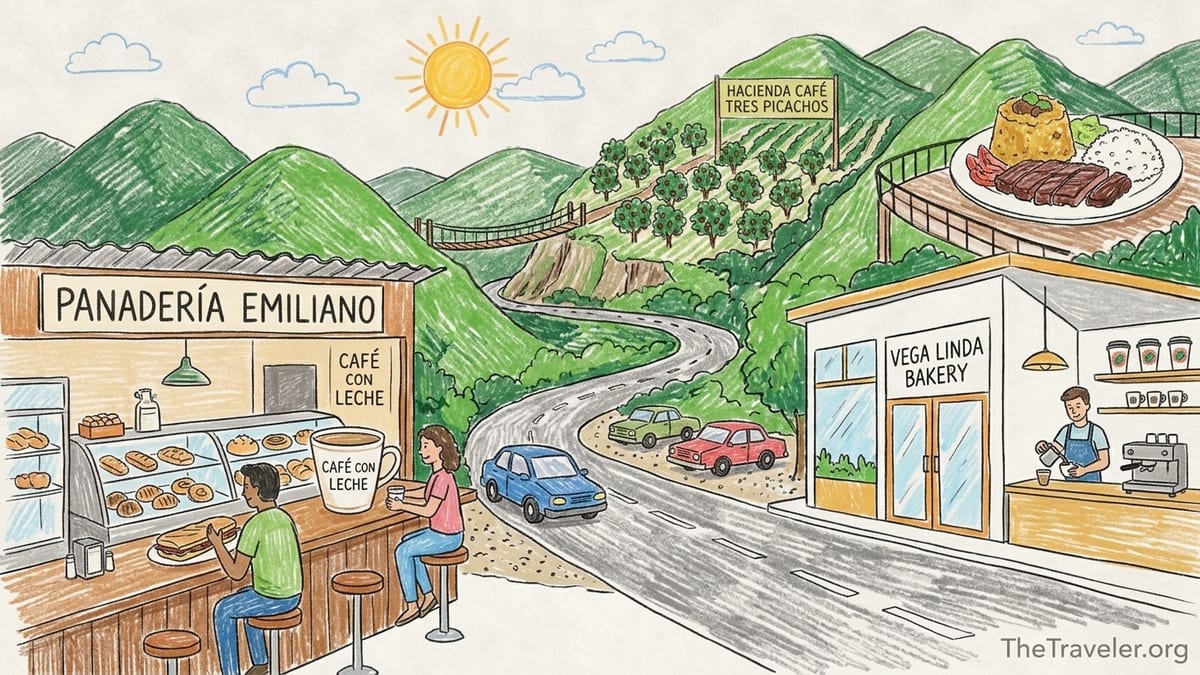
Morning in the Pueblo: Bakery Coffee vs Specialty Espresso
I started the day in Jayuya’s compact town center, the barrio-pueblo that clusters around the plaza and church. A few blocks from the square, Panadería Emiliano sits on Calle Guillermo Esteves, the kind of neighborhood bakery that wakes up before everyone else. Around 8:00 a.m. there was street parking along the block, no meters, and I walked straight into the smell of fresh pan sobao and strong coffee. The bakery has a short counter with stools and a handful of small tables; there is no outdoor seating and the only bathroom is a small, basic one in the back for customers.
At the counter I ordered what half the room already had: a medianoche sandwich and a café con leche. A pressed medianoche with ham, roast pork, Swiss cheese and pickles on the softer, slightly sweet roll was listed at about 6 dollars, while the café con leche in a medium cup was a little under 2 dollars. The staff confirmed what I suspected: their coffee was “de aquí de Puerto Rico” but roasted by a supplier outside Jayuya, not from the local haciendas. From order to first bite the wait was about 10 minutes, reasonable for a busy morning. The sandwich came hot, with a good sear on the bread, salty and rich enough that sharing one between two people plus pastries would be realistic.
To compare the old-school bakery coffee with something more curated, I walked and drove a short loop through town, then headed a couple of minutes toward Urbanización Vega Linda, where Vega Linda Bakery operates in a residential-commercial corner. The distance from the plaza is roughly 0.5 miles, under a 5 minute drive with easy on-street parking in front of the low-rise building. Inside, the vibe is brighter and more contemporary than at Emiliano, with display cases of pastries and some branded mugs and tumblers celebrating Jayuya. The bathroom here felt a bit fresher, and while there still was no true outdoor seating, large windows brought in light.
At Vega Linda I ordered a cortado made with their “gourmet” house espresso and a slice of tres leches. The cortado ran just over 2 dollars and the cake about 4 dollars. When I asked where the beans came from, the barista clarified that they rotate Puerto Rican origins and sometimes include Jayuya-grown coffee but that morning’s batch was from another mountain region. The difference in cup profile was obvious: the cortado had a cleaner, more focused acidity and lighter body than the dark, robust cup at Emiliano. The tres leches was generous, enough for two, soaked but not collapsing. Comparing the two stops, the bakery near the plaza won for local chatter and old-school sandwiches, while Vega Linda took the edge for more refined espresso drinks and slightly more polished surroundings, at a modestly higher price.
Café Nativo: Small-Town Third Wave in the Mountains
By late morning I was ready to hunt down a dedicated coffee spot. Café Nativo sits within the Jayuya area reached by a short drive from the pueblo. The road out of the center climbs gently, and although the distance is relatively small in miles, the curves mean it takes closer to 10 or 15 minutes than it looks on the map. Parking is informal but straightforward, with cars pulled onto gravel and along the roadside shoulder. When I arrived just after 10:30 a.m. there were still spots available and no wait to order, just two people ahead of me.
Inside, Café Nativo blends the look of a rural home with details of a modern coffee bar: a proper espresso machine, pour-over gear, chalkboard menu. I asked directly about the beans and was told that they were working with coffee from the central mountains, including lots sourced from Jayuya and nearby municipalities. A single-origin Jayuya roast was available as both pour-over and espresso that day, which not every rural café can claim. I ordered a pour-over of the Jayuya lot, a cappuccino based on the house espresso, and a simple ham and cheese sandwich on pan de agua to have a savory anchor.
The pour-over cost around 4 to 5 dollars, the cappuccino close to 3.50, and the sandwich about 6 dollars. From payment to the first drink was roughly 8 minutes on a calm midweek visit, but I could see how waits might stretch past 20 minutes on a busy weekend, given the small staff. The Jayuya pour-over was the standout: medium body, gentle sweetness reminiscent of panela and dried fruit, with a clean finish that cut through the morning humidity. The cappuccino was solid if less distinctive, offering a familiar chocolate and toasted nut profile. The sandwich, dressed with a thin smear of mayo and a slice of tomato, was straightforward but filling enough as a light brunch.
Café Nativo has an advantage for families and slow travelers. There is a mix of indoor tables and a covered terrace where kids can fidget without drawing glares, and the staff did not seem bothered by people lingering with laptops. There is a unisex bathroom that was clean, stocked with soap and paper, but it can create a small line since there is only one. For travelers who care specifically about drinking local coffee, this was the clearest example of a place able and willing to identify beans as from Jayuya itself, not just “Puerto Rican” in general.
Lunch at La Casita: Big Plates of Criollo Comfort
For a full sit-down meal I drove back down toward the main town area to La Casita Restaurant by Chef Javier, a well-known spot for Puerto Rican criollo cooking. It sits within a short drive of the central barrio-pueblo, and depending on where you park in town it can be reached in about 5 to 10 minutes. I arrived just before typical lunch rush, around 12:30 p.m. on a weekday. The gravel lot in front had enough space, so parking was free and easy. The building itself is indeed a little house, painted in warm colors, with a covered outdoor patio where several families were already eating.
I asked for a table for two and was seated within 5 minutes. By 1:00 p.m. every visible table was occupied and the wait list had grown to around 20 minutes, so arriving early helped. The printed menu features a long list of mofongos, grilled meats and daily specials. Based on recommendations from the server, we chose a mofongo stuffed with churrasco, an order of croquetas de malanga con bacalao to share, and a side of arroz mamposteao, along with two soft drinks. Portions here are in the generous mountain style: one mofongo easily serves a hungry adult, and the croquettes came four to the plate, big enough that two people could split them as a starter.
The mofongo with churrasco was just under 20 dollars, the croquettes around 10 dollars and the mamposteao rice about 5 dollars, with soft drinks adding another 6 dollars. With tax and a modest tip, lunch for two landed close to 45 dollars. The flavors justified the bill: the mofongo was garlicky and well-seasoned without becoming greasy, the churrasco sliced and cooked medium with plenty of char and a drizzle of house chimichurri, and the malanga-and-salt-cod croquettes creamy inside with a subtle ocean flavor rather than aggressive saltiness. Service was warm and quick at the start, though as the dining room filled, drink refills took longer and the check arrived only after a small wait, bringing the total seat time to a little over an hour.
La Casita’s drinks menu leans more toward cocktails and beers than towards specialty coffee, and staff confirmed that their coffee is Puerto Rican but not specifically from Jayuya. Dessert options rotate, but by 1:30 p.m. several had already sold out, a small inconvenience if you arrive with a sweet tooth. There is a multi-stall restroom area that was clean, with separate facilities for men and women, an advantage over the single-bathroom setups at smaller cafés. For families with children, the outdoor patio is the best bet; kids at neighboring tables had space to move around without feeling hemmed in, and staff seemed accustomed to multigenerational groups.
Driving Out to Hacienda Café Tres Picachos
In the mid-afternoon I pointed the car toward the countryside for a very different coffee experience at Hacienda Café Tres Picachos in Barrio Saliente. From Jayuya’s pueblo the drive out to kilometer 2.7 on Road 539 took a little under 25 minutes, following a narrow, winding route past small homes, roadside shrines and sudden views of the jagged mountain peaks that give the hacienda its name. I visited on a Sunday, one of the days when the hacienda is open from about 9:00 a.m. to 4:30 p.m.; the operation currently focuses on long weekends, so visiting outside Friday to Sunday risks finding the gate closed.
The entrance is signposted but easy to miss on the first pass. Free parking is in a grassy area next to the main structure and fills gradually around midday. By arriving around 2:00 p.m. I had no trouble finding a spot, but I could see from social media posts and visitor comments that festival weekends or holidays can bring crowds and waits. The setting is rural and photogenic: a coffee processing building, open-air seating areas, decorative touches referencing jíbaro traditions and a hanging bridge used as a popular photo backdrop.
At the main counter I asked specifically for coffee grown and roasted on site, and the staff were quick to highlight their café Tres Picachos served as “cafecito jíbaro” and in espresso-based drinks. I ordered a cafecito jíbaro, essentially brewed coffee served in a small green cup inspired by the old butter containers Puerto Rican families used as mugs, along with a latte made with their beans and a slice of quesito-style pastry. The cafecito cost around 3 dollars, the latte close to 4 dollars, and the pastry about 3 to 4 dollars. On Sundays they also offer hot meals, including a sancocho cooked over wood, in the 12 to 18 dollar range depending on the serving and sides.
Flavor-wise, this was the most explicitly “Jayuya” coffee of the day. The cafecito jíbaro came out dark and aromatic, with a smooth, almost chocolatey taste and none of the harsh bitterness that sometimes turns people off strong coffee. The latte had good milk texture and a pleasant balance, though the milk somewhat masked the more subtle notes I had picked up in the black coffee. Wait time from ordering to receiving everything was about 15 minutes, reasonable given that a steady line of families and groups kept the counter busy. Seating is mostly outdoor under roofs or umbrellas, with plenty of room for children to move around and pose for photos near the bridge or peacocks on the grounds.
Facilities at Hacienda Café Tres Picachos reflect its role as a destination rather than a quick stop. Bathrooms are larger and better equipped than in-town bakeries, with separate men’s and women’s restrooms and multiple stalls. There is table service in some sections, especially when ordering full meals, but drinks and snacks are often picked up at the counter. I noticed several signs encouraging payment by card as well as cash, and my bill went through without issue on a credit card. For travelers who enjoy seeing where coffee is grown and processed, the extra drive was absolutely worthwhile, both for the taste of beans grown on the hacienda’s slopes and for the relaxed, rural family atmosphere.
Comparing Meals, Snacks and Practical Details
By the end of the day I had moved across four types of eating experiences: a classic town bakery, a slightly more modern bakery-café, a specialty coffee shop with light food, a full-service criollo restaurant and a rural coffee hacienda that doubles as a weekend restaurant. The cost spread was instructive. A breakfast for two at Panadería Emiliano, with one shared sandwich and two coffees plus a couple of pastries, realistically lands between 12 and 16 dollars. At Vega Linda, a pair of espresso drinks and one dessert to share runs about 10 to 14 dollars. Café Nativo, with two coffee drinks and one sandwich, came closer to 18 to 22 dollars for two people.
Lunch at La Casita was easily the priciest single meal, with our shared starter, one main dish and sides plus soft drinks reaching around 45 dollars with tax and tip. Swapping soft drinks for cocktails would push that higher toward 60 dollars for two. At Hacienda Café Tres Picachos, an afternoon of coffee and sweets without a hot meal cost about 20 dollars for two, while adding two plates of weekend sancocho and drinks could bring the total into the 45 to 55 dollar range. These numbers matter for budgeting: in one long day a couple can comfortably spend between 80 and 120 dollars on food and coffee in and around Jayuya, more if they opt for cocktails or multiple big restaurant meals.
In terms of comfort and logistics, the order of stops also changed the experience. The town bakeries were the most casual and forgiving for quick, inexpensive bites, but bathrooms were small and there was little space for restless kids. Café Nativo offered a balance of decent parking, a single but clean bathroom, and relaxed seating that suited couples and small groups trying to linger. La Casita felt best suited to families and celebratory outings: generous portions, proper restrooms, covered outdoor seating and a menu that allowed children to nibble fries and plain rice alongside adults working through mofongo and steak. Hacienda Café Tres Picachos, meanwhile, was the most child-friendly setting, simply because of the open space and outdoor areas, although parents need to keep an eye on kids near steep edges and the bridge.
One practical consideration throughout Jayuya was payment and hours. None of the places I visited were cash-only; every bill I paid went through on a card. That said, cellular coverage in the mountains is patchy and point-of-sale tablets sometimes hesitated, so carrying some cash remains wise in case of connection problems. Hours vary more sharply in the countryside than in town. Panaderías in the pueblo open early every day and close in the late afternoon or evening, while Café Nativo and La Casita both operated on standard daytime and evening schedules during my visit. Hacienda Café Tres Picachos was the most limited, focusing on Friday to Sunday from mid-morning to mid-afternoon, with occasional closures for private events or bad weather. Checking opening days shortly before you drive out saves disappointment.
What Felt Overrated, and What I Would Repeat
Spending an entire day eating within a relatively small radius in Jayuya made the differences between stops stand out more sharply than if each were a one-off. The only aspect that felt slightly overrated was the idea, common in travel chatter, that every coffee you drink in the central mountains is automatically from the nearest hillside. Staff at both Panadería Emiliano and Vega Linda were candid that their beans, while Puerto Rican, did not necessarily come from Jayuya. Only Café Nativo and Hacienda Café Tres Picachos could point to beans with clear Jayuya ties, and the flavor differences backed that up. Travelers who care about origin should feel comfortable asking directly and adjusting their expectations.
I would gladly repeat breakfast at Panadería Emiliano or a similar town bakery. The medianoche and café con leche combination captured the everyday taste of Jayuya life, and the bill stayed comfortably under 20 dollars for two. However, I would pair that with a later-morning trip to Café Nativo for a single-origin pour-over rather than trying to make bakery coffee stretch into a “destination” cup. On another visit I would likely arrive at Café Nativo closer to opening time to avoid potential weekend crowds and to have the patient bandwidth to talk more with the baristas about roasting partners.
La Casita is a place I would reserve for a proper lunch or dinner instead of a casual midday bite, both because of the quantity of food and the price point. The mofongo with churrasco and croquetas de malanga con bacalao deserved the reputation they enjoy, and the service had the kind of warmth that makes a meal feel like part of the trip rather than a refueling stop. For budget-conscious travelers, though, splitting one starter and one main between two people and filling in the gaps with bakery snacks earlier or later can keep costs in check while still letting you experience the restaurant.
The one stop I would insist on repeating, even with the extra driving, is Hacienda Café Tres Picachos. The combination of Jayuya-grown beans, the cafecito jíbaro served in its nostalgic green cup, the rustic setting and the chance to see families spanning three generations enjoy a Sunday sancocho made it feel more like a small festival than a simple coffee shop. As long as you build the schedule around their limited hours and are prepared for some curves in the road, it is the most complete expression of Jayuya’s coffee identity that I found in a single place.
The Takeaway
Eating and drinking in Jayuya over a single day revealed a culinary identity built from overlapping layers: everyday bakery habits, a growing specialty coffee culture, hearty mountain cooking and small family-run haciendas that keep coffee production local. For two adults, a realistic food and coffee budget that includes a bakery breakfast, a specialty coffee stop, one big criollo meal and an afternoon at a rural hacienda comes to roughly 80 to 120 dollars, not counting alcoholic drinks. Within that envelope you can taste both the simple flavors that residents enjoy weekly and the more curated experiences aimed at visitors.
My favorite individual dish of the day was the mofongo stuffed with churrasco at La Casita, a plate that combined texture, seasoning and portion size in a way that justified its price. The best coffee was the cafecito jíbaro brewed with Hacienda Tres Picachos beans, served in that unassuming green cup that carries a piece of Puerto Rican domestic history. In terms of pure value, the neighborhood bakery breakfast near the town center provided the most satisfaction per dollar, filling and flavorful without trying to be anything other than what it is.
What felt most overrated was the assumption that every establishment in the mountains is pouring coffee from its own backyard. The reality is more nuanced, with only some cafés able to trace beans directly to Jayuya farms. Yet that nuance is also part of the appeal. By asking questions, noticing where beans come from and paying attention to the differences between a bustling pueblo bakery, a small specialty café, a busy criollo restaurant and a rural hacienda, you can piece together a fuller picture of what eating and drinking in Jayuya really means.
If I were to repeat the day, I would keep the same basic rhythm: bakery breakfast in the pueblo, mid-morning coffee at a specialty café, hearty lunch at La Casita, and an unhurried afternoon at Hacienda Café Tres Picachos. That sequence lets you feel the town wake up, taste coffee at both ends of the spectrum and finish in the countryside as the light softens over the peaks. For travelers willing to trade highway convenience for winding roads and mountain air, Jayuya rewards the effort with cups and plates that tell its story more clearly than any brochure.
FAQ
Q1. Is one day enough to explore Jayuya’s food and coffee scene?
Yes, one full day is enough to visit a town bakery, a specialty coffee shop, La Casita for a meal and Hacienda Café Tres Picachos, if you plan the driving and opening hours carefully.
Q2. How much should two adults budget for food and coffee in Jayuya for a day?
A realistic budget for two adults is about 80 to 120 dollars for a bakery breakfast, specialty coffees, one larger restaurant meal and an afternoon stop at a coffee hacienda, excluding alcoholic drinks.
Q3. Do the cafés and restaurants in Jayuya all serve locally grown Jayuya coffee?
No, some bakeries and restaurants use Puerto Rican coffee from other regions. Café Nativo and Hacienda Café Tres Picachos are more likely to serve beans directly connected to Jayuya.
Q4. Is driving to Hacienda Café Tres Picachos worth the extra time?
Yes, the 20 to 30 minute drive from the town center is worthwhile for its rural setting, Jayuya-grown coffee, weekend meals and relaxed family atmosphere.
Q5. Are these places family-friendly and suitable for children?
Yes, La Casita and Hacienda Café Tres Picachos are especially family-friendly with outdoor seating and space for children, while bakeries and café interiors are better for short visits with calmer kids.
Q6. Do I need cash, or can I pay by card in Jayuya’s eateries?
Most of the establishments described accept credit or debit cards, but carrying some cash is sensible in case of connection issues or small purchases at rural spots.
Q7. What are typical waiting times at popular spots like La Casita and Hacienda Café Tres Picachos?
Arriving a bit before peak hours, expect about 5 to 15 minutes for seating or ordering. At weekend peak times waits can stretch to 20 minutes or more for tables or food.
Q8. Can vegetarians or lighter eaters find good options in Jayuya?
Yes, lighter eaters can build meals from sides like rice, beans and root vegetables, share large mains at criollo restaurants and focus on bakery items and coffee drinks in cafés.
Q9. Is parking difficult near the town center and the coffee haciendas?
Parking near Jayuya’s plaza is generally on the street and manageable if you arrive earlier in the day. Both La Casita and Hacienda Café Tres Picachos offer on-site, free parking areas.
Q10. When is the best time of day to visit these places to avoid long waits?
For shorter waits, aim for bakery visits before 9:00 a.m., arrive at Café Nativo near opening, sit down at La Casita just before traditional lunch or dinner hours, and reach Hacienda Café Tres Picachos by early afternoon.