


Choosing between a traditional countryside hotel and a private mountain cabin in Jayuya is not just about style. Once you add platform fees, cleaning charges and the reality of driving narrow roads in the fog to reach dinner, the “cheaper” option on your screen can turn into the more expensive and less convenient stay. To find out what actually felt worth the money, I booked two nights at Hotel Hacienda Gripiñas and two nights at a reasonably comparable private mountain cabin in the hills above Jayuya on close dates, then tracked every charge, every comfort and every frustration.
Get the latest updates straight to your inbox!
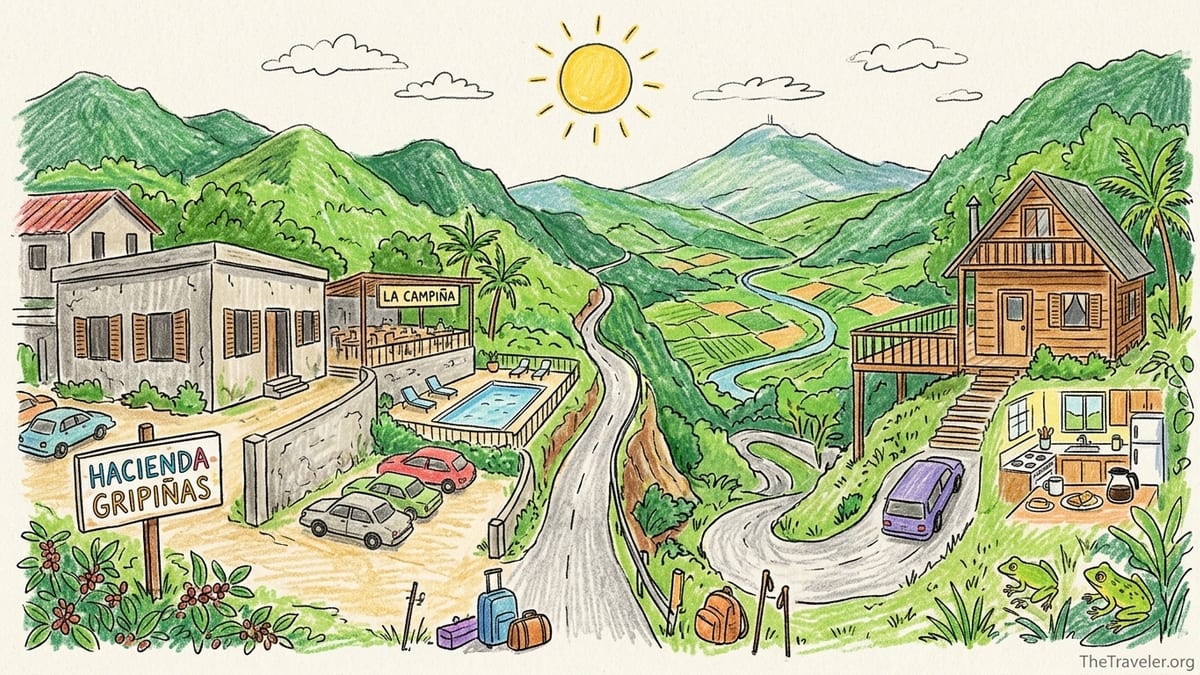
How I Booked: Hotel vs Private Cabin, Same Mountain, Same Season
For a fair comparison, I stayed at Hacienda Gripiñas, the long‑running countryside hotel in the Veguitas sector of Jayuya, and at a stand‑alone mountain cabin booked through a major home‑rental platform in the same municipality. Both stays were in shoulder season, outside major holidays, with overlapping midweek dates to keep weather and demand similar. Hacienda Gripiñas is a Puerto Rico Tourism Company endorsed rural hotel with on‑site restaurant, pool and parking. The cabin was a one‑bedroom wooden house with a separate loft, marketed as ideal for couples or small families, with mountain and valley views, full kitchen and private driveway.
On paper, the cabin’s nightly rate looked slightly cheaper. Hacienda Gripiñas showed a standard double room rate around 140 to 170 dollars per night for two adults for similar dates when checked through a leading hotel meta‑search and by calling directly, with taxes and tourism charges added at checkout. The cabin’s advertised rate floated around 150 dollars per night for two adults, with the option to add children for a small extra guest fee. The difference emerged in the line items the hotel folds into its rate versus what the rental platform lists after you click to book.
Hacienda Gripiñas quoted a per‑night room rate plus an 11 to 15 percent range in combined occupancy and sales taxes, depending on booking channel, and no separate resort or cleaning fee. Payment for my two‑night booking was due at check‑in with a credit card, with no security deposit hold. The cabin appeared at roughly 150 dollars per night before fees for two nights, but the final breakdown included a cleaning fee in the 40 to 60 dollar range, a separate service fee from the platform that pushed the effective nightly price closer to 190 dollars, plus occupancy and sales tax. The host also required a refundable security deposit through the platform’s system, visible in the pre‑arrival details.
Reservation Policies, Deposits and Cancellation Terms
Hacienda Gripiñas handled my booking in an old‑school but clear way. Over the phone, the staff confirmed nightly rate, taxes, and the fact that parking and Wi‑Fi were included. The cancellation policy followed a typical small hotel pattern in rural Puerto Rico: cancel without penalty until a set number of days before arrival, after which the first night plus tax would be charged if you did not show. There was no separate cleaning or service fee, and no damage deposit. I received a simple email confirmation listing check‑in time (mid‑afternoon) and check‑out (late morning) along with a contact number that was actually answered when I called from the road.
The cabin, by contrast, followed the standardized structure of major home‑rental platforms. The host had adopted a “firm” cancellation policy for my dates, which meant a full refund if cancelled more than a week in advance, then a sliding partial refund window until a few days before arrival, after which the first night and all fees except cleaning were non‑refundable. In addition, the platform held a security deposit authorization for several hundred dollars against potential damage. That amount was not charged up front, but it did reduce my available credit line for a few days around the stay.
Check‑in procedures also reflected the difference. Hacienda Gripiñas offers in‑person check‑in at reception until the early evening. When I mentioned that roadwork and rain might delay my arrival, the staff noted that someone from the family that operates the property lives on site and would wait for me if I called ahead from the main road. The cabin used self‑check‑in with a keypad lock. The host sent a detailed message with driving directions, a four‑digit code, and a reminder not to share it. That flexibility was welcome, but it came with the caveat that if the keypad failed in heavy rain or if I misjudged the route, help would arrive only as quickly as the host could respond through the app.
Sleeping at Hacienda Gripiñas: Comfort, Noise and Basics that Matter
Hacienda Gripiñas occupies former coffee estate buildings in the hills near Cerro de Punta, and the age of the structures shows in the best and worst ways. My standard double room had thick concrete walls, shuttered windows and high ceilings that trapped the mountain cool. The mattress fell into the medium‑firm category, not a luxury brand topper but better than many rural guesthouse beds in the region. After long drives on curvy mountain roads, the combination of decent support and crisp cotton sheets felt genuinely restorative. Pillows were on the soft side, and the hotel had no pillow menu, but extra pillows and blankets were available by asking at reception.
The bathroom was functional rather than stylish, with tiled floors and walls, a walk‑in shower, and a basic curtain. Hot water took about half a minute to arrive in the morning, and the pressure remained steady even when neighboring rooms were occupied. In my room, water temperature held reliably warm during a long post‑hike shower. The fittings looked a little worn in places, but nothing leaked. Soap and basic toiletries were included, though frequent spa users might miss higher‑end amenities. Hot water was electric, which meant brief outages during one afternoon thunderstorm; the staff warned about this at check‑in and power returned within the hour.
Not every room at Hacienda Gripiñas has full air conditioning, a common setup in the central mountains. My room was equipped with a wall unit plus a ceiling fan. In the evenings the outdoor air dipped into the low 70s Fahrenheit, and simply opening the windows with screens and running the fan was enough. I tested the air conditioning for a while in the afternoon and confirmed it cooled the space quickly but was noisier than a modern split unit. At night, mountain sounds replaced mechanical hum. Thanks to the solid walls and rural location, I heard very little from other guests. The loudest noises were coqui frogs and the occasional car climbing the access road.
Hotel Amenities: Restaurant, Pool, Breakfast, Staff and Parking
What the hotel lacks in slickness it makes up for in simple conveniences. The on‑site restaurant, La Campiña, served breakfast and dinner during my stay, with lunch available on weekends and busier days. Breakfast for two with coffee, eggs, toast and local fruit came out to roughly 25 to 30 dollars including tax and service. Dinner plates featuring pork, chicken or fresh trout from nearby farms ranged between 18 and 25 dollars. The food leaned toward hearty mountain fare, not fine dining, but it meant I never had to drive down narrow, poorly lit roads at night just to eat.
The small outdoor pool, framed by views of the hills, was open until early evening. The water felt chilly but clean, and there were enough loungers for the handful of midweek guests. Towels for the pool were available at reception. I used the pool once after a hot midday hike; if you travel with kids, it is easy to imagine them spending a big portion of the afternoon there while adults relax nearby with coffee from the bar. Wi‑Fi reached both the restaurant and the room but speeds fluctuated during storms, a common story in Puerto Rico’s interior.
Staff assistance at Hacienda Gripiñas proved to be one of the hotel’s strongest points. The same people who check you in will also recommend local bakeries, confirm if the road up to a viewpoint is passable after rain, and happily explain how long it really takes to reach the Cemi Museum or La Piedra Escrita petroglyphs. When a fog bank rolled in one evening just as I was thinking of driving out to a road‑side comedor, the receptionist gently suggested I might be happier eating on site and described which curves on Road 144 can be trickiest after dark. Parking, in contrast, was so easy that I almost forgot to note it: a free gravel lot steps from reception with enough space to maneuver even a larger rental SUV.
Life in a Jayuya Mountain Cabin: Access, Views and Practical Comfort
The private mountain cabin, set a short drive from central Jayuya, delivered a very different arrival. The last stretch left the main road and climbed a one‑lane concrete spur with sharp switchbacks and minimal lighting. In dry daylight it was manageable in a compact rental car at low speed. During my first evening arrival, a passing rain shower left the surface slick and a low fog settled in the valley. The combination of unfamiliar curves, limited guardrails and scattered dogs along the roadside demanded full attention. I was grateful for offline map downloads and the host’s written landmarks, because mobile service dropped in and out on the approach.
The cabin’s driveway, a steep gravel descent from the spur road, required a slow, committed turn. Drivers used to mountain terrain will likely find it invigorating, but for travelers who mostly drive in cities or flat suburbs, this final stretch can be intimidating, especially at night or in heavy rain. Once parked beside the cabin, though, the payoff became clear. The view opened across a green valley toward more peaks, with scattered farmhouses and the distant ribbon of a river. In the early morning the valley filled with white mist that gradually lifted to reveal patchwork fields. The listing’s photos had not exaggerated the panorama; if anything, the sense of space felt larger in person.
Inside, the bedroom provided a queen bed with a medium mattress and cotton sheets, plus an upper loft with two twin mattresses suitable for children or agile adults. The main bathroom was compact but modern, with a tiled shower, hot water from an on‑demand heater, and well‑sealed windows that kept out insects. Ceiling fans in the bedroom and living area moved air efficiently, and the elevated hillside position funneled breezes through open windows. There was no air conditioning, which the listing explained up front as a design choice in the cooler central mountains. Nighttime temperatures dipped enough that I reached for the extra blanket rather than wishing for a compressor.
Cabin Systems: Kitchen, Connectivity, Weather and Nighttime Isolation
Where the cabin truly outperformed the hotel was in its kitchen. A full‑size refrigerator, four‑burner gas stove, oven, microwave, basic cookware and a drip coffee maker turned the open living room into a practical base for self‑catering. On the first afternoon I stopped at a Jayuya supermarket and bakery for eggs, bread, fruit, coffee and some local sausage. Breakfast on the balcony, with the valley slowly brightening and roosters echoing from distant fincas, became the highlight of the stay. Instead of rushing into town in search of a café, I poured another mug and watched clouds snag on the ridges.
Wi‑Fi at the cabin came from a rural fixed‑wireless provider and carried a clear caveat in the listing: strong enough for email and light streaming, less reliable during storms. In practice, speeds felt slightly better than at the hotel when the weather was calm, but one night of heavy rain knocked service out for about an hour. Mobile service varied by carrier and location on the property. Standing on the balcony I could usually get signal bars, while deep inside the cabin, calls sometimes dropped. For travelers needing rock‑solid connections for work calls, neither option in Jayuya is ideal, though staying closer to the town center might help.
What the cabin offered in privacy it also delivered in isolation. Evenings, once the sun dropped behind the ridge around 6:30 to 7:00 pm depending on season, felt very quiet. No restaurant lights glowed next door, no laughter drifted from a bar. A neighbor’s dog might bark, and coquis sang from the ravine below, but human presence was minimal. To reach the nearest hot meal or coffee shop, I had to climb back up the spur road and drive 10 to 20 minutes along narrow highways. In dry conditions that was fine. In rain or fog with limited road lighting, every dinner outing became an exercise in careful, low‑gear driving.
Real Costs for Couples and Families: Two Nights, Two Very Different Bills
Comparing receipts over two nights for a couple highlighted how platform fees and meals shifted the value equation. At Hacienda Gripiñas, a two‑night stay for two adults at a midrange rate of about 150 dollars per night, plus roughly 15 percent tax, came to around 345 dollars out of pocket. Adding two hotel breakfasts, one dinner at the restaurant, and one dinner in town bumped the total closer to 450 to 480 dollars including fuel for local driving. Parking, pool access and Wi‑Fi remained free. There was no cleaning fee or extra guest charge.
At the cabin, the initial 150‑dollar nightly rate led to a surprisingly different bottom line. With two nights, a cleaning fee around 40 to 60 dollars, a platform service fee that effectively added several dozen dollars, and local taxes, the lodging total landed between roughly 380 and 420 dollars for two nights. Because we cooked two balcony breakfasts, one lunch and one simple dinner from supermarket groceries, meal costs were a bit lower per day than at the hotel. However, refueling after repeated climbs up and down the mountain and driving into town for outings and one restaurant dinner narrowed that advantage. For a couple, the final two‑night total ended up in the same 450 to 500 dollar band once everything was counted.
For a family of four, the calculus shifted more in favor of the cabin. At Hacienda Gripiñas, upgrading to a larger room or booking a second room, and buying four restaurant breakfasts, would bump the two‑night total significantly, often above 650 dollars in practice when sampled against online rate ranges. At the cabin, the loft beds absorbed two children without changing the base nightly rate, and supermarket groceries stretched further. After groceries and an extra restaurant meal in town, a family’s two‑night cabin stay could reasonably remain around 550 to 600 dollars, still not cheap, but with more space, privacy and the ability to feed picky eaters at home.
Where Each Stay Fell Short: Disappointments and Pleasant Surprises
Neither property was perfect, and it is important not to turn one experience into a blanket judgment about all hotels or all rentals in Jayuya. At Hacienda Gripiñas, some maintenance issues nudged the stay down a notch from its romantic reputation. A few public areas showed peeling paint and worn furniture, and the pool deck could use resurfacing. My air conditioning unit, while functioning, rattled enough that I chose to rely on the fan and open windows instead. Breakfast service was friendly but occasionally slow, which mattered on days when I wanted to get out early to trails. None of these flaws ruined the visit, but they remind travelers that historic countryside hotels can feel rustic rather than polished.
The cabin’s primary disappointments were rooted in logistics. Arrival instructions were clear in writing, yet the combination of late‑day fog, rain‑darkened roads and limited roadside lighting meant I missed one unmarked turn the first night and had to inch my way back downhill to correct it. With no staff on site, there was no quick human backup if the keypad had failed or if my car had struggled with the driveway. Waste disposal also required more effort than at the hotel: the host asked guests to separate recycling and carry trash down to a designated point on departure days, a fair request in a rural area but a minor hassle compared to leaving a key at reception.
On the plus side, both places overdelivered in intangible moments. At Hacienda Gripiñas, watching the early fog burn off the hillside from the restaurant terrace, with the silhouette of Cerro de Punta in the distance, felt like stepping into a classic Puerto Rican mountain postcard. In the cabin, brewing local coffee at dawn and stepping barefoot onto the wooden balcony to listen to distant roosters and tumbling water offered a different flavor of the same central highland magic. Those are the experiences that rarely show up in price comparisons but often determine whether you remember a stay as “worth it.”
The Takeaway: Which Stay Felt Worth My Money and For Whom
Looking back using the structure of properties booked, sleep quality, amenities actually used, unexpected costs and what felt overpriced, my conclusions are surprisingly narrow. In terms of properties booked, Hacienda Gripiñas gave me a sense of continuity with Jayuya’s coffee and mountain heritage, packaged in a modest hotel with staff on site. The cabin offered a more contemporary, private rural escape where my footprint on the landscape felt lighter but also more self‑reliant. Sleep quality was roughly comparable: both beds were comfortable enough for deep rest after hiking, with the nod going to the hotel’s thicker walls for sound insulation and to the cabin for crisper night air without the hum of machinery.
The amenities I actually used at Hacienda Gripiñas were the restaurant, pool, staff expertise and easy parking. The value of walking from my room to dinner without getting back in the car climbed every time rain swept the valley. At the cabin, the kitchen and balcony became essential, along with the simple pleasure of sitting alone with coffee above the clouds. The pool and restaurant I used at the hotel have no equivalent in most private cabins, while the ability to let kids sprawl in a loft or cook late at night is hard to replicate in a standard room. When I tally unexpected costs, the cabin’s cleaning and platform fees, plus higher fuel use due to repeated trips up and down mountain roads, were the only real surprises. At the hotel, the bill matched the quoted rate plus taxes almost exactly.
What felt overpriced, in the end, was not either property itself but certain add‑ons. At Hacienda Gripiñas, some dinner dishes edged into resort pricing for what remained hearty, home‑style cooking, though the convenience of eating on site partly justified it on stormy nights. At the cabin, the cleaning fee for a two‑night stay loomed large as a percentage of the bill, and the platform’s service fee quietly erased the apparent base‑rate savings. If I return with a partner for a romantic weekend where we plan to eat out, hike nearby and not worry about driving after dark, I would book Hacienda Gripiñas again for its staff, restaurant and grounded sense of place. For a family with kids or a group of hikers comfortable with mountain driving who want space, a kitchen and long quiet evenings on a balcony, I would choose a private cabin, going in with open eyes about access roads, fees and the reality of self‑reliance in the hills.
FAQ
Q1. Is Hacienda Gripiñas usually cheaper than a private Jayuya cabin for a couple?
For two adults over two nights, the total cost after taxes and meals is often similar once cabin cleaning and platform service fees are added, so neither option is consistently cheaper.
Q2. Do private mountain cabins around Jayuya really have the views shown in photos?
Many cabins are accurately photographed and offer sweeping valley or peak views, but weather, fog and tree growth can partially obscure panoramas at times.
Q3. How difficult are the access roads to Jayuya cabins for drivers used to flat cities?
Expect steep, narrow concrete or gravel roads with sharp curves and limited lighting; most are passable in a regular rental car in low gear but demand confident, unhurried driving.
Q4. Does Hacienda Gripiñas have reliable hot water and basic comforts?
Rooms generally offer steady hot water, comfortable beds, fans and, in some cases, air conditioning, though finishes feel more rustic than in urban hotels.
Q5. Are cleaning fees for Jayuya cabins really significant?
Typical cleaning fees in the area are around 40 to 60 dollars, which can noticeably raise the per‑night cost on short two‑night stays, especially for couples.
Q6. How is mobile and Wi‑Fi reception in the Jayuya mountains?
Both hotels and cabins can experience spotty connectivity, with Wi‑Fi speeds and mobile coverage often dropping during storms or on the most remote ridges.
Q7. Is it safe to arrive at a Jayuya cabin late at night?
It is generally safe but can feel stressful; darkness, fog and unfamiliar curves make earlier arrivals safer and more comfortable for those new to mountain roads.
Q8. Does staying at Hacienda Gripiñas mean I will be close to restaurants and attractions?
The hotel has its own restaurant and sits within driving distance of Jayuya’s town center and key sights, but you will still use a car for most outings.
Q9. Which option is better for families with children?
Cabins with lofts or extra bedrooms often give families more space and self‑catering flexibility, while Hacienda Gripiñas offers a pool and the convenience of on‑site meals.
Q10. Who should avoid private Jayuya cabins and choose a hotel instead?
Travelers uncomfortable with night driving on steep, narrow roads, or those who prioritize on‑site staff support and a restaurant, are usually happier at Hacienda Gripiñas or other countryside hotels.