


More news on this day
Europe’s new biometric border regime is colliding with peak summer travel, as the EU’s Entry Exit System triggers long queues, missed flights and mounting pressure from airlines and airports to suspend checks at the busiest crossings.
Get the latest news straight to your inbox!
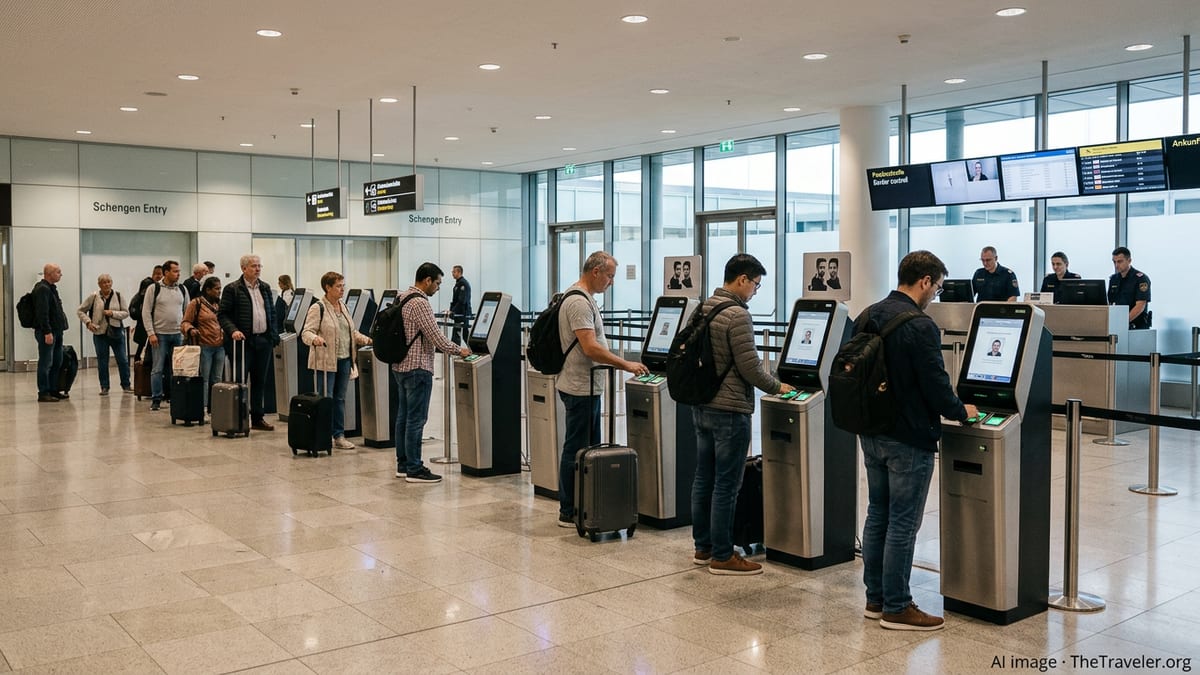
Biometric border rollout meets summer demand
The EU’s Entry Exit System, which became fully operational at Schengen borders in April 2026, was designed to replace manual passport stamping for most non EU visitors with a digital register of entries and exits, backed by fingerprint and facial image collection. Publicly available information from EU institutions describes the scheme as a core part of the bloc’s efforts to tighten external border security while modernising controls.
The timing of the rollout means many non EU travellers are encountering the system for the first time just as holiday traffic surges. Reports from major European hubs indicate that first time biometric enrolment, which involves capturing four fingerprints and a live facial image, has become a serious bottleneck at passport control.
Industry bodies and travel operators point in particular to the extra processing time required when equipment fails or travellers struggle with fingerprint scanners, issues that are being magnified by staff shortages and infrastructure constraints at some airports.
Queues, missed flights and “critical point” warnings
Across the Schengen area, travel media and aviation outlets are documenting lengthy waits at border lines for non EU passengers. Coverage from Amsterdam, Paris, Lisbon and Rome describes queues stretching for hours at peak periods, with some passengers reportedly missing connections after spending more than two hours in the EES process.
Reports from specialist aviation and biometrics publications note that problems emerged almost immediately after full activation, including repeated enrolments when biometric records could not be retrieved, and passengers being asked to complete the entire procedure again on subsequent trips. Travel forums and social media posts echo these accounts, with some travellers describing six hour lines during busy weekend peaks.
Europe’s aviation sector has framed the situation as reaching a “critical point.” In an open letter published in early July, airport, airline and industry associations warned that border delays of up to five hours were being recorded at certain Schengen entry points and argued that without further flexibility the impact on flights, tourism and airport operations would intensify through July and August.
Rome and other hubs weigh suspending biometric checks
Concerns are particularly acute in Italy, where Rome’s airport operator has publicly warned of a potential “disaster” if full EES checks are maintained during the height of the summer season. Coverage by European and Italian news outlets indicates that Fiumicino and Ciampino, which serve as major gateways for long haul and intra European traffic, are examining options to scale back or suspend biometric collection if queues become unmanageable.
Italian media reports suggest that Rome’s airports have already tested reverting some passengers to traditional manual booths during peak surges, effectively bypassing biometric capture to clear backlogs. Aviation focused coverage notes that such workarounds are likely to remain under consideration as traffic builds in late July and August.
Elsewhere, references in travel reporting to past suspensions in Lisbon and operational pauses at smaller regional airports highlight how national authorities and border forces have used available legal levers to relieve pressure when waiting times became excessive. These precedents are now central to the argument that wider, time limited suspensions should be on the table for the current summer.
Industry pushes Brussels for broader EES flexibility
The most coordinated pushback has come from Europe’s aviation industry, which has repeatedly urged EU decision makers to allow broader and longer suspensions of EES checks during peak months. A joint statement in February from Airports Council International Europe, Airlines for Europe and the International Air Transport Association called for Member States to retain the ability to partially or totally suspend the system through at least October 2026.
More recent letters and press materials from these groups argue that existing safeguards, which already permit temporary relaxation of biometric collection when queues breach defined thresholds, are not sufficient. According to their analysis, uneven implementation, equipment failures and incomplete passenger pre registration have combined to produce chronic delays that cannot be solved solely through local adjustments.
Individual carriers have amplified the message. Low cost operators with large non EU customer bases have warned of “queue chaos” at certain airports and are publicly calling for EES enforcement to be eased until at least September. Industry communications point to specific hubs where infrastructure upgrades are still underway and where the risk of missed flights is considered especially acute.
EU defends long term goals as travellers adapt
While acknowledging operational issues, EU institutions continue to present the Entry Exit System as a necessary investment in border security and fraud prevention. Official background material emphasises that once initial enrolment is complete, subsequent crossings should be faster, as biometric data and travel history are automatically retrieved and passport stamping is no longer required.
Statements from the EU’s border and security agencies referenced in media coverage suggest that teething problems are expected to persist through at least the next one to two years as systems, staff and travellers adapt. Officials quoted in these reports underline that EES is intended to provide real time information on overstays and irregular movements, capabilities that are seen as critical for the integrity of the Schengen area.
For now, however, the lived experience for many visitors is dominated by uncertainty over wait times and procedures. Travel advisories from airlines, airports and tourism boards increasingly recommend that non EU passengers arrive at departure terminals earlier than usual, allow extra time for passport control on arrival, and closely monitor guidance from their carriers and departure airports throughout the summer.