

Emergency medical care is a critical consideration for anyone planning a medium or long term stay in Thailand. The country combines world class private hospitals, a dense urban hospital network and relatively low treatment costs, but capacity constraints and quality variation across regions mean that outcomes for expatriates depend heavily on where they live, how they access care and how they plan financially.
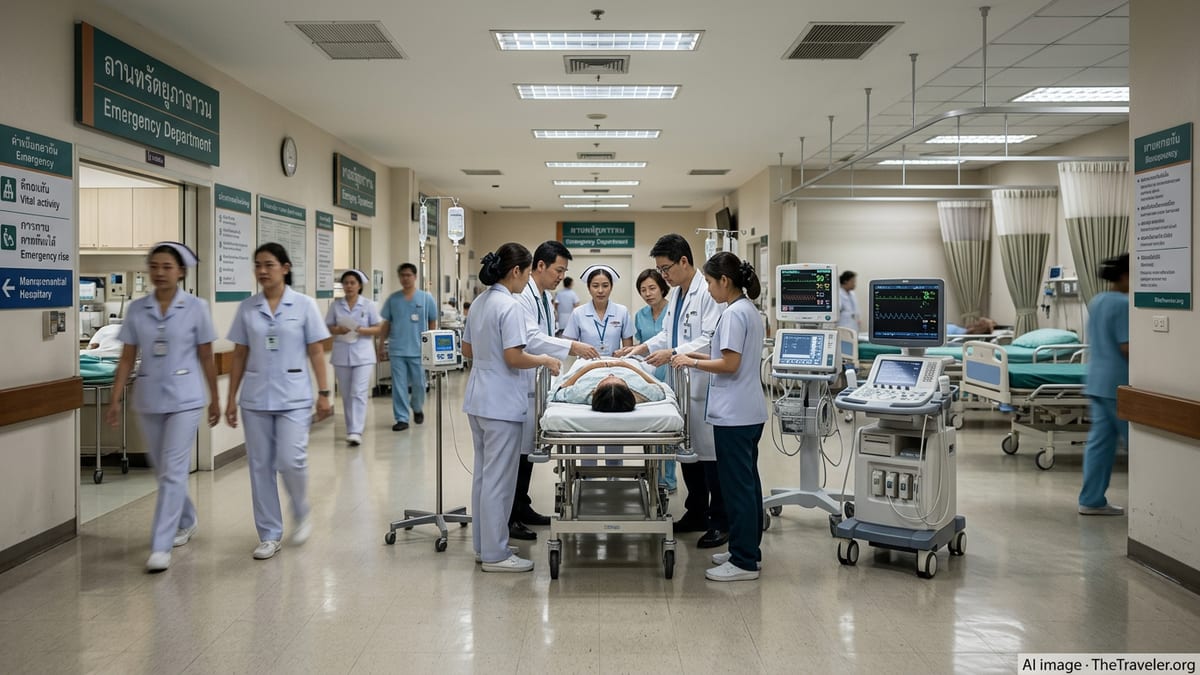
Structure of Emergency Medical Care in Thailand
Emergency medical care in Thailand operates through a mixed public and private system. Public hospitals form the backbone of the national emergency response network and are present in all provinces, while private hospitals are heavily concentrated in Bangkok, major regional cities and popular tourist areas. As of the early 2020s there are more than 400 registered private hospitals nationwide, but a much larger number of public hospitals and smaller community facilities provide first line emergency services, particularly outside major urban centers.
In cities such as Bangkok, Chiang Mai, Pattaya and Phuket, emergency care for foreigners is predominantly delivered by large private hospitals with 24 hour emergency departments, advanced imaging and specialist coverage. These facilities often operate alongside nearby public teaching hospitals, giving residents a choice between faster, higher cost private treatment and lower cost care in more crowded public institutions. In smaller towns and rural districts, however, the nearest facility with advanced emergency capacity may be a provincial public hospital, with private options limited to small clinics or secondary hospitals.
Pre hospital emergency services, including ambulance dispatch and roadside stabilization, are coordinated under the national Emergency Medical Institute and delivered by a mix of state run rescue units, municipal services and volunteer foundations. The system has expanded significantly over the last decade, but performance is uneven and response times are typically more reliable in metropolitan areas than in remote provinces. For serious emergencies, especially trauma and cardiac events, rapid transfer from a basic local unit to a major referral hospital is often required.
For expatriates, this structure means that access to high standard emergency care is excellent in major urban centers served by large private hospitals, adequate but sometimes congested in public hospitals, and more variable in peripheral regions where transport time to a referral facility can be the key determinant of outcomes.
Ambulance Access, Triage and Response Patterns
Ambulance systems in Thailand do not operate in the same way as in many Western countries, and this difference is important for relocation decisions. There is no single nationwide three digit emergency number with uniform dispatch and performance standards across all provinces. Several numbers exist in parallel and callers may be routed to different services depending on their location. In practice, many expatriates in large cities bypass the generic emergency numbers and contact their preferred private hospital’s emergency line directly, which can dispatch a hospital operated ambulance for transport.
Ambulance response times in central Bangkok and other major cities can be relatively fast, particularly where private hospital ambulances are used and traffic management support is available. In congested districts response may still be slowed by traffic and road constraints, and blue light privileges are not always enforced as consistently as in some Western jurisdictions. In provincial areas, ambulance coverage is more limited and many runs are performed by volunteer foundations equipped for basic life support rather than advanced interventions.
At hospital level, triage processes are increasingly standardized, with emergency departments using color coded or category based systems to separate life threatening conditions from non urgent cases. Severe trauma, stroke, acute coronary syndromes and compromised airways are generally prioritized rapidly, but waiting times for non life threatening emergencies can be considerable in busy public hospitals. Private hospitals typically offer faster triage and shorter waiting times, although surges in demand, especially during disease outbreaks or holiday periods, can still create bottlenecks.
Relocating expatriates should understand that in Thailand calling an ambulance is not always the fastest option for non catastrophic events. In urban areas it is common for patients or family members to use private cars, taxis or ride hailing services to reach hospital emergency departments directly, particularly when the hospital is nearby and the condition is stable enough to allow self transport.
Quality and Capabilities of Emergency Departments
There is a pronounced quality and capability gradient between major private hospitals, large public teaching hospitals and smaller regional or district facilities. Thailand is a global leader in medical tourism and, by 2025, more than 60 Thai hospitals held international accreditation from major quality bodies, a significant proportion of them in Bangkok and other large cities. These hospitals typically maintain modern emergency departments with 24 hour specialist coverage in emergency medicine, intensive care, cardiology and surgery, as well as rapid access to CT and MRI imaging, catheterization labs and operating theaters.
Flagship private hospitals in Bangkok and regional hubs manage complex trauma, neurosurgical emergencies and advanced cardiac cases for both local and international patients. These facilities often benchmark clinical protocols against international standards and have English speaking emergency teams and interpreters on site. For expatriates living within reasonable travel time of such hospitals, access to emergency care can be comparable to or better than in many developed countries, particularly in terms of speed of imaging, specialist consultation and procedure scheduling.
Public referral hospitals and university hospitals generally have strong clinical capabilities and are the main trauma centers for large geographic catchment areas. However they often operate at or beyond capacity, which can translate into crowded emergency departments, boarding of patients waiting for inpatient beds and longer delays for non critical cases. Smaller regional and district hospitals may lack certain specialties on site and may not be fully equipped for high level trauma, stroke intervention or complex pediatric emergencies, relying instead on transfer arrangements with provincial or national referral centers.
For expatriates, the practical impact is that the quality of emergency care experienced in Thailand is closely tied to hospital selection and geographic proximity. Those considering relocation outside major cities should map travel times to the nearest hospital with advanced emergency capabilities and evaluate whether that aligns with their personal risk profile and any existing medical conditions.
Costs, Billing Practices and Insurance in Emergencies
Emergency medical care costs in Thailand are generally lower than in North America, Western Europe or parts of East Asia, but for foreign residents without appropriate insurance or cash reserves, serious emergencies can still create a substantial financial burden. Large private hospitals in Bangkok and major tourist destinations often require either a deposit, proof of insurance with direct billing arrangements or a guarantee of payment shortly after admission, even for emergency cases once the patient is stabilized.
Typical emergency department charges in private hospitals include triage and consultation fees, diagnostic imaging, laboratory tests, medication and procedure costs, plus daily rates for intensive care units or standard wards where admission is necessary. While it is not possible to quote precise figures that apply universally, bills for short emergency visits for minor conditions can easily reach the low hundreds of US dollars equivalent, and complex emergencies requiring surgery and intensive care can climb into tens of thousands. Public hospitals are significantly cheaper, but foreigners are generally billed at higher rates than Thai nationals and payment is expected during or shortly after the episode of care.
Most major private hospitals maintain dedicated international or expat departments that work with global health insurers and travel insurance providers. Direct billing is often available where policies meet the hospital’s requirements, but pre authorization may still be required for non life threatening admissions. Without valid insurance, families are commonly asked to pay a deposit at the point where the decision to admit is made, and in serious cases hospitals may consult relatives about transfer to public facilities if financial constraints are severe.
From a relocation planning perspective, access to robust health insurance that explicitly covers emergency care in private Thai hospitals is essential for most expatriates, particularly those with dependents or pre existing conditions. Individuals intending to rely on savings alone should consider realistic upper bounds for life threatening events, take into account currency risk and ensure that close contacts in Thailand know where documentation and funds can be accessed during an emergency.
Regional Disparities and Typical Emergency Scenarios
Emergency care experiences for expatriates differ markedly between Bangkok, major regional centers and rural or island locations. In Bangkok, a dense cluster of private hospitals with advanced emergency departments provides a high level of redundancy. Residents can choose among several facilities within a short radius, and specialized centers for trauma, cardiac events and pediatric emergencies are all available within the metropolitan area. This concentration of resources underpins many relocation decisions by multinational companies and international organizations that base staff in the capital.
In secondary cities such as Chiang Mai, Khon Kaen, Udon Thani or Hat Yai, expatriates typically rely on one or two large private hospitals plus a provincial public hospital as backup. These cities often have good emergency surgical and critical care capabilities, but may require air or road transfer to Bangkok or another tertiary center for highly specialized interventions. On islands and in remote coastal or border regions, the first point of care is often a small local hospital or clinic with limited imaging and specialist capacity. In serious cases patients may need stabilization followed by transfer by speedboat, helicopter or fixed wing aircraft, subject to weather and transport availability.
Common emergency scenarios affecting expatriates include road traffic accidents, particularly motorbike crashes, acute cardiac events, strokes, falls, heat related illness, acute infections and exacerbations of chronic conditions. Road traffic injuries remain a significant national challenge and are a major driver of emergency department visits. Access to trauma capable hospitals, blood banks and operating theaters is therefore of particular importance for long term residents who commute regularly or ride motorbikes.
These regional and scenario based differences should be considered when selecting a place to live, commuting patterns and recreational activities. For some expatriates, particularly families with young children, the decision to live within 20 to 30 minutes of a major hospital with a fully equipped emergency department can be a central factor in neighborhood choice.
Language, Communication and Expat Focused Services
Communication in emergency situations is a recurrent concern for expatriates. In Thailand, English proficiency varies significantly between facilities. Major private hospitals in Bangkok and key tourist centers employ English speaking physicians, nurses and administrative staff and often provide interpretation in additional languages. Written documentation such as consent forms, discharge summaries and medication instructions can typically be issued in English on request in these institutions.
Public hospitals and smaller regional facilities may have limited English speaking staff, particularly during night shifts or in non teaching hospitals. In these settings miscommunication risks around symptoms, allergies, medical history and consent are higher, which can affect both clinical decision making and patient confidence. Many expatriates mitigate this by maintaining key medical information translated into Thai, using smartphone based interpretation tools or engaging Thai speaking colleagues or family members as support during emergencies.
A number of large private hospitals operate international or expat centers that provide navigation support, translation, case coordination, liaison with insurers and assistance with documentation for work or school requirements after hospitalization. These centers can simplify the emergency journey considerably, from ambulance dispatch through admission and discharge. Some facilities and private services in Bangkok and major resorts also offer hotel or home visit emergency assessment for non life threatening problems, with transfer to hospital arranged if needed.
For those planning relocation, it is advisable to identify at least one nearby hospital known for strong English language support, save its emergency contact number and, where possible, pre register details with the international department so that records and insurance information are available at short notice.
The Takeaway
For expatriates, emergency medical care in Thailand offers a combination of advantages and risks that must be weighed carefully in relocation planning. On the positive side, large private hospitals provide high quality emergency services, short waiting times for serious conditions, advanced diagnostics and specialist coverage that meet or exceed international standards. Costs, while potentially high in serious cases, are generally lower than in many Western systems, and the presence of dedicated international departments can make navigation and insurance interaction relatively smooth.
At the same time, the absence of a fully unified national emergency call system, variability in ambulance performance, regional disparities in hospital capabilities and capacity pressures in public hospitals introduce real constraints. Outcomes can depend heavily on whether a critical event occurs within easy reach of a major private or teaching hospital, whether the patient has comprehensive insurance and how effectively language and communication barriers are managed.
Relocating individuals and families should therefore integrate emergency medical care considerations into decisions about city and neighborhood choice, mode of transport, leisure activities and insurance coverage. Those who prioritize proximity to advanced emergency facilities, maintain robust health insurance with clear emergency benefits and prepare basic contingency plans are likely to find Thailand’s emergency medical environment compatible with long term residence. Those planning to live in remote or underserved regions should evaluate their personal risk tolerance carefully in light of longer transport times and more limited local resources.
FAQ
Q1. Do Thai hospitals provide emergency care to foreigners without prior registration?
Most Thai hospitals will treat foreigners in genuine emergencies without prior registration, but administrative and payment details are typically requested soon after stabilization.
Q2. Are ambulances in Thailand free for expatriates?
Public or volunteer ambulances may be low cost or free at point of use, but private hospital ambulances usually charge fees that are billed to the patient or insurer.
Q3. Can foreigners use public hospital emergency departments in Thailand?
Yes, foreigners can use public emergency departments, but they are charged as self paying patients and may experience longer waits compared with private facilities.
Q4. How good is emergency care in Bangkok compared with rural areas?
Bangkok offers significantly higher density of advanced emergency departments and specialists, while rural areas often rely on smaller hospitals and transfer to provincial or national centers.
Q5. Will Thai emergency doctors and nurses speak English?
In major private hospitals, many emergency staff speak English, while in public and smaller regional hospitals English proficiency may be limited, especially outside big cities.
Q6. Do I need private health insurance to access emergency care in Thailand?
Insurance is not legally mandatory but is strongly recommended, since serious emergencies in private hospitals can be costly and deposits are common without proof of coverage.
Q7. What should I do in an emergency if I live near several hospitals?
In non catastrophic situations, many expatriates go directly to their preferred private hospital, while for life threatening events the closest facility with an emergency department is usually safest.
Q8. Are emergency departments in Thailand overcrowded?
Public emergency departments can be crowded, particularly in large cities, while private hospitals generally have better staffing ratios and shorter waits for non critical cases.
Q9. Can I be transferred from a Thai public hospital to a private hospital during an emergency?
Transfers between public and private hospitals are possible once the patient is stable, but depend on clinical judgment, bed availability, logistics and financial authorization.
Q10. How can I prepare for medical emergencies before relocating to Thailand?
Preparation typically includes securing comprehensive insurance, identifying nearby hospitals with strong emergency capability, saving their contact details and keeping key medical information accessible.