

More news on this day
Dubai-based Emirates is racing to restore its full global network within days, accelerating capacity growth while pledging heightened safety and passenger care as Middle East tensions continue to unsettle regional airspace.
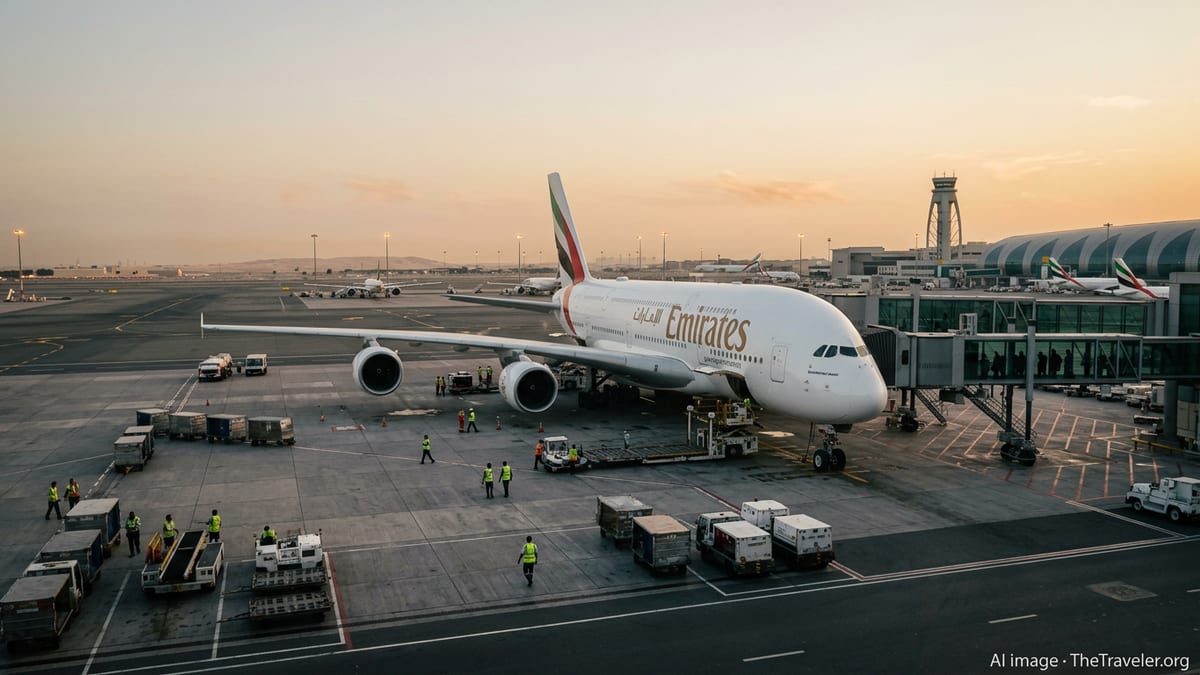
Network Restoration Accelerates After Airspace Disruptions
Emirates is working to bring its operations back to 100 percent of its pre-disruption network in the coming days, after a wave of regional airspace closures and route suspensions following recent strikes involving Iran, Israel and the United States. The carrier has been operating a reduced schedule out of Dubai International while progressively reintroducing flights as regulators reopen corridors and ease restrictions.
The airline confirmed this week that it is ramping up frequencies across its long haul network and reinstating connections that were temporarily halted as the security situation deteriorated across parts of the Middle East. Schedules remain in flux on some routes as Emirates coordinates with aviation authorities, air traffic control providers and military authorities that still control key segments of regional airspace.
Travelers have been urged to check for schedule changes up to the last minute, as flight times and routings adjust in line with evolving safety assessments. While some destinations continue to face extended suspensions, Emirates executives insist that connectivity via Dubai is recovering faster than during earlier waves of disruption in 2024 and 2025, when airspace closures lasted longer and diversions were more extensive.
Industry analysts note that the airline’s hub-and-spoke model gives it flexibility to retime and retarget capacity as conditions improve. The carrier has focused initial restoration efforts on trunk routes linking Dubai with major cities in Europe, Asia and North America, where pent-up demand remains strong and alternative connections through the Gulf are in high demand.
Record Profits Underpin Aggressive Capacity Rebuild
The push to restore the full network comes on the back of record financial results for Emirates and its parent group. For the financial year ended March 31, 2024, the Emirates Group reported its strongest performance in history, with profits and revenues rising sharply as long haul demand roared back and capacity ramped up toward pre-pandemic levels.
Emirates carried more than 50 million passengers over that period, with seat capacity growing by more than one fifth as grounded aircraft were returned to service and additional Airbus A380s and Boeing 777s rejoined the active fleet. The rebound allowed the airline to further invest in cabin refurbishments, onboard product upgrades and operational resilience, reinforcing Dubai’s role as a major global transfer hub.
Subsequent results for the first half of the 2024 to 2025 financial year showed that momentum had continued, with Emirates again posting record half-year profits and modest revenue growth, even as global macroeconomic conditions became more challenging. The airline rewarded employees with substantial bonuses and signaled that it would keep expanding services where demand remained robust.
These strong fundamentals are now giving Emirates the financial and operational headroom to absorb the latest geopolitical shock and move quickly to restore capacity. Aviation consultants say the carrier is better positioned than many rivals to weather temporary disruptions because its balance sheet has strengthened, its fleet is largely widebody and its network is built around long haul connections that recover rapidly once confidence returns.
Safety Measures Tightened Amid Ongoing Regional Tensions
Even as it accelerates its recovery, Emirates has been at pains to stress that safety remains its overriding priority. The airline continues to reroute flights around higher-risk airspace, adjust cruising levels, and extend block times where necessary to avoid conflict zones and areas with active military operations.
Dubai’s flag carrier is working closely with the United Arab Emirates’ civil aviation authorities, international regulators and airspace managers to implement layered risk assessments on every route. That includes real-time monitoring of missile and drone activity, intelligence sharing on potential threats, and detailed contingency plans for diversions and emergency landings should the security situation deteriorate suddenly.
In recent months, Emirates has suspended or permanently withdrawn service to certain destinations where the risk profile has changed significantly, including Tel Aviv, while keeping open limited connectivity to the wider region through its sister carriers and partner airlines. Flights to parts of Iran and Iraq have been paused or curtailed at various points since mid-2025, with decisions updated as security advisories evolve.
Routing changes are also affecting flying times across key corridors between Europe and Asia, with some services operating longer, more southerly tracks to avoid conflict zones or military exclusion areas. While these detours add cost and complexity, airline executives argue that conservative routing is essential to maintain passenger trust and comply with tightening insurer and regulator expectations.
Passenger Care, Flexibility and Communication Brought to the Fore
For travelers, the most visible impact of the latest disruption has been a surge in schedule changes, rolling delays and rebookings. Emirates has introduced additional flexibility measures, including broader change fee waivers on affected routes, expanded options to reroute journeys via alternative gateways, and extended ticket validity for customers who prefer to postpone travel.
The airline has been operating a series of special and repatriation flights to clear backlogs of stranded passengers where local conditions allow. Additional staff and call center capacity have been deployed to handle surging volumes of itinerary changes, while airport ground teams in Dubai and key outstations have been tasked with prioritizing vulnerable travelers and those connecting to essential onward journeys.
Inside the cabin and at the airport, Emirates has emphasized a return to its hallmark service standards despite the operational strain. On-the-day disruption teams coordinate with crew schedulers, network planners and airport authorities to arrange hotel accommodation, meal vouchers and ground transport when misconnects occur. Cabin crew have been briefed to provide more frequent updates and reassurance during flights that divert or experience delays linked to shifting airspace restrictions.
Travel agents and corporate clients say timely communication has become critical. Emirates has expanded the use of direct notifications by text message and email, and is pushing real-time updates through its app and booking channels to help customers make decisions quickly. The airline has also urged passengers to leave longer connection times in and out of Dubai while regional routings remain volatile.
Strategic Positioning in a Volatile Middle East Aviation Landscape
Industry observers see Emirates’ rapid move toward full network restoration as a strategic gambit to consolidate its role as the primary long haul connector through the Gulf at a time when some competitors are more constrained by local security dynamics. By reestablishing broad connectivity quickly, the carrier aims to capture demand from travelers and freight forwarders seeking reliable alternatives to disrupted routes through other regional hubs.
At the same time, the ongoing Middle East tensions highlight the structural vulnerability of hub carriers that sit close to conflict zones and critical maritime and air corridors. In the past two years, Emirates and its Gulf peers have faced repeated disruptions stemming from clashes involving Iran, Israel and regional proxies, missile and drone activity near key waterways such as the Red Sea, and temporary shutdowns of Gulf airspace.
Emirates has responded by refining its contingency planning, diversifying some flows via secondary gateways, and pushing ahead with fleet renewal that will eventually give it more fuel-efficient aircraft capable of operating longer reroutes without heavy payload penalties. The airline has also used its recent profitability to invest in technology for more dynamic network planning, aiming to shift capacity quickly as geopolitical fault lines shift.
For now, the carrier’s bet is that demand for global travel through Dubai remains resilient enough to absorb short-term uncertainty. As airspace gradually reopens and schedules stabilize, Emirates is positioning itself as both a symbol of regional resilience and a test case for how major airlines can balance aggressive growth with heightened safety and passenger care in one of the world’s most volatile aviation markets.