

More news on this day
Etihad Airways is sharpening its North American strategy, with New York now part of a growing group of hubs including Chicago, Toronto, Washington DC, Boston and Atlanta that feed passengers into an expanding global network via Abu Dhabi, reshaping options for transatlantic and transpacific travelers and opening new tourism and trade opportunities for the United States and Canada.
Get the latest news straight to your inbox!
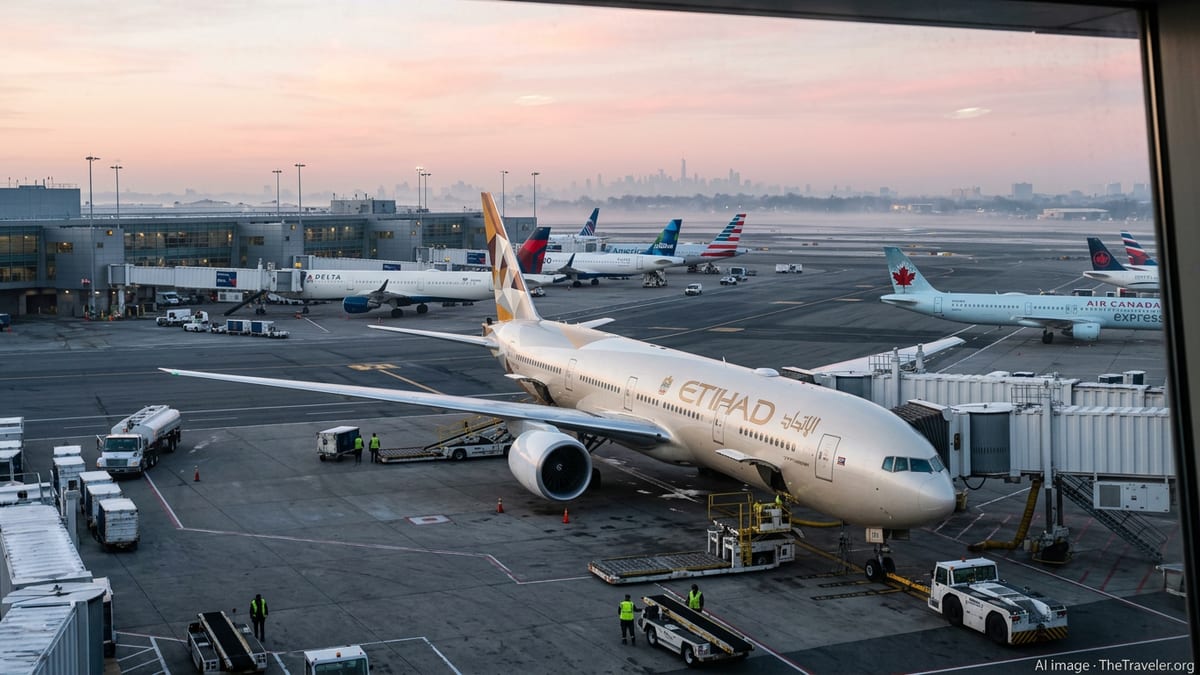
A Consolidated North American Gateway Strategy
Publicly available schedules and route maps show that Etihad’s North American footprint now spans major business and leisure markets across the United States and Canada, anchored by New York’s John F. Kennedy International Airport and complemented by Chicago, Washington DC, Boston, Toronto and additional partner-linked cities such as Atlanta. From these gateways, travelers are funneled through Abu Dhabi’s Zayed International Airport to reach destinations across the Middle East, Africa, Asia and Australia.
Etihad’s own network map materials for 2025 highlight this strategy, listing New York, Chicago, Washington DC, Boston and Toronto as primary North American points, with Atlanta and other cities accessible through codeshare and interline partnerships. This web of routes and partnerships effectively positions Abu Dhabi as a central hub for travelers originating in both the northeastern and midwestern United States, as well as key Canadian markets.
New York’s inclusion alongside Chicago and Toronto is particularly significant. These three cities already rank among the busiest long-haul markets in North America, and the ability to connect seamlessly via Abu Dhabi gives travelers additional options beyond traditional European stopovers. The expanded access is intended to capture both premium corporate demand and a fast-growing segment of leisure travelers heading to destinations such as Thailand, India, the Maldives and Indonesia.
Alongside passenger growth, Etihad Cargo has reinforced its presence in the same corridor, adding capacity on routes linking Abu Dhabi with New York, Chicago, Washington, Boston and Toronto. This parallel cargo expansion underscores a broader strategy to use the North American gateways as conduits for high-value goods, from pharmaceuticals to e-commerce shipments, flowing between East and West.
New York’s Evolving Role and Aircraft Changes
New York has long been one of Etihad’s flagship long-haul routes, and recent changes to aircraft deployment illustrate how the carrier is fine-tuning capacity in response to demand. In 2024, Etihad reintroduced the Airbus A380 on the Abu Dhabi to New York route, bringing back a high-profile premium product for the busy transatlantic market. Subsequent reports indicate that the airline later shifted A380 operations from New York to Toronto, while maintaining service to JFK with other widebody aircraft.
This adjustment reflects a balancing act between premium capacity and overall network optimization. Toronto’s rapidly growing demand and limited long-haul competition make it a strong candidate for A380 service, while New York, with multiple daily widebody flights and deep connectivity via partner airlines, can sustain strong volumes using other aircraft types. For travelers, the practical takeaway is that nonstop Etihad flights remain available between JFK and Abu Dhabi, but the specific aircraft and onboard experience may vary over time based on the carrier’s fleet and commercial strategy.
The operational focus at Abu Dhabi’s Zayed International Airport further enhances the New York route. The airport now hosts an upgraded United States preclearance facility used across Etihad’s US-bound services, allowing passengers departing Abu Dhabi for cities such as New York, Chicago and Washington DC to complete immigration and customs processes before boarding. Upon arrival, these flights are treated as domestic arrivals, streamlining onward connections within the United States and reducing time spent in queues at congested arrival halls.
New York’s gateway role is also reinforced by seasonal peaks in both business and leisure traffic. Financial services, technology and media sectors continue to generate year-round corporate demand, while tourism flows rise sharply during holiday and summer seasons. Etihad’s network flexibility, combined with preclearance and interline connections onward within North America, positions JFK as one of the airline’s most strategically important points outside its home region.
Chicago, Washington, Boston and Atlanta Strengthen the Web
Beyond New York, Etihad’s presence across other US cities forms a complementary web of access. Chicago O’Hare and Washington Dulles provide coverage for the US Midwest and capital region, respectively, while Boston Logan has emerged as a newer east coast link that has already seen increased frequencies since its launch. Public announcements in 2023 and 2024 detailed the introduction and ramp-up of Boston services, reflecting brisk demand from both corporate travelers and the city’s large student and academic population.
Etihad’s cooperation with partner airlines further extends its reach into markets such as Atlanta, which appears on the carrier’s published North America route materials as a key connecting point through alliances. Rather than operating its own nonstop Atlanta to Abu Dhabi flight, Etihad uses joint itineraries that link passengers from Atlanta to one of its US gateways, such as New York, Washington or Chicago, and then onward to Abu Dhabi on Etihad metal. This model enables broader coverage without the immediate need for additional widebody aircraft.
Chicago and Washington play particularly important roles in connecting energy, manufacturing, government and defense sectors to the Gulf region and beyond. Business travelers from the Midwest benefit from direct access to Abu Dhabi’s growing financial and logistics ecosystem, while Washington-linked traffic often involves governmental, diplomatic and international organization itineraries. The presence of US preclearance in Abu Dhabi adds a layer of operational reliability that is especially valued by corporate travel planners.
Boston, meanwhile, provides a strong base of technology, biotech and higher education demand. Frequent flyers on the route are often connecting onward to India and Southeast Asia, where Abu Dhabi offers competitive one-stop journeys compared with hub options in Europe or other Gulf gateways. The corridor has proven sufficiently robust that Etihad has previously signaled growth in frequencies and capacity on the Boston route, bolstering its standing as a core US gateway.
Toronto’s Upgauging and Canada’s Growing Importance
On the Canadian side, Toronto Pearson Airport has seen some of the most visible changes in Etihad’s North American strategy. The airline has progressively upgraded capacity on the Abu Dhabi to Toronto route, moving to next-generation widebody aircraft and, more recently, introducing the Airbus A380 on a daily basis according to industry reports. This shift followed a period when the same aircraft type was reassigned from New York, signaling a vote of confidence in Toronto’s long-haul market.
Earlier announcements also highlighted the deployment of the Airbus A350 on the Toronto route, underlining Etihad’s intention to offer a modern, fuel-efficient fleet with enhanced passenger comfort on its key Canadian services. As demand continued to grow, the introduction of the larger A380 provided additional seats in economy, business and first class, aligning capacity with a strong mix of visiting-friends-and-relatives traffic, tourism and corporate travel.
Toronto’s role is reinforced by its position as a major hub for travel between Canada and South Asia, the Middle East and Africa. Many passengers originating in secondary Canadian cities connect through Toronto onto Etihad’s Abu Dhabi flight, then continue onward to destinations such as Delhi, Mumbai, Cairo or Johannesburg. For these travelers, Abu Dhabi serves as a one-stop alternative to routings via London, Frankfurt or other European hubs.
Canada’s broader aviation landscape also benefits from the additional cargo capacity that comes with larger aircraft. Etihad Cargo’s increased frequencies and payload on the Toronto route support sectors such as pharmaceuticals, automotive parts and perishables, strengthening trade ties between Canada, the Gulf region and key markets across Asia and Africa.
Tourism, Connectivity and What Travelers Should Know
The combined effect of Etihad’s expanded North American network is a significant boost to tourism potential for cities such as New York, Chicago, Toronto, Washington, Boston and Atlanta. Tourism boards and airport authorities in these markets have highlighted record or near-record passenger volumes in recent years, with long-haul connectivity cited as a key driver. Direct or one-stop access via Abu Dhabi exposes US and Canadian destinations to a larger pool of visitors from the Middle East, India, Southeast Asia and Australia.
For travelers based in North America, the network unlocks an array of new and restored global destinations now served by Etihad from Abu Dhabi, including recent additions across Africa and Asia. Many of these cities were previously more difficult to reach from the United States and Canada without multiple connections. By using Abu Dhabi as a central transfer point, passengers can often complete complex itineraries with a single stop, simplifying planning and shortening overall journey times.
Those considering using Etihad’s services from New York or the other North American gateways should pay close attention to aircraft types, schedules and connectivity options when booking. Published information indicates that route configurations, including the assignment of aircraft such as the A380 and A350, can change over time based on demand and broader operational considerations. Travelers with specific preferences for cabin products or connection times are advised to review current schedules carefully during the booking process.
Looking ahead, industry analysis suggests that Etihad’s focus on profitable growth, modern fleet deployment and deeper partnerships with North American carriers will continue to shape its strategy in the region. As Abu Dhabi strengthens its position as a global hub, the airline’s North American gateways, led by New York but supported by Chicago, Toronto, Washington DC, Boston, Atlanta and additional partner-linked cities, are expected to play an increasingly prominent role in global tourism and trade flows.