

More news on this day
Air travel across Europe faced another bruising day this week as 231 flights were cancelled and around 1,449 delayed at major hubs in Germany, England, the Netherlands, Portugal and Denmark, disrupting schedules for carriers including Lufthansa, easyJet, SAS, KLM and Iberia and stranding passengers from Frankfurt to Copenhagen.
Get the latest news straight to your inbox!
Wave of Cancellations Hits Frankfurt, London and Amsterdam
According to compilations of publicly available flight tracking data for early April 2026, Germany, England and the Netherlands have been among the hardest hit by the latest wave of disruption. Frankfurt Airport, London’s main gateways and Amsterdam Schiphol again featured prominently in Europe wide delay and cancellation summaries, underlining their role as pressure points in the regional network.
Reports from travel industry outlets indicate that well over two hundred cancellations were recorded in a single operating cycle, part of a broader tally of 231 cancelled flights linked to operations in these five countries. The majority of the remaining affected services operated with significant delays, pushing the total number of disrupted flights above 1,600 and creating knock on congestion throughout the day.
Data referenced by European travel news platforms shows that London area airports and Amsterdam Schiphol have repeatedly ranked among the most disrupted hubs in recent days, alongside Frankfurt. Even when airports remained open, extended turnaround times, slot restrictions and weather related flow controls contributed to mounting queues on departure boards.
For passengers, the concentration of cancellations and long delays at these transfer heavy airports meant missed connections, rebookings onto already busy later services and, in some cases, enforced overnight stays when long haul links could not be recovered the same day.
Madeira and Copenhagen Underscore Vulnerability of Regional Gateways
While Europe’s primary hubs drew much of the attention, airports in Portugal and Denmark also registered an outsized share of disruption. Flight tracking summaries for early April highlight delays and cancellations at Madeira’s main airport and at Copenhagen, both of which serve as important links between regional and long haul traffic flows.
In Portugal, disruptions affected services between the mainland, the Madeira archipelago and wider European destinations. Delays on these routes have a disproportionate impact on leisure travelers and cruise passengers who often operate on tight embarkation and hotel schedules. Portuguese airport performance data compiled in recent days shows elevated delay levels at Lisbon and Porto, providing further evidence of strain in the country’s aviation system.
In Denmark, Copenhagen Airport has appeared repeatedly in regional disruption round ups, with reports describing a persistent pattern of heavy delays and scattered cancellations linked to wider European weather and airspace challenges. As a Nordic hub feeding traffic deeper into Scandinavia and the Baltic region, problems in Copenhagen can quickly spill over to smaller airports that rely on connecting traffic.
Together, the issues in Madeira and Copenhagen illustrate how operational stress at mid sized gateways can amplify the effect of problems at larger hubs, especially during peak travel hours when aircraft and crew rotations are tightly scheduled.
Airlines From Legacy Groups to Low Cost Carriers Affected
The disruption has cut across airline business models, affecting both major network carriers and low cost operators. Published coverage of the recent wave of delays and cancellations lists Lufthansa, easyJet, SAS, KLM and Iberia among the airlines most exposed, alongside other European and international carriers operating through the affected airports.
For Lufthansa and KLM, whose networks rely heavily on hub and spoke structures at Frankfurt and Amsterdam respectively, cancellations on short haul feeder legs can ripple quickly into long haul operations. Missed inbound connections may force last minute rebooking of transatlantic passengers or require aircraft to depart with empty seats to maintain global schedules.
For low cost carriers such as easyJet, point to point flying provides some insulation from complex connection patterns, but the knock on effects of air traffic control restrictions and weather constraints still bite. Reports from consumer facing flight statistics platforms suggest that dense schedules with limited slack make it difficult for budget airlines to recover once morning rotations are disrupted.
Regional and flag carriers in Scandinavia and Iberia have faced similar pressures. SAS services in and out of Copenhagen and Iberia flights linking Spanish and Portuguese destinations with northern Europe have both been noted in recent disruption summaries, highlighting the breadth of the impact across alliances and route structures.
Weather, Airspace Constraints and Staffing Add to Systemic Strain
Recent analysis published by travel rights organizations and aviation data firms points to a familiar mix of contributing factors behind the latest surge in cancellations and delays. Unsettled spring weather across parts of western and northern Europe has repeatedly reduced runway capacity at key hubs, forcing flow restrictions that cascade through national and cross border networks.
In parallel, periods of crowded airspace and air traffic control constraints have limited the ability of airlines to make up lost time once conditions improve. On several recent days, operational data from multiple hubs shows that delays persisted long after the most severe weather cells had passed, suggesting that the underlying system was already running near capacity.
Staffing challenges in ground handling, security and airline operations continue to feature in assessments of European reliability. While headline shortages are less acute than during the initial post pandemic rebound, reports from airports in London, Amsterdam and Frankfurt describe how localized staffing gaps can still slow turnarounds and lengthen recovery times after disruptions.
Combined, these factors help explain why a single day’s total of 231 cancellations and almost 1,449 delays can emerge without any single catastrophic trigger, instead reflecting cumulative pressure on an intricate, highly interconnected system.
Passengers Face Crowded Terminals and Complex Rebooking Choices
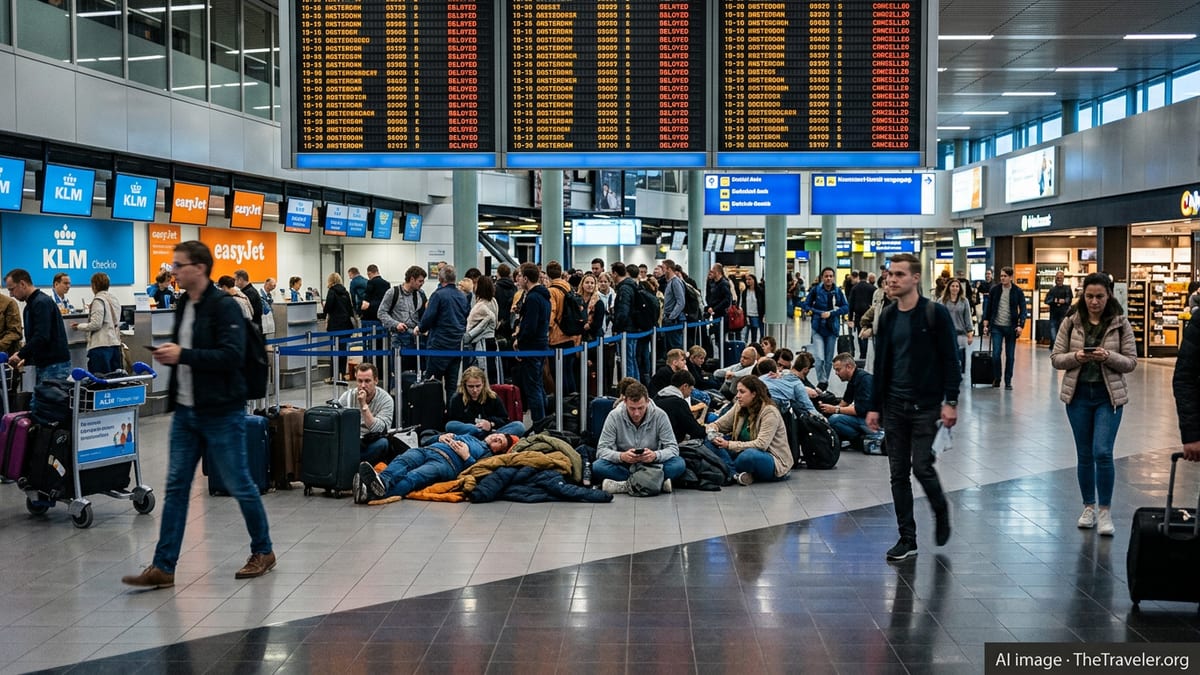
For travelers caught up in the latest disruption, the practical consequences have ranged from missed business meetings to lost vacation time. Images and descriptions shared through consumer channels in recent days depict busy terminals at Frankfurt, Amsterdam, London, Madeira and Copenhagen, with long queues at service desks as passengers attempt to secure alternative routings.
Guidance from passenger advisory platforms stresses the importance of monitoring flight status closely before leaving for the airport, making use of airline apps where possible and understanding compensation and care rules under European and UK regulations. Publicly available information from legal and consumer bodies notes that eligibility for compensation may depend on whether the disruption is attributed to extraordinary circumstances such as severe weather or airspace restrictions.
Analysts following the situation suggest that the elevated disruption figures in early April 2026 form part of a broader pattern of volatility in European aviation, in which moderate levels of cancellations and significant waves of delays have become more common. With peak summer still ahead, there are growing calls in industry commentary for further investment in resilience, from staffing and infrastructure to air traffic management improvements, to reduce the likelihood that similar mass disruptions will recur later in the year.