


More news on this day
Hundreds of travellers across Europe are facing missed connections and overnight airport stays after a new wave of operational disruption triggered more than 1,100 delayed flights and over 70 cancellations at major hubs including Amsterdam and Vienna, affecting carriers such as easyJet, Eurowings, Finnair and several national airlines.
Get the latest news straight to your inbox!
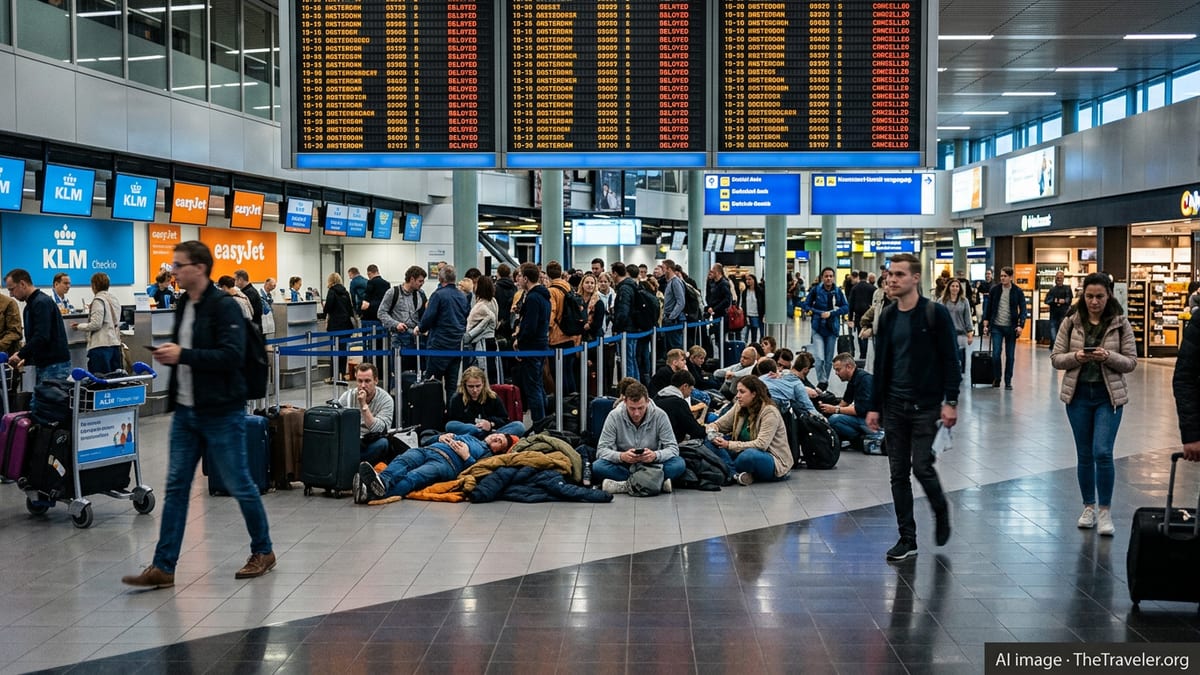
Wide-Ranging Disruptions Across Europe’s Air Network
Publicly available tracking data and regional aviation reports indicate that a fresh spell of disruption has swept through European skies, with around 1,132 flights delayed and at least 73 cancelled in a single operating window. The impact is concentrated in the busy northwestern and central European corridor, touching the Netherlands, Austria, France, Portugal and several neighbouring states.
Airlines most affected include major low-cost and network carriers, among them easyJet, Eurowings and Finnair. These operators rely heavily on dense European schedules and rapid aircraft turnarounds, which makes them particularly vulnerable when air traffic control restrictions, weather, staffing issues or knock-on effects from earlier disruptions compress available capacity.
Amsterdam Schiphol and Vienna International Airport are among the hubs experiencing significant pressure, alongside key airports in France and Portugal that serve as gateways to transatlantic and leisure markets. Reports describe departure boards dominated by late departures and rolling gate changes, with some services delayed long enough to cause missed onward connections even when flights eventually depart.
Although the disruption is spread across multiple countries and carriers, the pattern reflects a familiar fragility in the European aviation network, where localized constraints in airspace management or airport operations can rapidly ripple across the continent’s interconnected schedule.
Amsterdam, Vienna and Other Hubs Struggle to Recover
Amsterdam Schiphol has been one of the focal points of this latest episode of travel chaos. The airport is a critical transfer node for both full-service and low-cost airlines, and any slowdown in its tightly planned movements can quickly generate queues of arriving and departing aircraft. Recent seasons have already seen Schiphol contend with weather-related cancellations and capacity restrictions, leaving both airlines and passengers with limited margin for further disruption.
In Austria, Vienna International Airport has faced a combination of delayed departures and cancellations that are affecting routes to Germany, the Benelux region and Nordic destinations. Eurowings and other carriers using Vienna as a connecting point are reporting isolated cancellations alongside a significant number of late-running flights, adding further strain to already compressed schedules across the Lufthansa Group and its partners.
Elsewhere, airports in France and Portugal have again emerged as stress points. France occupies a central position in European airspace, and any reduction in capacity there can slow traffic flows between northern and southern Europe. Portugal, which is simultaneously handling strong seasonal demand and ongoing adjustments linked to new border and security procedures, remains susceptible to bottlenecks that can reverberate through airline networks serving Lisbon, Porto and Faro.
While some airports have managed to avoid full-scale shutdowns, the cumulative effect of partial delays at multiple hubs has been enough to strand travellers across a wide geographic area, from secondary regional airfields to the largest European gateways.
Passengers Face Long Queues, Missed Connections and Overnight Stays
The operational statistics translate into a difficult experience on the ground. Travellers report hours-long queues at check-in, security and customer service desks, as passengers whose flights are delayed or cancelled compete for limited rebooking options. In some terminals, seating and hotel capacity have struggled to keep pace with the number of people forced to spend unplanned nights at or near the airport.
Missed connections are a particular concern for those using Amsterdam, Vienna and French hubs as transfer points. Even when original flights eventually depart, their late arrival can cause onward services to leave without connecting passengers, leading to extended layovers or, in some cases, the need to rebook entire itineraries. This is especially challenging for travellers heading to long-haul destinations, where alternative flights may operate only once per day or even less frequently.
Budget carriers such as easyJet and Eurowings, which often operate point-to-point networks with limited interline agreements, face additional scrutiny when disruptions occur. For affected travellers, a cancelled or heavily delayed flight on a low-cost carrier may require purchasing a completely new ticket on another airline or resorting to alternative forms of transport such as trains or long-distance coaches.
Finnair and other network airlines are also grappling with the operational knock-on effects. Late arriving aircraft from central and western Europe can lead to schedule changes on routes to and from the Nordic region, complicating travel plans for passengers who rely on tight connections through Helsinki or other northern hubs.
Underlying Causes: Capacity Limits, Weather and Systemic Strain
The exact mix of causes behind the latest disruptions varies by country and airport, but published aviation briefings and industry analyses point repeatedly to a combination of capacity limits in air traffic control, adverse weather episodes and structural strain in airline operations. In parts of France and central Europe, reduced airspace capacity and staffing challenges have led to flow restrictions that increase en route and airport delays when traffic volumes are high.
Portugal and parts of western Europe have also seen congestion linked to border and security processing, especially when peak holiday traffic coincides with infrastructure or staffing constraints. Even short interruptions at these bottlenecks can cascade into missed departure slots, forcing airlines to reshuffle rotations and, in some cases, cancel services where aircraft and crews fall out of legal operating hours.
For airlines such as easyJet, Eurowings and Finnair, the commercial pressure to maximize aircraft utilization means that schedules often leave little room for extended recovery. Once a morning delay occurs on a key rotation, it can continue to affect several subsequent flights operated by the same aircraft, stretching into late evening and across multiple countries.
Analysts note that the current episode fits into a broader pattern of volatility that has characterized recent European travel seasons, where recurring labour actions, weather extremes and infrastructure upgrades have repeatedly collided with strong demand and tight airline timetables.
What Travellers Can Do Amid Ongoing Volatility
With delays and cancellations continuing to fluctuate day by day, consumer advocates and travel specialists highlight a few consistent strategies for passengers caught in the disruption. The most common advice is to monitor airline apps and airport departure boards closely, since same-day schedule changes are now frequent across much of Europe’s short-haul network.
Travellers whose flights are cancelled or significantly delayed are encouraged by passenger rights organizations to familiarize themselves with European compensation rules, which may offer meals, hotel accommodation and, in some cases, financial compensation when disruptions are not caused by extraordinary circumstances. However, the application of these rules can be complex, particularly when airlines cite external factors such as air traffic control restrictions or severe weather.
Where distances are relatively short, some travel commentators recommend considering rail or coach alternatives when multiple flights on the same route are affected, particularly on busy corridors linking cities like Amsterdam, Brussels, Paris, Frankfurt and Vienna. In several recent disruption events, passengers who switched to ground transport reported reaching their destinations sooner than those who waited for the next available flight.
For now, the scale of the current disruption highlights how quickly Europe’s tightly interconnected aviation network can shift from near-normal operations to widespread delays. With summer demand building and underlying capacity constraints still present, travellers planning itineraries through hubs such as Amsterdam, Vienna and major French and Portuguese airports are being urged by public advice channels to factor additional buffer time and flexible arrangements into their plans.