


More news on this day
Severe operational disruption at Guangzhou Baiyun International Airport has triggered hundreds of delayed departures and a clutch of cancellations among China’s biggest state-owned airlines, snarling flight schedules across mainland China and key Southeast Asian gateways in Singapore, Malaysia, Thailand and Vietnam.
Get the latest news straight to your inbox!
Major Chinese Carriers Face Concentrated Disruptions in Guangzhou
Publicly available flight tracking boards for Guangzhou Baiyun International Airport on June 16 and June 17 show an extensive build-up of late-running services, with at least 485 departures and arrivals operated by Air China, China Eastern, Hainan Airlines and China Southern recorded as significantly delayed, alongside nine outright cancellations. The disruption is concentrated at Guangzhou, one of China’s busiest hubs, where these four carriers handle a large share of domestic and regional traffic.
Operational data and timetable information indicate that China Southern, the dominant hub carrier in Guangzhou, is bearing much of the strain. China Southern routinely operates around 485 flights a day from its Guangzhou base in the current schedule period, and the latest disruption has affected a substantial portion of that program. The knock-on effect has extended to partner and feeder services run by Air China, China Eastern and Hainan Airlines, particularly on trunk routes linking Guangzhou with Beijing, Shanghai, Chengdu and other major cities.
While some flights, such as China Eastern and China Southern services on key domestic sectors, have continued to operate within schedule windows, a growing cluster of late departures and arrivals has reduced overall on-time performance at Guangzhou Baiyun. Aggregated airport statistics compiled from flight-status platforms point to a marked deterioration from the airport’s recent on-time rating, as aircraft and crews struggle to return to planned rotations.
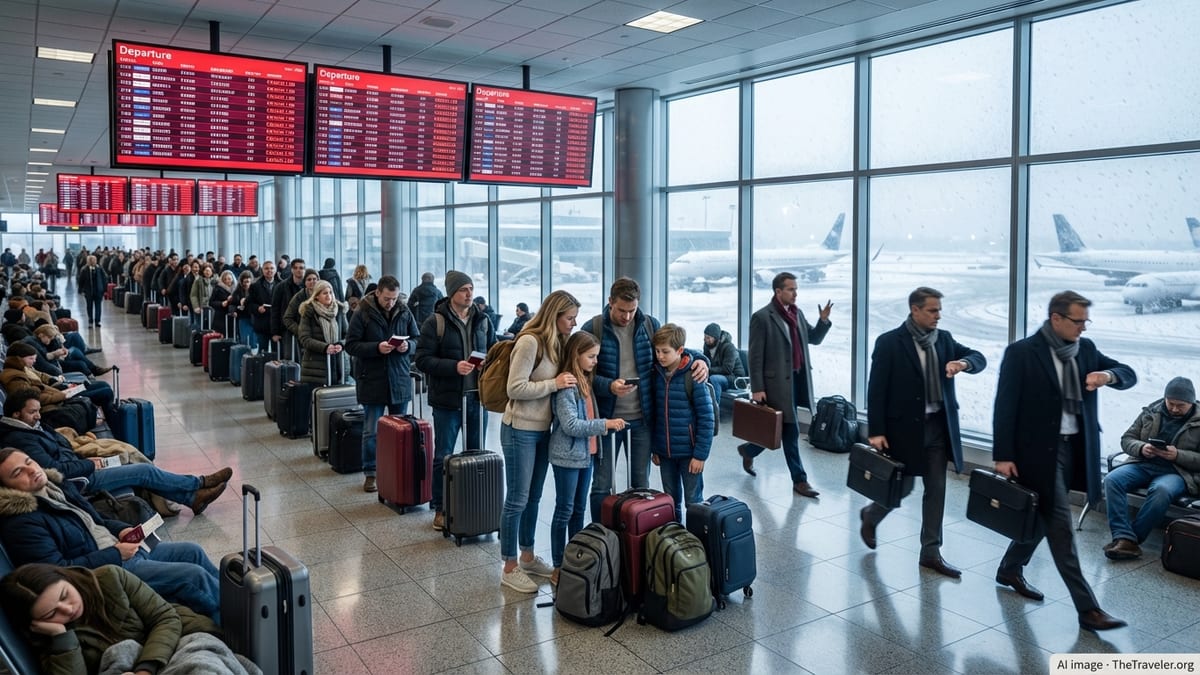
The cancellations, though relatively limited in number compared with the volume of delays, have exacerbated crowding at departure halls as passengers compete for seats on remaining services. Rebooking desks for the four carriers have reported sustained queues, with many travelers being shifted onto later departures or rerouted through alternative mainland hubs.
Weather and Network Constraints Combine to Overload a Key Hub
Weather conditions over southern China have been a critical factor behind the current wave of disruption. Meteorological observations for Guangzhou Baiyun on June 16 recorded persistent rain and low cloud, constraining runway capacity and extending separation between arrivals and departures. In such conditions, even modest schedule pressure can quickly cascade into significant delays as aircraft miss their departure slots and inbound connections arrive off-schedule.
These weather challenges are colliding with structural capacity limits at Guangzhou Baiyun. The airport handled close to 84 million passengers last year and was China’s second-busiest airport in the first quarter of 2026, a level of activity that leaves relatively little slack when operations are strained. Terminal works, including the temporary closure of Terminal 1 for renovation, have further tightened gate availability and ground-handling resources at peak times.
Industry analyses of historical performance at Guangzhou highlight that several Chinese carriers, including China Southern and Hainan Airlines, already operate close to the margins of available slot and turnaround capacity at the airport. When storms, air-traffic flow restrictions or crew duty constraints intervene, recovery windows are narrow. The present episode illustrates how quickly a spike in late operations can overwhelm contingency plans, especially during busy travel periods.
Network planners also face the challenge of repositioning aircraft that have ended up in the wrong city after diverted or rescheduled flights. Each adjustment made to restore one route can ripple across the rest of the day’s schedule, turning what began as a localized weather event into a network-wide disruption for the four major carriers.
Knock-on Effects Across China, Singapore, Malaysia, Thailand and Vietnam
The disruption at Guangzhou is reverberating through regional travel corridors that link China with Southeast Asia. China Southern and its peers operate multiple daily flights between Guangzhou and cities such as Singapore, Kuala Lumpur, Bangkok and Ho Chi Minh City. When departures from Guangzhou are delayed or cancelled, aircraft and crews intended for subsequent legs are not in place on time, creating secondary delays on outbound and inbound regional services.
Flight-status snapshots on June 16 and June 17 show late-running Guangzhou departures to Bangkok, alongside inbound services from the Thai capital to Guangzhou operating off-schedule. Similar patterns are reported on connections to Vietnam, where services to Hanoi and Ho Chi Minh City are closely tied to aircraft rotations originating in southern China. Travelers heading for business and leisure trips across the region are facing extended journey times, missed onward connections and overnight stays at intermediate hubs.
The disruption is also affecting intra-China itineraries that feed regional flights. Passengers traveling from inland cities such as Xi’an, Kunming or Chengdu into Guangzhou to connect onward to Southeast Asia have found that even modest upstream delays can cause them to miss tightly timed connections. With aircraft operating full or near capacity during summer scheduling peaks, spare seats for same-day rebooking are limited, particularly in economy cabins.
In Singapore and Malaysia, airport departure boards show a mixture of on-time and delayed services on China-bound routes, reflecting the uneven pattern of disruption. Where aircraft and crews departed Guangzhou late, turnarounds in Southeast Asia have been compressed, at times leading to further delays on the return leg. In other instances, carriers have opted to hold departures to allow misconnecting passengers more time to board, trading punctuality for passenger recovery.
Passengers Confront Long Queues, Missed Connections and Limited Remedies
For passengers, the immediate effects of the Guangzhou disruption are most visible in congested terminals and shifting departure times. Reports from travelers in recent days describe long lines at check-in counters and transfer desks, with some passengers being advised to return the following day when rebooking options are exhausted. Others have recounted missed connections at onward hubs such as Beijing and Shanghai after initial delays out of Guangzhou.
Airlines are applying standard rebooking and care policies, but outcomes vary by carrier and ticket type. Publicly available guidance from the major Chinese airlines suggests that passengers whose flights are cancelled may be offered a choice between a refund, travel credit or re-accommodation on the next available service, subject to seat availability. In cases where delays are attributed to weather or air-traffic control constraints, compensation beyond rebooking and basic assistance is generally limited.
Travel forums and consumer advisory platforms have seen a rise in queries related to missed connections involving Chinese carriers. Several recent posts describe situations in which passengers on weather-delayed flights arriving in China have been rebooked only on the domestic leg, leaving them to negotiate separately with international partners for onward travel. These experiences highlight the importance for travelers of understanding how responsibility is shared between operating carriers on multi-ticket or code-share itineraries when disruption occurs.
Passengers connecting onward to international airlines at Guangzhou or other mainland hubs are being urged by travel advisers to monitor departure boards closely, allow for extended minimum connection times, and proactively contact both their operating carrier and any partner airline involved in the itinerary when delays develop. Those holding flexible or higher-fare tickets generally have more options for rerouting or same-day changes when large-scale disruption unfolds.
What Travelers Can Expect in the Coming Days
Operational data suggests that recovering from a disruption of this scale can take several schedule days, particularly at a heavily utilized hub such as Guangzhou Baiyun. Even after weather conditions improve, out-of-position aircraft and crew duty constraints can leave gaps in the network, and carriers typically prioritize restoring core trunk routes before adding back lower-frequency services.
Given Guangzhou’s role as a primary gateway for southern China and a transfer point for Southeast Asia, residual delays are likely to persist on some routes linking China with Singapore, Malaysia, Thailand and Vietnam. Passengers booked on Air China, China Eastern, Hainan Airlines and China Southern in the near term are being advised by travel information services to check flight status frequently, utilize airline mobile applications for real-time updates and, where possible, confirm that contact details are up to date so that rebooking notices can be received promptly.
Industry observers note that infrastructure projects in the Greater Bay Area, including new airports intended to relieve pressure on Guangzhou Baiyun in the coming years, may eventually help the region manage surges in traffic more effectively. In the meantime, the current episode underscores both the strategic importance and the vulnerability of a single major hub in shaping travel reliability across a wide swath of Asia.
For now, travelers transiting Guangzhou are facing a period of heightened uncertainty. With schedules under strain and spare capacity limited, flexibility around travel dates and routes, along with careful attention to minimum connection times, may be the most practical tools available for navigating the latest bout of travel chaos at one of China’s busiest airports.