


You feel it before you can quite explain it. The ferry pulls away from Lower Manhattan, the towers shrink behind you, and a red-brick island complex rises ahead, framed by the green copper of the Statue of Liberty to your left. Ellis Island looks, at first, like another handsome Beaux-Arts building in New York Harbor. Yet the moment you step into its cavernous halls, you understand you are walking into the place where the modern United States was, in many ways, created.
Get the latest updates straight to your inbox!
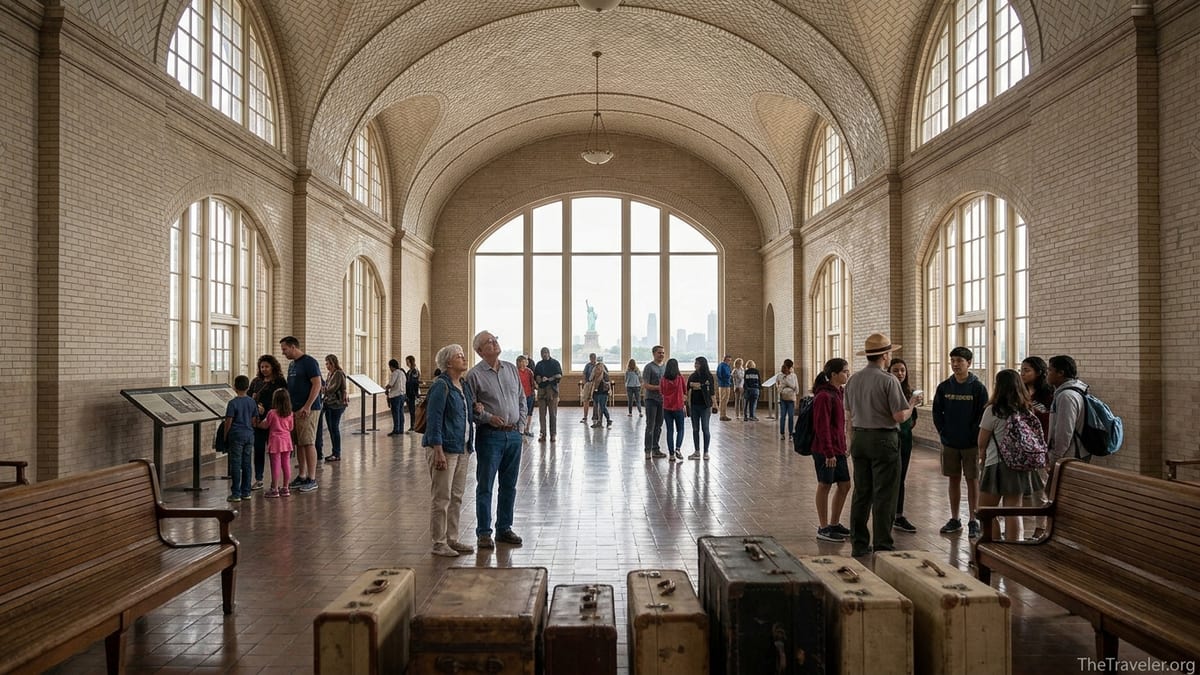
Stepping Into the Great Hall Where Millions Once Waited
The Ellis Island National Museum of Immigration occupies the original Main Immigration Building, restored and opened to the public in 1990. Today, visitors enter through the same ground-floor Baggage Room where newly arrived passengers once had their trunks piled into chaotic rows before being funneled upstairs. The polished terrazzo floors, exposed brick, and carefully preserved luggage carts are not replicas. They are the real stage set on which 19th and early 20th century arrivals began their American story.
Climb the grand staircase and you emerge into the Registry Room, often simply called the Great Hall. It is an enormous, light-filled space with a barrel-vaulted ceiling tiled in pale Guastavino arches. National Park Service rangers still point to historic photos that show this hall packed with people from Italy, Russia, Ireland, Germany, Syria, and beyond, queued in lines that snaked around wooden railings. Historians estimate that about 12 million immigrants were processed on Ellis Island between 1892 and 1954, most of them during the steamship era before restrictive quotas slowed the flow. Walking across the echoing floor, with benches placed where inspection lines once formed, you can almost hear the murmur of dozens of languages at once.
The power of the Great Hall is how little separates you from that past. The original windows still frame views of Lower Manhattan, where many newcomers settled in tenements on the Lower East Side. The same clerks’ desks, arranged along the perimeter, now hold interpretive exhibits and audio stations. A modern visitor in jeans and sneakers stands exactly where a 17-year-old arriving from Galicia or Sicily once stood, gripping a handful of documents and a small satchel. That physical continuity turns history from an abstract chapter heading into an immersive experience.
Practical detail underscores the point that Ellis Island is not a quick photo stop. The National Park Service notes that a full visit to the museum can easily take half a day, not counting Liberty Island. Ferries generally begin service around 9 a.m., with last departures from Ellis in the late afternoon, and your ferry ticket includes access to the museum without an additional entry fee. For many travelers, the most meaningful way to experience the Great Hall is to plan at least an hour there, simply wandering under the tiled vault, reading personal stories, and watching other visitors reckon with the scale of what happened in this room.
The Baggage Room: America’s Threshold in Wood and Canvas
On the first floor, the Baggage Room exhibit tells the story of arrival through the things people carried. Here you walk past pyramids of original steamer trunks, wicker baskets, battered valises, and homemade wooden crates that once held everything a family possessed. Many travelers today may check a rolling suitcase at JFK and arrive with a smartphone and a credit card. Standing in front of these century-old bags makes clear how different the stakes were for those who crossed the Atlantic in third-class steerage.
The National Park Service has curated the space to stay close to its historical function. Information desks and tactile maps of the museum are tucked into one side, but most of the floor remains open, echoing the emptiness that once waited for each day’s human cargo. Ranger-led tours often begin here, using the original baggage scale and signage to explain how inspectors watched the crowds disembark. A limp or a persistent cough could mean extra scrutiny or even detention.
For modern visitors, emotional impact tends to come in small, unexpected ways. You may notice a child’s tiny suitcase no bigger than a shoebox, or a carefully folded hand-embroidered tablecloth tucked into a trunk labeled with a Hungarian or Greek surname. It is easy to imagine a grandmother somewhere in the Midwest or New England still setting that cloth on a Sunday table. Ellis Island changed America not in sweeping slogans, but in quiet domestic details that multiplied across the continent.
If you arrive on a crowded summer weekend, the Baggage Room can itself feel like a modern immigration hall, full of school groups, families, and international tourists. That shared crush of humanity, all funneling through the same doors, mirrors the experience of earlier arrivals and subtly reminds you that U.S. immigration remains a living, contested, and deeply human story.
From Screening Station to Symbol of a Nation of Immigrants
Ellis Island began operating as a federal immigration station in 1892, replacing an earlier facility at Castle Garden in Lower Manhattan. At its busiest, especially before World War I, the island processed thousands of arrivals on a single day. Steamships from Hamburg, Naples, Liverpool, and Trieste would anchor offshore, discharging steerage passengers onto ferries that deposited them directly at Ellis Island. First and second-class passengers, by contrast, usually underwent only cursory inspection aboard ship and were allowed to go ashore in Manhattan, reflecting the class and racial biases built into the system.
Inspection on Ellis Island was famously brisk. Most people cleared the process in a matter of hours, undergoing quick medical checks and brief interviews that focused on health, criminal record, and destination. Contemporary research suggests that a large majority were admitted to the United States, but for the minority pulled aside for detailed examination the island could become a place of anxiety and sometimes heartbreak. A diagnosis of trachoma, or an assessment that someone was likely to become a “public charge,” might mean detention in the island hospital or even deportation.
By the mid-1920s, restrictive immigration laws and new visa requirements meant that fewer people came through Ellis Island’s main hall. It increasingly functioned as a detention and deportation center until it closed as an immigration station in 1954. For decades the buildings decayed, their windows broken by weather and vandals. When you see the restored Great Hall today, it can be hard to picture the crumbling ruin that photographers documented in the 1960s and 1970s.
The transformation from decrepit complex to national symbol required a massive public-private effort, culminating in the opening of the Ellis Island Immigration Museum in 1990. That effort itself is part of the story of how America chose to remember its immigrant past. The renovation, which began with the north-side buildings and has continued with stabilization of the former hospital complex on the south side, reflects a decision to treat Ellis Island as a core piece of national heritage rather than a forgotten administrative facility. As a visitor, you are not simply walking into an old building. You are entering a carefully considered narrative about who Americans believe they are.
Stories in Faces, Voices, and Names
What makes Ellis Island particularly affecting for travelers today is how specific its storytelling has become. The museum’s exhibits weave together large-scale history with individual accounts drawn from letters, oral histories, and passenger manifests. You might hear a recording of a woman remembering how she clutched her mother’s skirt while inspectors chalked symbols on passengers’ coats, or see a black-and-white photo of a group of Italian teenagers, captured by photographer Lewis Hine as they waited to be processed.
Interactive displays allow visitors to trace real journeys: a family leaving a Polish village, boarding a train to a northern port, enduring cramped steamship conditions, then finally stepping into the Great Hall. A modern teenager from Texas, for example, might tap a screen and discover how a 14-year-old from Naples in 1907 boarded a ship with a cardboard name tag and a few coins sewn into a jacket. That connection across time and space helps younger visitors grasp that immigration is not an abstract policy debate but a sum of individual risks and hopes.
The American Family Immigration History Center, located within the complex, gives the experience an even more personal dimension. Here, for an additional fee, visitors can search ship manifests and passenger records, sometimes spotting a relative’s name in spidery handwriting. It is not uncommon to see a grandparent and grandchild bend together over a computer terminal, quietly mouthing a familiar family name that suddenly appears in official records. For many, that discovery is the moment when Ellis Island stops being “their story” and becomes “our story.”
Importantly, the museum increasingly contextualizes Ellis Island within broader narratives of migration to the United States. Exhibits on the Peopling of America look beyond the peak Ellis era to earlier forced migrations, including the transatlantic slave trade, and to more recent arrivals from Latin America, Asia, Africa, and the Middle East. Aligning the experience of a Lithuanian farmworker in 1905 with that of a Syrian refugee family in the 2010s pushes visitors to see patterns of movement, discrimination, resilience, and reinvention that recur across centuries.
Walking the Island: Architecture, Views, and the Hospital’s Ghosts
Ellis Island is more than its main building. Stepping outside after touring the Great Hall, you can wander the perimeter paths and courtyards that ring the island. On clear days, the views are spectacular: the skyscrapers of Lower Manhattan rise to the north, the Verrazzano-Narrows Bridge spans the horizon to the south, and the Statue of Liberty appears at close range across a channel. For early arrivals, these panoramas were often the first detailed sight of the country that would become their home. For modern travelers, the juxtaposition of historic brick buildings and glass-and-steel skyline sums up the story of continuity and change.
The architecture of Ellis Island carries symbolic weight of its own. The symmetrical French Renaissance-style main building, with its corner pavilions and red-tiled roofs, projects an image of order and authority. Inside, the layout channeled bodies efficiently from ferry dock to registry lines, examination rooms, and, if necessary, dormitories or hospital wards. Visiting today, you might find yourself pausing in a narrow stairwell or at the entrance to a former dormitory, imagining the nervous conversations that once filled that confined space as people waited to learn if they would be allowed to enter the country.
On the island’s south side lies the former Ellis Island Immigrant Hospital complex, a cluster of pavilions and corridors where those who failed initial health screenings were treated. Long off-limits to the general public, parts of this area can now be visited on specialized guided tours that focus on medical history and preservation. Walking through peeling corridors with views back toward Manhattan, visitors confront a more sobering dimension of the Ellis story: the children who died in quarantine, the families separated by disease, the reality that admission to the United States was not guaranteed.
Even without joining a hospital tour, you can sense that duality of hope and vulnerability throughout the island. Benches along the waterfront invite quiet reflection. A modern visitor might sit with a coffee from the on-site café, looking out at container ships and Staten Island ferries, and try to imagine the same channel filled with coal-burning steamers. The harbor remains busy, but its cargo has shifted from human bodies and trunks to steel boxes and commuters. Ellis Island stands as a reminder that the movement of people once defined this harbor as surely as the movement of goods does today.
Connecting Past and Present: Immigration Debates in Real Time
Ellis Island is not a neutral monument. It has become a touchstone in contemporary debates about immigration, border control, and national identity. School groups from across the United States, as well as visitors from around the world, arrive with assumptions shaped by modern headlines about asylum seekers at the southern border, visa backlogs, and fluctuating refugee caps. Walking through the exhibits, many are struck by how familiar some of the language sounds. Fears of “unassimilable” newcomers, worries about labor competition, and stereotypes about culture and religion all appeared in editorials and political speeches during Ellis Island’s peak years.
In response, the museum has gradually expanded its storytelling to include more voices and a wider range of experiences. Exhibits on the Peopling of America after 1945 highlight migrations from the Caribbean, Mexico, South and East Asia, and Africa, as well as internal movements such as the Great Migration of African Americans from the rural South to northern cities. For a visitor in 2026, this broader narrative pushes against the narrow myth of Ellis Island as a single golden gate through which all “legal” immigrants passed in orderly fashion.
Recent and ongoing updates to the museum, including a multi-year project to “reimagine” the exhibits, aim to make this complexity more explicit. Plans emphasize interactive media, new film presentations, and refreshed gallery spaces that address topics like exclusion laws, refugee policy, and the changing geography of migration across the United States. As you move through the building, you are encouraged not only to marvel at your great-grandparents’ courage but also to ask who was kept out, who was detained, and how the rules have shifted over time.
That tension between pride and discomfort is part of what hits visitors when they first walk inside. Ellis Island makes a powerful case that the United States has always been shaped by newcomers, yet it also documents how often those newcomers were greeted with ambivalence or hostility. Standing in the Great Hall, you can feel both the exhilaration of arrival and the unease of inspection. For many travelers, confronting that complexity in a physically imposing space is more persuasive than any policy essay.
Planning Your Visit: Practical Tips for a Meaningful Experience
Because Ellis Island is part of the Statue of Liberty National Monument, visiting requires a bit of logistical planning. Ferries to Liberty and Ellis Islands operate from Battery Park in Manhattan and Liberty State Park in New Jersey, with security screening at departure similar to airport procedures. The ferry ticket typically includes access to both Liberty Island and the Ellis Island museum, but specialized tours, pedestal access, or crown tickets for the Statue of Liberty may need to be reserved separately and well in advance, especially in peak season.
Plan for a full day if you want to experience both islands without rushing. Many travelers choose to visit the Statue of Liberty first and then continue to Ellis Island, spending at least two to three hours in the museum. Arriving on one of the first ferries of the morning can help you avoid some of the midday crowding in the Great Hall and exhibits. Comfortable shoes are essential, as you will be walking on hard surfaces and climbing stairs, although elevators and ramps make the main building accessible for visitors with mobility challenges.
The museum itself is free once you are on the island, but it is worth budgeting for optional extras such as audio guides or a research session in the American Family Immigration History Center. Audio tours, available in multiple languages, can deepen your understanding of specific rooms and artifacts, while family history research can be a highlight for those with known immigrant ancestors. Food options on the island are limited to a café offering casual meals and snacks at typical New York attraction prices, so some visitors prefer to bring a light lunch or snacks, respecting park rules.
Most importantly, build in unstructured time. Some of the most memorable moments at Ellis Island happen not in front of a display panel, but in quiet corners: lingering in the echo of the Great Hall as closing time approaches, watching a school group fall silent as a ranger describes a deportation case, or stepping outside to feel the harbor wind on your face. Allow yourself time simply to sit with the place. That is often when the realization hits: this is where countless journeys into American life began.
The Takeaway
Ellis Island changed America by transforming a surge of global migration into a foundational national experience, and you sense that transformation as soon as you walk through its doors. The Baggage Room, the Great Hall, the dormitories, and the hospital complex together tell a story of hope and hardship, bureaucracy and bravery, exclusion and opportunity. They are not mere backdrops to family legend, but the actual spaces where decisions about who could enter the United States were made.
For modern travelers, a visit here offers more than a history lesson. It is an invitation to consider how personal stories intersect with national narratives. Whether or not your own ancestors passed through Ellis Island, the museum’s exhibits make clear that the country you encounter when you step back onto the ferry has been profoundly shaped by those who did. The moment you walk inside, surrounded by echoes of many languages and the weight of millions of journeys, you begin to see the United States not as a fixed destination, but as an ongoing project built by people in motion.
FAQ
Q1. Is Ellis Island still an active immigration station?
Ellis Island no longer processes new arrivals. It closed as an immigration station in 1954 and now operates as a museum within the Statue of Liberty National Monument.
Q2. How long should I plan to spend at Ellis Island?
Most visitors find that two to three hours is a comfortable minimum for the museum alone, while a combined trip to Liberty and Ellis Islands can easily fill a full day.
Q3. Do I need a separate ticket to visit the Ellis Island museum?
No. Access to the Ellis Island National Museum of Immigration is included with the standard ferry ticket to the Statue of Liberty and Ellis Island, although special tours may cost extra.
Q4. Can I research my family history at Ellis Island?
Yes. The American Family Immigration History Center on the island offers access to passenger records. Some services are free to browse, while more in-depth research tools may involve a fee.
Q5. Are the exhibits suitable for children?
Many exhibits are designed with families in mind, featuring interactive elements and engaging stories. However, topics like illness, detention, and deportation are presented frankly, so parents may want to guide younger children.
Q6. Is Ellis Island accessible for visitors with mobility challenges?
The main museum building includes ramps and elevators, and theaters are wheelchair accessible. A limited number of wheelchairs are typically available on a first-come, first-served basis at the information desk.
Q7. What is the best time of year to visit Ellis Island?
Spring and fall often offer milder weather and somewhat lighter crowds than peak summer. Weekday mornings tend to be less busy than weekends and holidays.
Q8. Can I visit the old hospital buildings on the south side of the island?
Parts of the former hospital complex can be visited on specialized guided tours focused on medical history and preservation. These usually require advance booking and are subject to availability.
Q9. Are there food and drink options on Ellis Island?
Yes. A café on the island serves simple meals, snacks, and beverages at prices similar to other major New York attractions, but you can also bring light snacks if you prefer.
Q10. Why do people say you “feel” Ellis Island the moment you walk in?
The building is largely authentic, from the Great Hall’s tiled ceiling to the worn stairways and original trunks. Stepping into these spaces makes the scale and emotion of past migrations immediately tangible.