


More news on this day
Escalating tensions involving Iran and neighboring states have pushed the Middle East’s aviation network into crisis, triggering extensive flight cancellations, soaring fares and a visible redirection of long-haul tourism demand toward Asia’s key leisure markets, particularly Japan and Thailand.
Get the latest news straight to your inbox!
Middle East Airspace Closures Upend Global Flight Networks
Published aviation briefings and industry analyses indicate that international airlines have faced one of the most disruptive route overhauls in years after Iran’s airspace was effectively closed to most civilian overflights following a sharp regional military escalation in late February 2026. The Tehran flight information region, a key corridor between Europe and Asia, remains heavily restricted for foreign carriers, forcing aircraft to divert either far north via the Caspian and Central Asia or south via Egypt and Saudi Arabia.
Specialist operational advisories and safety bulletins describe a patchwork of additional restrictions affecting parts of the airspace over Israel, Iraq, Jordan and the Gulf, creating chokepoints around traditional hubs in Dubai, Doha and Abu Dhabi. Commercial reports on the crisis point to what some analysts call the largest rerouting operation since the Iraq conflict, with long-haul widebody fleets burning more fuel and spending extra hours in the air to avoid high-risk zones.
Travel-industry coverage from regional business outlets notes that capacity cuts and last-minute cancellations at major Gulf hubs have become commonplace, with some large carriers scrapping dozens of daily services at the height of the disruption. Routes linking Europe with South and Southeast Asia have been particularly affected, as airlines weigh the added cost and operational complexity of diversions against the option of cutting certain frequencies entirely.
According to economic coverage from European media, the rerouting is colliding with a spike in jet fuel prices, amplifying cost pressures across the sector. Airlines adjusting flight plans around the Middle East corridor are facing higher fuel bills, and many have passed at least part of these increases on to passengers in the form of sharply higher fares on routes that previously relied on fast, direct links over Iran and neighboring states.
Severe Travel Chaos and Fare Hikes Hit Europe–Asia Passengers
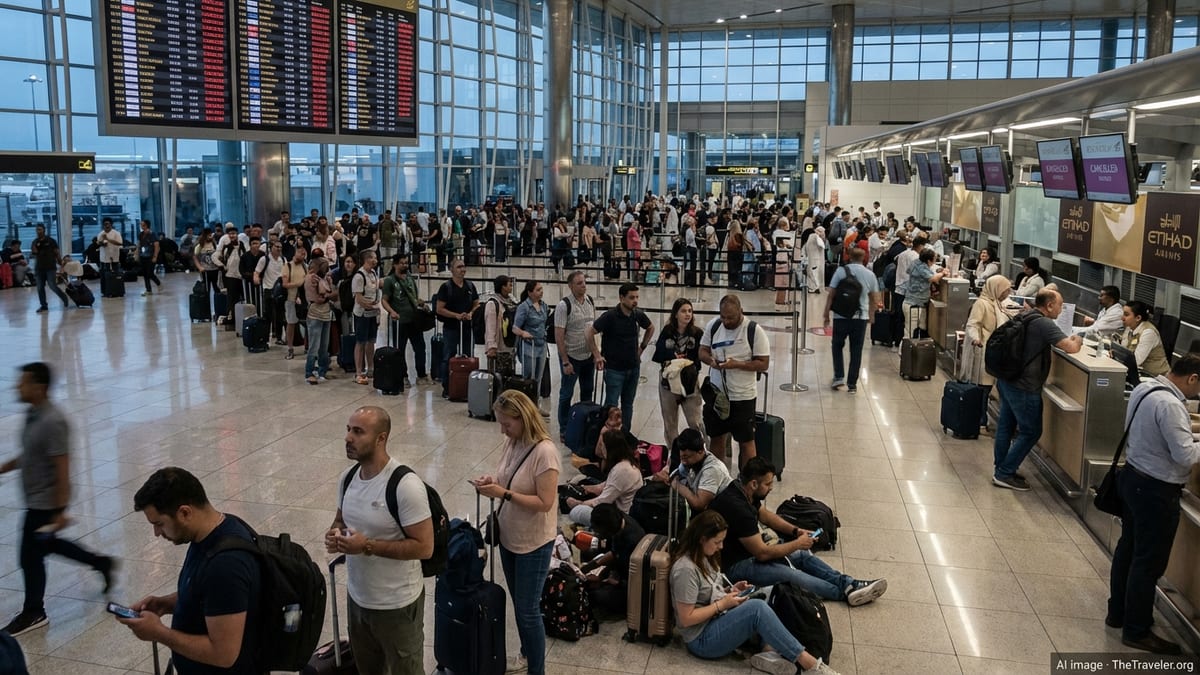
For travelers, the most immediate impact of the Iran-centered airspace crisis has been a wave of cancellations, missed connections and longer journey times across some of the world’s busiest intercontinental flows. Reporting from international newspapers and aviation-focused platforms describes thousands of passengers stranded at Gulf and European airports on peak days in March and April, as airlines attempted to rebuild timetables around new routings.
Data cited in regional travel analyses suggest that overall travel demand in affected Middle Eastern markets slumped by well over half in the early phase of the crisis, reflecting both capacity reductions and a surge in cancellations by would-be visitors unnerved by the proximity of conflict. Long-haul itineraries that once relied on single-stop connections through Dubai, Doha or Abu Dhabi have in many cases become two-stop or multi-leg journeys, reducing the appeal of itineraries routed through the region.
Industry commentary highlights that premium and business travelers, in particular, have reacted swiftly to the operational uncertainty. Corporate travel managers in Europe and Asia have reportedly shifted bookings away from routes dependent on Middle Eastern airspace or hubs, favoring alternative corridors via East Asia, South Asia or the North Pacific. This shift has helped reinforce demand on certain transcontinental routes that bypass the region entirely.
At the same time, publicly available fare-tracking data referenced in travel trade coverage show double-digit percentage increases on many Europe–Asia city pairs since early spring. Fares on routes most exposed to Middle Eastern overflight risk and fuel-cost spikes have risen especially sharply, pressuring middle-income leisure travelers to reconsider plans for trips to destinations that require crossing the affected corridor.
Japan Becomes a Key Beneficiary of Rerouted Long-Haul Demand
As airlines and passengers pivot away from the Middle East corridor, Japan has emerged as one of the clearest beneficiaries of the evolving route map. Japanese and other Asian carriers operating transpolar and North Pacific services between Europe or North America and East Asia have been able to offer itineraries that avoid the volatile Middle Eastern airspace while retaining reasonable flight times.
Tourism data and outlooks published by Japanese authorities in recent months already pointed to a robust rebound in inbound travel, with record or near-record arrivals from Europe and North America. Now, analysts following the crisis suggest that Japan’s position at the terminus of relatively stable northern routes is reinforcing that strength, particularly in higher-spending long-haul segments.
Travel media note increased interest in Japan from European tour operators that had previously packaged multi-stop itineraries through Middle Eastern hubs. Some are reportedly refocusing brochures and marketing on itineraries that combine Japan with other East Asian gateways reachable via northern or Pacific routes, offering an alternative to itineraries that once used Gulf stopovers as central connecting points.
Airline schedule trackers show that several carriers have either restored or expanded direct services linking major European cities with Tokyo and Osaka for the 2026 northern summer season. While these expansions were planned before the latest spike in tensions, observers say the Iran-related aviation disruptions are likely to support load factors and encourage airlines to sustain or deepen their presence on Japan-bound routes.
Thailand Targets Long-Haul Visitors as Middle East Routes Falter
Thailand, another heavyweight in Asia’s tourism economy, is experiencing a more nuanced impact from the Middle East crisis. Official projections and recent strategy updates from the Tourism Authority of Thailand outline ambitious targets for 2026, with international arrivals expected in the low-to-mid thirty million range and a strong emphasis on higher-value long-haul visitors from Europe, the Americas and the Middle East.
At the same time, recent government and central bank assessments acknowledge mounting headwinds stemming from geopolitical instability, higher energy costs and weaker demand from some long-haul markets. Economic commentary notes that rising jet fuel prices and rerouting around the Middle East have made long-distance trips to Southeast Asia more expensive, particularly for travelers originating in Europe and the Gulf who would previously have used rapid one-stop connections via regional hubs.
More granular tourism reporting from Thailand’s official channels and local business media shows that arrivals from the Middle East have softened in early 2026, while long-haul visitors from Europe and the Americas have modestly increased. Analysts interpret this as evidence that Thailand is partially offsetting lost Gulf traffic with renewed interest from Western markets that still see the country as a value-oriented winter-sun and beach destination, even with higher airfare.
In response, Thailand’s tourism planners are doubling down on efforts to attract high-spending long-haul travelers. Public strategy documents describe campaigns aimed at Europe, North America and selected secondary markets, as well as moves to encourage more direct or non-Middle-East-dependent connections. Coverage of the sector indicates that Thai authorities and industry groups are seeking to reduce reliance on any single region by broadening the country’s long-haul customer base.
Global Airlines Recalibrate Long-Haul Networks for a New Normal
The Iran-triggered airspace crisis is accelerating a broader reassessment of long-haul network design that was already under way as airlines adapted to post-pandemic demand patterns and evolving geopolitical risks. Industry briefings and financial analysis point to a growing preference for diversified routing options that can keep key city pairs connected even when conflict zones or regulatory changes suddenly affect one corridor.
Carriers with flexible fleets and access to multiple hubs appear better positioned to capture displaced demand. Those with strong footprints in Japan, Thailand and other Asia-Pacific markets on the periphery of the Middle East disruption are leveraging that strength to market rerouted itineraries to both corporate and leisure travelers seeking predictability and perceived safety.
For tourism-dependent economies in Asia, the crisis presents both risk and opportunity. Destinations like Japan, with strong direct links from Europe and North America that avoid contested airspace, stand to gain from travelers and tour operators reconfiguring their plans. Thailand, while more exposed to fuel costs and long flight times, is working to harness the shift by emphasizing value, diversified source markets and, where possible, more direct connectivity.
With tensions around Iran and the wider region remaining volatile, travel analysts caution that airlines and tourism boards will need to plan for prolonged uncertainty. The evolving pattern of airspace restrictions, route diversions and pricing pressures suggests that long-haul tourism flows may continue to tilt toward destinations that can be reached without traversing the Middle East, reinforcing the emerging advantage for Japan, Thailand and other Asia-Pacific markets positioned on alternative global corridors.