


More news on this day
Air travel across Europe faced another turbulent day as publicly available data indicated around 1,854 flight delays and 41 cancellations affecting services in Italy, France, Germany, Spain, Portugal, Ireland and other countries, with major hubs such as Rome, Amsterdam and Lisbon seeing knock-on disruption for airlines including Lufthansa, KLM, ITA Airways and Ryanair.
Get the latest news straight to your inbox!
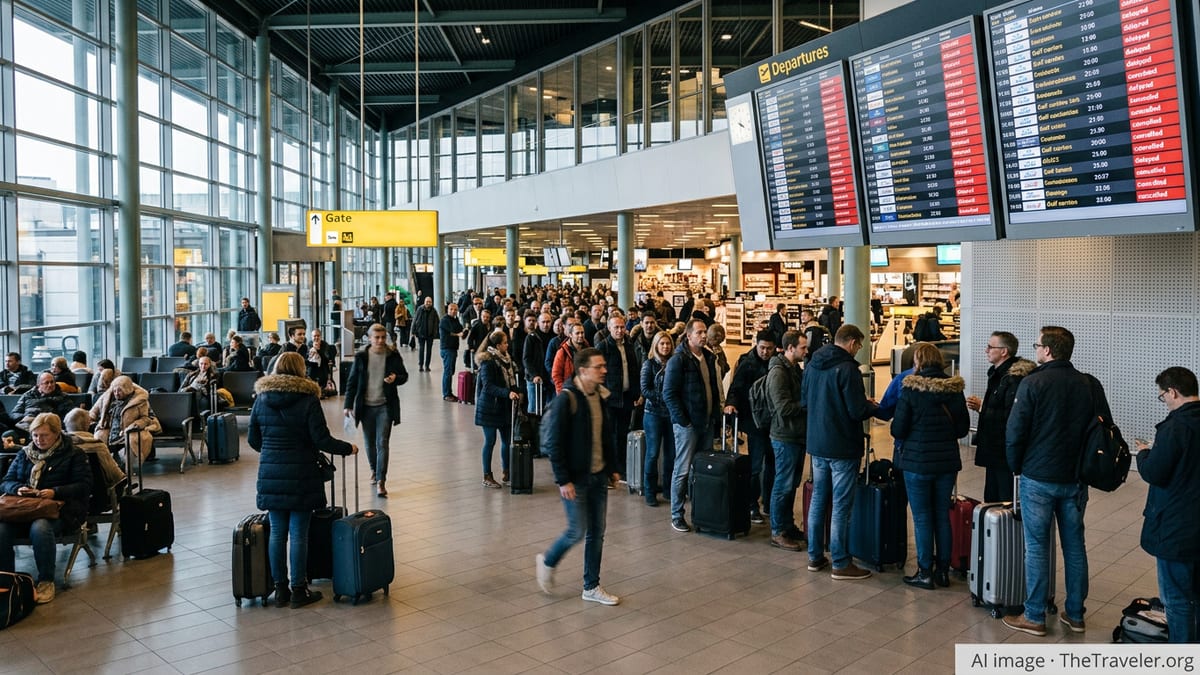
Delays Mount Across Southern and Western Europe
Operational data compiled from flight-tracking and disruption-monitoring platforms shows a heavy concentration of delays around major Southern and Western European markets, particularly Italy, Spain and Portugal. Rome Fiumicino and Lisbon, together with other large airports such as Madrid and Barcelona, have recorded dense clusters of late departures and arrivals, feeding reactionary delays across the network.
Reports on recent disruption patterns indicate that on comparable days this year, several hundred flights in Europe have been delayed at short notice due to a mixture of air traffic flow restrictions, staffing constraints and weather-related capacity limits. The latest figures of roughly 1,854 delayed and 41 cancelled flights fall in line with earlier 2026 episodes in which more than 1,000 flights were affected in a single day across Germany, France, Spain, the Netherlands, Italy and Ireland.
Rome’s primary hub is among the airports that frequently sit near the top of European delay tables, and today’s performance again reflects that vulnerability. The combination of busy peak-hour schedules, constrained runway capacity and tight aircraft rotations means that a delay on one sector can quickly cascade into subsequent services, particularly on dense intra-European routes.
In Portugal, Lisbon has also featured prominently in recent delay and cancellation statistics, with earlier months marked by disruption linked to strong winds and reduced visibility around the Atlantic coast. Today’s figures suggest that the airport remains sensitive to any operational strain, with minor timetable disturbances quickly translating into missed slots and departure backlogs.
Germany, France, Ireland and the Netherlands Feel the Ripple Effect
While Southern European hubs are bearing much of the immediate operational stress, the latest disruption is being felt widely in core markets such as Germany, France, Ireland and the Netherlands. Published data from previous large-scale events this year shows how quickly a disturbance in one country can spread, with disruption on a single busy day having affected flights across Germany, the Netherlands, France, Spain, Italy, Ireland and beyond.
Germany’s large hub airports, led by Frankfurt and Munich, have already endured several rounds of severe disruption in 2026, especially during labor-related actions that grounded significant portions of Lufthansa’s European schedule. Although today’s figures are more modest, they add to what has been a persistently fragile operating environment where even routine days can be marked by long queues and missed connections.
Amsterdam Schiphol, home base for KLM, remains another focal point. Earlier this year, statistics from air passenger advocacy platforms documented dozens of cancellations and hundreds of delays in a single day at Schiphol as a result of congestion and air traffic control restrictions. The current tally of delays in the Netherlands fits into that broader pattern of a hub operating close to capacity, where sudden pressure on de-icing, staffing or runway operations can trigger rapid schedule deterioration.
Ireland, primarily through Dublin Airport, is also caught up in the latest wave of disruption. Past weather systems and traffic bottlenecks in the North Atlantic corridor have shown how quickly Irish hubs can be affected when rotational aircraft from mainland Europe arrive late, compressing turnaround times and narrowing the margin for on-time operations on subsequent flights.
Lufthansa, KLM, ITA Airways and Ryanair Among Most Affected Carriers
Airline-level data from recent disruption events highlights that large European network carriers and high-frequency low-cost operators are the most exposed when the system comes under strain. In earlier 2026 episodes, Lufthansa and its group airlines have seen hundreds of cancellations and thousands of delays on single strike-affected days, with Frankfurt and Munich recording long rows of grounded aircraft.
KLM, as the dominant carrier at Amsterdam Schiphol, has similarly faced heightened cancellation and delay counts whenever weather, staffing shortages or air traffic control constraints reduce capacity. Publicly available reports have also noted that KLM has been among the European airlines with higher absolute numbers of cancellations in recent years, reflecting both its size and its concentration at a single congested hub.
In contrast, ITA Airways, which operates the Italian flag carrier network from Rome and Milan, has at times posted relatively low cancellation counts compared with some larger rivals, according to earlier data collated by European media and passenger rights organizations. Even so, today’s disruption figures show that ITA is not immune when Rome Fiumicino experiences rolling delays, as tight aircraft turnarounds quickly reduce operational flexibility.
Ryanair, which operates one of Europe’s largest short-haul fleets, consistently tops rankings for total flight numbers, and as a result its services feature prominently anytime systemwide disruption occurs. Passenger advocacy platforms have documented tens of thousands of delayed Ryanair flights in prior years, and the airline’s extensive presence across Italy, Spain, Germany, Portugal and Ireland ensures that any spike in airport or airspace congestion is quickly reflected in its daily performance statistics.
Knock-On Impacts for Passengers at Rome, Amsterdam, Lisbon and Beyond
The immediate consequence of today’s delays and cancellations has been long queues at check-in desks, security screening and customer service counters across some of Europe’s busiest terminals. Although the number of outright cancellations remains limited compared with peak strike days, the high volume of late departures is creating missed connections and extended layovers for passengers travelling through major hubs such as Rome, Amsterdam and Lisbon.
Past disruption reports illustrate that even a relatively small proportion of cancellations can lead to thousands of travelers needing rerouting or accommodation, particularly when they are already mid-journey on connecting itineraries. With much of Europe entering peak spring and early summer travel periods, available spare seats on alternative flights are often scarce, limiting airlines’ ability to quickly absorb stranded passengers.
In Amsterdam and Rome, recent case studies shared by travelers show how a single delayed departure can cause missed long-haul connections to North America or Asia, resulting in arrival delays of a full day or more. Although today’s disruption is focused mainly on intra-European flights, the same pattern of reactionary delay is visible as late-arriving aircraft shorten turnaround windows, pushing subsequent departures further behind schedule.
Secondary airports in countries such as Ireland, Portugal and Spain are also seeing schedule irregularities, particularly on high-frequency leisure routes to and from major hubs. These smaller airports may be more vulnerable when airline staffing is stretched, as there is limited redundancy in ground handling and aircraft availability once the daily plan starts to slip.
What Travelers Can Do When Disruption Strikes
Consumer organizations and passenger rights platforms routinely advise travelers to monitor flight status frequently on days with heightened disruption, to keep documentation of boarding passes and delay notifications, and to stay in close contact with airlines or booking intermediaries about rebooking options. Recent guidance across Europe emphasizes the importance of acting quickly, as available seats on later flights can disappear rapidly once widespread delays become apparent.
Publicly available information on European passenger-protection rules indicates that travelers whose flights are cancelled or subject to severe delay may be entitled to assistance such as meals, refreshments and hotel accommodation while they wait for a replacement service. Depending on the cause and length of the disruption, additional monetary compensation may be available on qualifying itineraries.
Specialist platforms tracking flight disruptions also encourage passengers to factor in the possibility of operational issues when planning future trips, especially during busy holiday periods. Allowing longer connection times at major hubs such as Rome, Amsterdam or Lisbon, scheduling critical meetings a day after long-haul arrivals rather than immediately upon landing, and considering travel insurance that specifically covers delays and missed connections are among the risk-mitigation strategies often highlighted.
With today’s figures once again showing more than 1,800 delays and several dozen cancellations across Europe, the latest episode underlines how sensitive the continent’s tightly interconnected aviation network remains to operational shocks. For passengers, building in flexibility and understanding available protections remain key tools for managing an increasingly unpredictable travel landscape.